

Editor’s Note: This is an Extended Version of the Author’s Earlier Report
Winter had just begun in New Delhi, and the day after my arrival, I decided to meet him for a lengthy discussion. He welcomed me warmly the moment I stepped into his ancestral home, a space surrounded by shelves of books and adorned with countless images and statues of gods and goddesses, exuding a temple-like, almost divine aura. In the living room, an old desktop, worn by the passage of time, stood as evidence of the countless hours this passionate author and journalist had devoted to his craft. He is M. R. Narayan Swamy, a celebrated author on the LTTE, best known for his biography of its leader, Velupillai Prabhakaran. “It may be possible for the Buddha to come back, but mark me, LTTE cannot revive; that’s how that organisation is,” he said, his certainty framing much of the conversation that followed.
Swamy spoke first of the beginnings of his fascination with the Sri Lankan Tamil struggle. In the early 1980s, he explained, the Tamil militant groups were primarily producing literature in Tamil, and they sought journalists who could read and understand the language. “Now, fortunately I could read Tamil because I had studied in Tamil school… I can read Tamil, I can understand Tamil, I can speak Tamil,” he recounted. His ability to navigate multiple languages became the doorway into a world few outsiders could access. He described how, by 1985, his initial curiosity evolved into immersion: “By ’85 I was into it, I started swimming in it. I am still swimming in it.” His engagement was not partisan; he positioned himself as a chronicler of history, observing the conflict as a narrative rather than aligning with any ethnic or political faction. “While it was an ethnic conflict, I did not identify myself with one community or be anti one group or anti one community. I looked at it as a story,” he explained, emphasising the journalistic principle of portraying both sides: “Because we were from an agency background — UNI, AFP — so for us, two sides of the story are always important. So, we are not into editorialising and all that.”
Swamy offered a meditation on misconceptions, particularly the misunderstandings both Indians and Sri Lankans held about each other. He noted that geographic proximity and personal interest shaped perceptions: “Geographically speaking, the people who are closer to South India, particularly those in Tamil Nadu, thought more about Sri Lanka. And obviously, when you are emotionally drawn to a conflict, then you don’t look at the right and wrong. You look at it emotionally — I am with them, because he is a Tamil, I am a Tamil.” Yet he also pointed out the duality of misconception: “I remember also, it worked both ways. In Sri Lanka also, there are a lot of misconceptions about India. Probably some people think that entire India is somehow, one day… they’ll swallow us up. We are not interested. We are unable to resolve our own problems. How can we… take you or take somebody else?”
The discussion moved inevitably to Prabhakaran, whose figure dominated Swamy’s writings. Swamy insisted on the inseparability of the man and the movement: “Prabhakaran would not compromise… Prabhakaran means LTTE. LTTE may not necessarily mean Prabhakaran or probably in some ways it does. Because minus Prabhakaran, as you know, the LTTE doesn’t exist… The god is gone, the sun has set.” He reflected on the historical trajectory of the LTTE and its moral transgressions, observing that Prabhakaran’s rigid adherence to Tamil Eelam trapped him in a cycle of inevitable destruction: “Once you tie yourself in knots — I cannot give up Tamil Eelam, because I made people die in the name of Tamil Eelam… So he got caught in that cycle. If you are going to get caught in the cycle, I am sorry, you are only heading for destruction.” Swamy dismissed any notion that the diaspora manipulated Prabhakaran, stating emphatically, “Tamil diaspora could not have had 1% of manipulation over Prabhakaran… Prabhakaran… led himself to the ultimate — his own self-destruction and the destruction of a large number of Tamils and the LTTE. But it was his decision.”
Swamy’s observations on insurgency extended beyond Sri Lanka. He drew parallels with other movements, noting distinctions and similarities in human behaviour, organisational logic, and historical context. Comparing the LTTE to Hamas, he remarked, “Hamas may have attacked Israel, but Hamas is a bacha, a child compared to LTTE… If LTTE had done the same job, they would have done it far more ruthlessly than Hamas.” Yet he categorically dismissed parallels with India’s Maoists, saying, “Maoists are a completely home-grown group and there can be absolutely no comparison between Maoism and the very ideologically centred group.” He made clear the limits of organisational revival: “Even if your heart says you can revive LTTE… you cannot. The people who gave birth to the LTTE are all gone. Either they are gone ideologically, they are gone physically, whatever.”
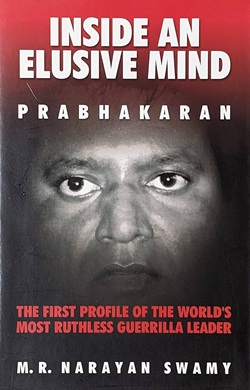
Reflecting on the process of research and biography writing, Swamy described the painstaking diligence required to piece together Prabhakaran’s life. Sources were elusive, unreliable, or fearful. “A lot of people… promised to talk, they backed off at the last moment… because people became kind of… they either refused to take the phone calls or they put up some excuses. I don’t mind them. I don’t mind. This is part of the professional hazards,” he said. Even Prabhakaran’s father, he noted, could offer only emotional insights: “Prabhakaran left his home a long time back. All his life he lived underground and away from home… He had given birth to him… but he did not know what he did.” Swamy described the challenge of verifying claims: “There was someone who was with Prabhakaran… who told me that he was such a good marksman… I asked lots of people who had known Prabhakaran and I never got a single confirmation… So I never included it in his biography.”
Time, according to Swamy, was a healer of wounds and perceptions. He spoke of transformation and evolving mindsets among former combatants: “Things evolve over a period of time… I see the changes in their mindset… virtually they are saying we could have taken a different path.” This principle extended to reconciliation between communities in Sri Lanka. “My whole thing about Sri Lanka is that the two communities, the dominant sections of the two communities, need to understand this: that they are destined to live together, and they can live together — as friends, as brothers, as sisters or whatever.” He warned against the perpetuation of ethnic hostility by political or diaspora interests: “Just as you said, it is in the interest of the diaspora to see the fires burning. It is also in your interest to see the fires burning within, so that you can do your politics.”
On the role of India in the Sri Lankan conflict, Swamy provided a nuanced view, acknowledging both contributions and limits. Speaking of intelligence cooperation and military assistance, he remarked, “The intelligence help that India provided at that time was probably more crucial than any weapons they could have given… India itself would be coy of speaking about it because they don’t want to hurt sentiments here.” He further addressed the IPKF intervention, noting both operational constraints and the statutory limitations of compensation: “An army functions with certain army rules. When an army man dies in combat, he gets a certain payment… Whether he dies on the Pakistan border or in any other conflict zone, he gets the same amount. Rank to rank it may differ. But this is a statutory payment.”
Swamy’s historical lens extended to global geopolitics. He saw 1991 as a transformative year for India: “That could only be… the 1991 financial reforms by Dr Manmohan Singh… and Narasimha Rao, equally creditable… The financial reforms they unleashed… could be called a moment in history which rapidly kind of transformed India.” He also analysed the influence of China in South Asia, stressing its longstanding presence and contemporary rise: “China always existed in South Asia through Pakistan… China also mattered in South Asia because it had a long lingering border dispute. But obviously China’s rise as an economic giant… has altered the game throughout the world.”
Swamy’s reflections consistently returned to the human dimensions of conflict. Soldiers’ perceptions, civilian experiences, and the ethical dilemmas of warfare were central. Recounting an anecdote of a Tamil soldier killed in battle, he highlighted the humanity that persists even in violent conflict: “Finally, for a soldier, a person who fought me needs to be respected because he fought me… He was not a terrorist… He fought me in the battlefield… I managed to kill him. Even when India and Pakistan fight a war… sometimes the Indians tell their Pakistani counterparts, ‘Look, one of your fellows really fought well.’”
No discussion with Swamy could omit the moral and symbolic finality of the LTTE’s defeat. He was unequivocal: “LTTE cannot be revived… It’s not possible. Some things that happen at a certain point in history, you cannot keep on repeating them… There will be no more Adolf Hitler in Germany. It cannot be possible.” He described the moral collapse of the LTTE over time: “Till Anuradhapura took place, the moral righteousness was there… Anuradhapura was the first major dent… morally. Morally.” He drew parallels with other insurgencies and extremist organisations, emphasising historical inevitability and context: “Hamas may exist in some form… but Hamas as Hamas we knew it is gone… They cannot go on and on like this.”
Towards the conclusion of our discussion, contemporary events came under scrutiny, including the Easter Sunday attacks in Sri Lanka. Swamy rejected conspiratorial interpretations, insisting on grounded reasoning: “I don’t believe this… because I refuse to believe in conspiracy theories… Whatever you might say about Gotabaya, there would have been… No leader of any country would have stooped so low as to create the killings of people so that he can come to power… Weeks before, if not months before the bomb blasts, Gotabaya’s victory was inevitable. Why would he plan such a thing? That is all.”