


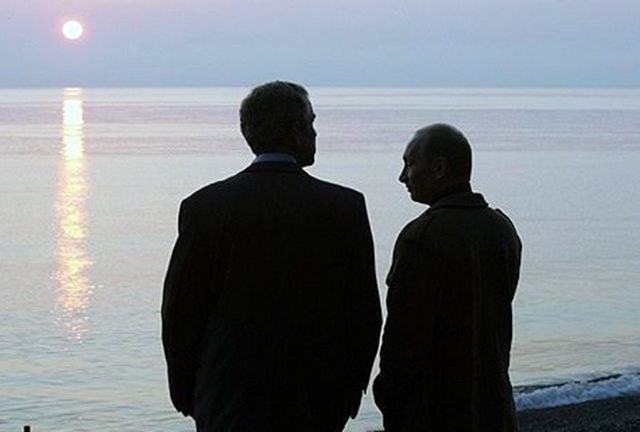
A newly released set of verbatim transcripts detailing meetings and telephone conversations between Russian President Vladimir Putin and former U.S. President George W. Bush provides an unusually candid portrait of one of the most consequential bilateral relationships of the early 21st century. Made public following a Freedom of Information Act lawsuit by the National Security Archive, the documents trace a striking evolution from close post-9/11 cooperation to deep estrangement by the end of Bush’s presidency in 2008.
The records, covering the period from 2001 to 2008, reveal that Putin initially positioned himself as Washington’s most reliable partner in the global fight against terrorism. In the immediate aftermath of the September 11 attacks, Putin aligned Russia’s brutal war in Chechnya with the U.S. campaign against Al-Qaeda, repeatedly describing Chechen militants as ideological and operational disciples of Osama bin Laden. During their first personal meeting in Slovenia in June 2001, Putin spoke forcefully and at length, dominating the conversation and framing Russia as a frontline state in the struggle against extremist violence. Bush, clearly receptive, told Putin, “You’re the type of guy I like to have in the foxhole with me,” signaling a level of trust rarely extended to a Russian leader since the Cold War.
Early conversations depict a relationship grounded in personal rapport and strategic optimism. Bush assured Putin that he did not view Russia as an enemy and suggested that Russia belonged in the Western political family. At the same time, the transcripts show Putin pressing longstanding grievances about the post-Soviet order, arguing that Russia had voluntarily surrendered vast territories after the collapse of the Soviet Union and had been unfairly marginalized by NATO’s expansion. When Bush raised concerns about press freedom and Russian military operations in Chechnya, Putin deflected by returning the discussion to terrorism and security threats.
By Bush’s second term, the tone of the exchanges had begun to shift. A 2005 Oval Office meeting demonstrates continued cooperation on nuclear nonproliferation, particularly regarding Iran and North Korea. The two leaders appeared closely aligned in their fear of nuclear weapons falling into extremist hands, and the conversation included moments of humor and ideological reflection. Putin spoke candidly about his past as a committed member of the Communist Party, describing his belief in communist ideals and the long process of personal transformation after the Soviet collapse. Yet beneath the apparent warmth, disagreements were becoming sharper and more persistent.
Those tensions came to the surface over the U.S. invasion of Iraq, Washington’s withdrawal from the Anti-Ballistic Missile Treaty, and plans to deploy missile defense systems in Eastern Europe. Putin increasingly viewed these moves as direct threats to Russia’s strategic stability. In a 2007 exchange, Bush admitted that he had failed to grasp the depth of Putin’s anger over missile defense, telling him, “I must confess I didn’t realize the harshness of your reaction.” By that time, Putin had publicly broken with Washington, most notably in his 2007 Munich speech accusing the United States of undermining international security and seeking global dominance.
The final meeting between Bush and Putin in April 2008, held at Putin’s Black Sea residence in Sochi, underscores how far relations had deteriorated. Although the atmosphere remained formally courteous, the substance of the discussion was fraught with warning and resentment. Coming just after the NATO summit in Bucharest, where the alliance debated membership prospects for Ukraine and Georgia, Putin delivered a blunt assessment of Russia’s red lines. He warned that missile launches from submarines in Northern Europe could reach Moscow in six minutes, forcing Russia to maintain constant nuclear readiness. Bush acknowledged the concern but made clear that U.S. policy would not change.
On NATO expansion, Putin was even more explicit, stating that Russia would rely on anti-NATO forces in Ukraine and would “create problems” there indefinitely to prevent what it saw as an encroaching military threat. Bush, while rejecting Putin’s position, expressed admiration for his directness and effectiveness in confronting NATO leaders, calling his performance “very admirable.”
The release of these documents follows a prolonged legal struggle. In November 2023, Dr. Svetlana Savranskaya, director of Russia programs at the National Security Archive, submitted a detailed FOIA request to the George W. Bush Presidential Library seeking all records of Putin–Bush interactions. In June 2024, the library informed the Archive that the declassification review could take as long as 12 years. With pro bono representation from the law firm Goodwin Procter, the Archive filed suit in federal court in November 2024, challenging what it described as an excessive backlog. As a result, the National Archives and Records Administration processed the records in 2025 and released them after notifying both the former and sitting U.S. presidents.
Taken from the National Security Archive, the transcripts provide rare, high-level insight into discussions on nuclear proliferation, Iran’s and North Korea’s weapons programs, and the emerging challenge posed by China. In one exchange, Bush described China as the “biggest long-term problem” for both countries, prompting Putin to reply dryly, “More for you.”









