


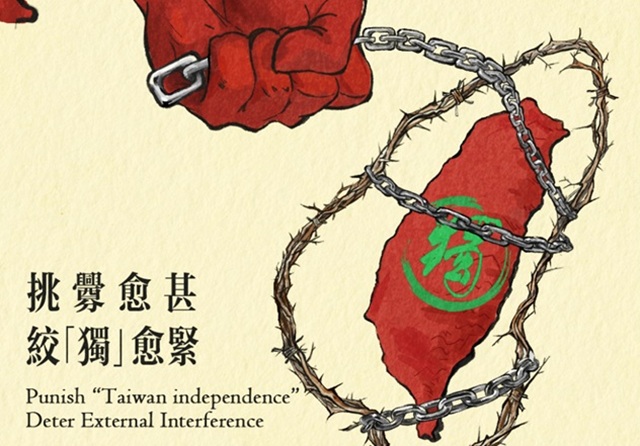
China has encircled Taiwan with one of its most expansive and coordinated military exercises to date, conducting large-scale live-fire drills over the past 48 hours that simulated the seizure of key ports, precision strikes, and leadership decapitation operations. The drills, branded “Justice Mission 2025” by the People’s Liberation Army’s Eastern Theater Command, marked a sharp escalation in both scale and intent, with Chinese forces operating closer to Taiwan than in previous exercises.
According to data compiled from Taiwan’s Ministry of National Defense and regional monitoring, the exercises began on December 29 with coordinated deployments of PLA Navy, Air Force, Rocket Force, Ground Forces, and the China Coast Guard across multiple axes around the island. The PLA announced seven designated exercise zones spanning the Taiwan Strait and waters to the north, south, east, and southwest of Taiwan, later expanding operations to an eighth zone east of the island. State media described the maneuvers as approaching Taiwan “from different directions,” signaling a multi-vector encirclement rather than a single-axis demonstration.
On the first day, Chinese naval task groups, including guided-missile destroyers, frigates, amphibious assault ships, and a Hainan-class amphibious vessel, operated within 160 to 170 nautical miles of Taiwan. Live-fire drills were conducted using main and secondary guns, while aircraft and naval units practiced air-sea coordination, anti-submarine warfare, missile defense, and blockade maneuvers. Taiwan’s defense ministry reported that 130 PLA aircraft were detected around the island that day, with 90 crossing the median line of the Taiwan Strait or entering Taiwan’s air defense identification zone.
The exercises intensified on December 30. PLA forces conducted long-range live-fire drills even closer to Taiwan, with rockets landing inside Taiwan’s 24-nautical-mile contiguous zone, the closest such activity recorded to date. The PLA Rocket Force fired at least 27 rockets during a four-hour window, while ground-based units on the Chinese coast practiced simulated joint strikes toward northern and southern Taiwan. Air activity surged further, with 153 PLA aircraft detected, marking one of the highest daily tallies on record.
A prominent feature of the drills was the integrated role of the China Coast Guard. At least 14 coast guard vessels were detected on the first day and another 15 on the second, forming what analysts described as a law-enforcement encirclement layered atop military operations. Coast guard task forces conducted simulated inspections, identification, control, and expulsion operations around Taiwan and near the frontline islands of Matsu and Wuqiu, reinforcing a scenario in which civilian maritime traffic could be halted under the guise of law enforcement.
PLA statements made clear that the exercises were aimed at rehearsing a comprehensive blockade. “It is a noose-style blockade,” the official PLA press account said, adding that the drills had evolved from symbolic shows of force into a coordinated network designed to choke off Taiwan’s vital supply lines. The stated objectives included blockade of key ports, seizure of comprehensive superiority, identification and expulsion of vessels, and all-dimensional force projection beyond the first island chain.
The scope of forces involved underscored the seriousness of the operation. Between 14 and 18 PLA Navy warships were active around Taiwan on the first day, with additional vessels joining on the second. Bomber task forces, including H-6K aircraft, practiced long-distance raids and joint precision strikes. Surveillance drones, helicopters, and special-purpose aircraft operated alongside fighter jets, while joint combat readiness patrols crossed the median line and penetrated multiple sectors of Taiwan’s air defense zone.
The drills also highlighted China’s growing reliance on domestic command-and-control integration. PLA Rocket Force units deployed short-range ballistic missiles and multiple-launch rocket systems, supported by intelligence, mission planning, and data-support platforms. Analysts noted that the simulated strikes targeted not only military installations but also maritime infrastructure, reflecting a focus on disabling Taiwan’s ports at Keelung and Kaohsiung early in a conflict.
Taiwanese authorities have not announced a formal conclusion to the exercises, and Chinese officials have left open the possibility of further activity. With no declared end date and forces already positioned around the island, regional observers are watching closely for a potential third day of operations that could expand the drills or transition into sustained pressure.
The latest maneuvers represent a qualitative shift in Beijing’s military signaling toward Taiwan. Rather than episodic demonstrations, the PLA appears to be rehearsing the mechanics of a real-world blockade and rapid strike campaign, combining naval, air, missile, ground, and coast guard forces into a single operational framework. For Taiwan and its partners, the exercises offer a stark preview of how quickly pressure could escalate from drills to crisis, tightening the strategic noose around the island.










