


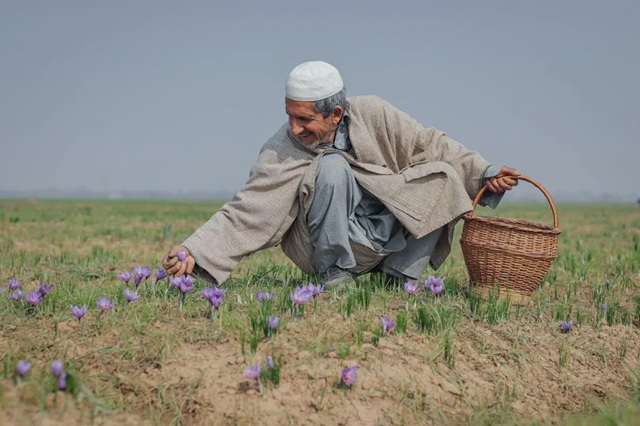
As dusk settles over Pampore, Kashmir’s famed saffron town, 73-year-old Mohammad Akbar Ganie sits outside his grass-thatched hut, watching the last light fall on fields that once glowed with purple flowers. For three decades, Akbar worked as a rachdaar, a night guard entrusted with protecting saffron crops through long, freezing harvest nights. This year, for the first time in his life, he goes home early. “There’s no point staying longer when the flowers are gone,” he says.
According to Front Line India, Akbar’s experience reflects a deeper crisis unfolding across Kashmir’s saffron belt. Once a symbol of abundance and cultural pride, saffron cultivation in the valley has sharply declined. Official data shows saffron-growing land shrinking from 5,707 hectares in the late 1990s to 3,665 hectares in 2025, while production has dropped from nearly 16 metric tonnes in 1996 to just five or six tonnes in recent years.
Erratic rainfall, warmer winters, dry springs, and worsening water scarcity have battered a crop that depends on precise climatic conditions. Rapid urbanisation and unplanned construction have further eaten into farmland, while cheaper Iranian saffron flooding Indian markets has undercut local growers. Agronomist Rifat Un Nisa, cited by Front Line India, says many farmers have abandoned saffron altogether, switching to apples and pears in search of more reliable returns.
The decline has had cascading effects on livelihoods once tied to the harvest. Night guards like Akbar and his longtime colleague Mohammad Kamal Bhat, 70, once patrolled fields from dusk till dawn, protecting the delicate blooms from animals and theft. Now, only a handful of villages still hire guards, and even there, watches end by nightfall. “Our generation will be the last of the saffron guards,” Kamal says. “When there’s no saffron, who will hire us?”
For some families, the break is deeply personal. Abdul Majeed Yattoo, a third-generation saffron guard, stayed home this year after his village decided guarding was no longer necessary. “There’s nothing left to protect,” he says, standing amid nearly barren fields. Younger villagers like college student Shahid Mustafa still try to preserve the practice by pooling resources, but such efforts are increasingly rare.
Government interventions have offered limited relief. The National Saffron Mission, launched in 2010-11 with a Rs.400 crore budget, promised irrigation and infrastructure upgrades. While some improvements were made, a government committee later found that more than half of the planned bore wells were non-functional. Growers quoted by Front Line India say uneven implementation has failed to arrest the crop’s decline.
Beyond economic loss, the fading of saffron signals a cultural erosion. Known locally as zafran or kong, the spice has shaped Kashmir’s cuisine, rituals, and identity for centuries. In Pampore, once alive with harvest celebrations and night fires lit by guards, silence is replacing tradition. As Akbar sits by a dying fire on what may be one of his final patrols, he reflects on the land his ancestors worked and protected. “This is my home,” he says softly, keeping watch as long as the embers glow, over a legacy that may not see another dawn.











