


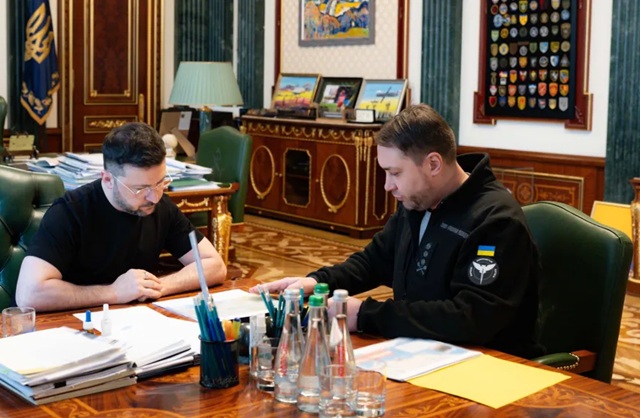
Ukrainian President Volodymyr Zelensky has named Lt. Gen. Kyrylo Budanov as his new chief of staff, replacing Andrii Yermak, a controversial figure recently dismissed amid a corruption scandal. In an exclusive conversation with The War Zone, Budanov said his priorities in the role will center on “negotiations and stabilization of the internal situation and, of course, coordination.” Until this week, Budanov led Ukraine’s Defense Intelligence Directorate (GUR), a position in which his high-profile operations and public statements have made him widely recognized both domestically and internationally.
“It’s absolutely a new page,” Budanov told The War Zone, adding that he will retain his military rank but will no longer oversee GUR operations, which he said he will “miss.” The new appointment comes at a perilous moment, as Ukraine faces heavy fighting in the east and south, frequent Russian missile and drone attacks, and ongoing efforts to negotiate an end to the war.
President Zelensky emphasized Budanov’s experience in security and defense, noting that the Office of the President will now focus on “security issues, the development of the Defense and Security Forces of Ukraine, as well as the diplomatic track in negotiations.” Zelensky added that Budanov, in cooperation with other leaders and institutions, will update and present for approval strategic foundations for Ukraine’s defense and development.
Budanov’s career has been marked by frontline service and high-stakes intelligence operations. He was thrice wounded fighting Russian forces since 2014, became head of GUR in 2020, and in 2021 predicted Russia’s full-scale invasion months in advance. Under his leadership, GUR has carried out sophisticated cyber operations, uncrewed surface vessel missions, helicopter raids, and targeted strikes against Russian military leaders, surviving several assassination attempts in the process. He also participated in recent peace talks, marking a shift toward diplomacy.
Domestically, Budanov is a popular figure and a rising political contender, regularly appearing in polls as a potential presidential successor. According to the Kyiv Independent, in a hypothetical runoff against Zelensky, Budanov could receive 56% of the vote. His appointment therefore also gives Zelensky strategic political cover while consolidating loyal military expertise at the top of his administration.
To fill Budanov’s former role, Zelensky appointed Lt. Gen. Oleg Ivashchenko, former head of Ukraine’s Foreign Intelligence Service (SVR), as the new GUR commander.
Meanwhile, on the battlefield, Ukraine continues to hold parts of Pokrovsk despite Russian advances and heavy losses. Recent delivery of 12 Australian Abrams tanks, the final tranche of 49 provided, has supported counterattacks, allowing Ukrainian forces to prevent Russian troops from cutting off withdrawals from Myrnohrad. The fighting also sees innovative tactics, including uncrewed ground vehicles armed with machine guns and the use of drones for logistical support and combat, as reported by The War Zone. Russian forces, in contrast, have resorted to cavalry units for assaults, demonstrating a stark contrast in warfare approaches.
Ukraine is also intensifying attacks on Russian infrastructure. On January 2, Ukrainian drones targeted the Novokuybyshevsk Oil Refinery in Russia’s Samara Region, causing fires, though the extent of the damage remains unclear. Russian forces have continued to strike Ukrainian cities with drones, prompting robust air defense responses.
On the diplomatic front, peace talks continue with the involvement of U.S. President Donald Trump and Zelensky, who reported that a “20-point peace proposal” covers most of the issues needed to end the war. The main sticking point remains Russia’s insistence on full control of Donbas, including territory still held by Ukraine. Trump emphasized the urgency of reaching a deal, warning that time favors Moscow.
With Budanov at the helm of the presidential office, Ukraine gains a leader with frontline and intelligence experience to coordinate military, political, and diplomatic efforts during one of the most critical phases of the conflict. As The War Zone notes, his appointment reflects both the militarization of Ukrainian governance under wartime conditions and the growing intertwining of battlefield and political strategy.










