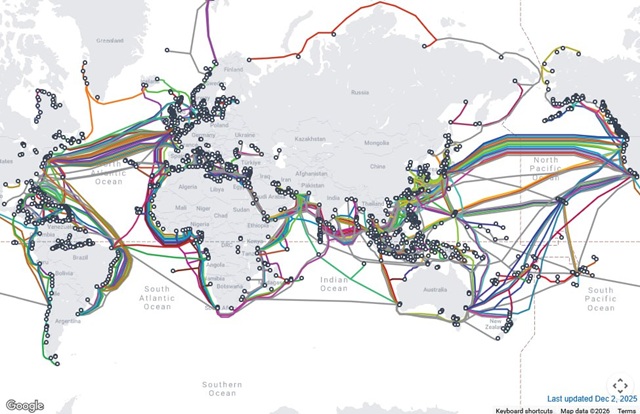
A growing struggle over the world’s underwater fiberoptic cable networks is emerging as a new front in great-power rivalry, raising fears that the internet itself could be divided into competing geopolitical blocs. According to a recent analysis highlighted by Foreign Affairs magazine, the vast web of submarine cables that carries nearly all international data traffic is increasingly viewed as an arena for competition, surveillance, and even covert warfare.
These cables, laid across the seabed and largely out of public sight, are vulnerable to both physical and political interference. Analysts warn that sabotage could range from direct attacks using manned vessels or underwater drones to quieter forms of disruption, such as bureaucratic and regulatory pressure designed to delay or block the construction and repair of critical links. As dependence on digital connectivity deepens, the strategic value of these networks has risen accordingly.
The article points to US-led initiatives to work closely with allies and partners on new cable routes explicitly designed to limit access by geopolitical rivals. Similar efforts are under way within blocs such as the European Union and ASEAN, suggesting a coordinated push to redraw the digital map along political lines. Washington is portrayed as uniquely positioned to shape what it calls a “rules-based subsea order” by promoting a comprehensive global architecture of data cables that could marginalize competitors like Russia and China.
At stake is the integrity of a system that currently spans around 1.5 million kilometers of submarine cables, with roughly 600 individual lines carrying between 95 and 99 percent of the world’s international internet traffic. Major corridors link the United States and Europe through about 20 transatlantic cables, while another dozen connect the US and Japan across the Pacific, complemented by dense regional networks elsewhere.
The economic scale of this infrastructure is immense. New cable projects cost billions of dollars and were once dominated by consortia of traditional telecom firms such as AT&T, major European operators, SubCom, and NEC. In recent years, however, ownership and control have shifted dramatically toward US-based technology giants. Google, Meta, Amazon, and Microsoft now dominate the sector, accounting for roughly 71 percent of all new submarine cable capacity in 2024, up from about 10 percent a decade earlier.
Critics argue that a fragmented internet could serve powerful interests seeking tighter control over information flows. By limiting cross-border access to alternative narratives, competing digital spheres could foster divergent versions of reality and make it easier for authorities to manage public perception. Such a scenario, they warn, would echo dystopian visions of information control while eroding the mechanisms that allow independent verification across borders.
Non-aligned and developing nations could find themselves particularly vulnerable in this emerging order. As rival blocs harden their digital boundaries, countries outside the major power centers may be forced to choose sides, sacrificing strategic autonomy and risking a new form of technological dependence often described as digital neocolonialism.
For now, several factors temper the rush toward a fully fractured internet. Intelligence agencies in the West rely heavily on global social networks for information gathering and influence operations, while multinational corporations and media organizations depend on worldwide connectivity to project soft power. Equally important, the open internet underpins modern supply chains, cloud computing, and global commerce. Severing or overly compartmentalizing these connections could undermine the very elites and institutions that benefit from digital dominance, slowing the march toward a divided online world even as pressures to control it intensify.