


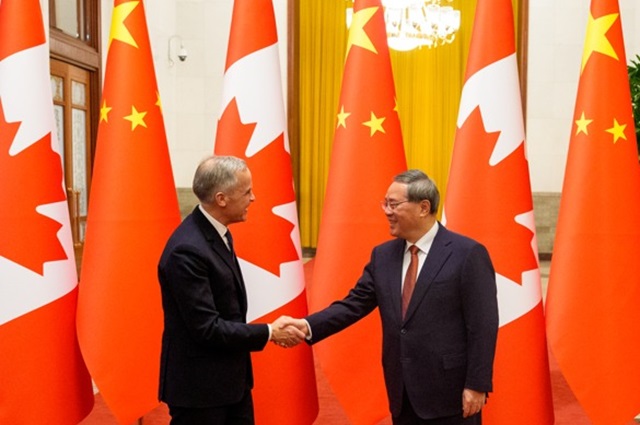
Canadian Prime Minister Mark Carney on Thursday hailed what he described as rapidly improving relations between Canada and China, praising the leadership of President Xi Jinping and declaring that both countries were charting a new course of cooperation at a time of global division and uncertainty. Speaking in Beijing during a four-day visit, Carney said the renewed engagement marked an opportunity for the two nations to act as strategic partners across a wide range of sectors.
The trip is the first by a Canadian prime minister to China since 2017 and follows a positive meeting between Carney and Xi on the sidelines of an international summit in South Korea last October. The two leaders are scheduled to meet again on Friday, underscoring the momentum behind efforts to recalibrate a relationship that deteriorated sharply in recent years.
Meeting China’s top legislator Zhao Leji, Carney said Canada was encouraged by Xi’s leadership and the speed at which bilateral ties had advanced since his government took office. He said the progress had set the stage for discussions on cooperation spanning energy, agriculture, people-to-people exchanges, multilateral institutions and security-related issues, framing the partnership as one with global significance.
Carney’s optimistic tone reflects months of quiet but intense diplomatic re-engagement aimed at reversing the damage done under former prime minister Justin Trudeau, whose tenure saw relations plunge amid disputes over trade, human rights and national security. The renewed outreach has also been driven by Canada’s desire to diversify export markets after U.S. President Donald Trump imposed tariffs on Canadian goods last year and openly questioned Canada’s sovereignty, suggesting it could become the United States’ 51st state.
In a separate meeting with Premier Li Qiang, Carney said both sides had worked to address longstanding trade irritants and build platforms for new opportunities. He expressed confidence that the relationship was being steered back toward a more constructive footing after years of mistrust and economic retaliation.
One of the most sensitive issues remains auto tariffs. Tensions escalated in 2024 when Canada imposed tariffs on Chinese electric vehicles, citing unfair advantages created by state subsidies in China and risks to Canada’s domestic auto industry. Beijing responded last year with tariffs on more than $2.6 billion worth of Canadian agricultural and food products, including canola oil and meal, a move that contributed to a sharp drop in Chinese imports of Canadian goods in 2025.
Canadian Industry Minister Melanie Joly, who is accompanying Carney, said negotiations over auto tariffs were continuing and declined to confirm whether Ottawa might cut the levies. She said further talks would take place on Friday during Carney’s meeting with Xi, signaling that the issue remains central to efforts to stabilize ties.
Dialogue between the two countries has gathered pace since Carney became prime minister last year, with frequent contacts between senior officials laying the groundwork for renewed leader-level engagement. On Thursday, the two sides signed a trade and economic roadmap committing to open channels of communication to resolve disputes, particularly in agricultural trade.
Under the roadmap, Canada welcomed Chinese investment in energy, agriculture and consumer products, while China expressed interest in Canadian investment in services, advanced manufacturing, aerospace, new materials and other high-value sectors. In energy, both countries agreed to explore cooperation in oil and gas development and natural uranium trade.
Carney said the agreements demonstrated that cooperation was possible even as global politics grew more fragmented. Since arriving in Beijing, he has also met executives from major Chinese companies, including battery maker CATL, energy giant China National Petroleum Corp, financial institutions and technology firms, as he seeks to translate diplomatic warming into concrete commercial ties.









