


Editorial
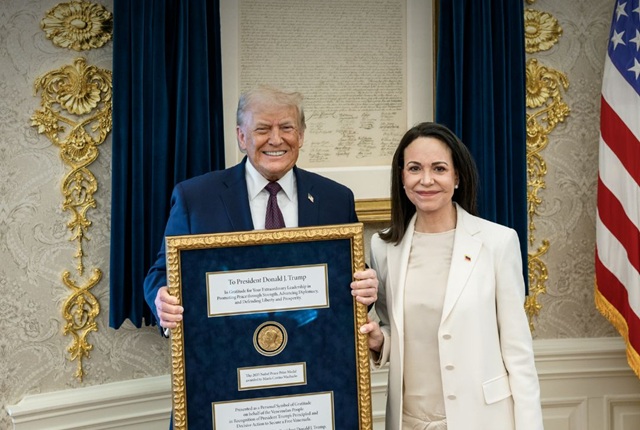
That was not the first time the world witnessed something that should symbolise humanity’s finest ideals being warped into political theatre, and yet what we saw yesterday — in another term for America’s White House — felt chillingly familiar in its rancid absurdity. Venezuelan opposition leader María Corina Machado, the 2025 Nobel Peace Prize laureate, presented her Nobel medal to former U.S. President Donald Trump in a staged ceremony that reeked of opportunism. Trump, who has long coveted a Nobel accolade, accepted the medal with the glee of a man receiving a crown he never earned, and immediately treated it as a trophy for his own vanity rather than the symbol of peace it was meant to be. The Norwegian Nobel Committee, not surprisingly, had already insisted that the honour of the prize is non-transferable, and that the award remains inseparably tied to the laureate alone. Yet Machado’s stunt was not merely a misunderstanding of the rules; it was a deliberate act of disrespect.
The Nobel Peace Prize was created to honour those who work for “fraternity between nations,” the abolition or reduction of armies, and the promotion of peace. Alfred Nobel, haunted by the destructive legacy of his own invention of dynamite, demanded a prize that would recognise the building of peace, not the spectacle of power. What Machado has done is the exact opposite: she has turned the medal into a bargaining chip, a token to be used in pursuit of political ambition. She did not hand over her medal as a gesture of humility or reconciliation; she handed it over as a means of securing her own future. In doing so she has made the prize itself a mockery, a plaything for the very forces that Nobel sought to condemn.
There is a dark precedent for this kind of betrayal. In 1943, the Nobel Prize in Literature winner Knut Hamsun — a celebrated Norwegian author — gifted his Nobel medal to Joseph Goebbels, the Reich Minister of Propaganda. Hamsun, once revered for his writing, had become a fervent Nazi supporter after the German occupation of Norway. He praised Hitler as a “warrior for mankind” and a “preacher of the gospel of justice for all nations,” and wrote that “the Germans are fighting for us.” In a letter to Goebbels, he declared: “I know of no one who has so tirelessly written and spoken year after year on the cause of Europe and humanity as idealistically as you, Herr Reichsminister… I beg your pardon for sending you my medal. It is a completely useless thing for you, but I have nothing else to give.” Goebbels replied with the sickening gratitude of a man who understood the value of symbols: “I see it as an expression of your connection with our struggle for a useful Europe and a happy society.” The medal disappeared after Goebbels’ death in 1945, lost to history, but the stain of that transaction endures. Machado’s act now sits in the same lineage: a Nobel accolade turned into a symbol of political allegiance rather than an award for peace.
Machado’s gesture is not merely embarrassing; it is strategically humiliating. It reveals the crude truth that she is not seeking peace so much as power. She has long been sidelined within Venezuela’s chaotic political culture, and her hopes of returning as a dominant figure appear to hinge on external support rather than domestic legitimacy. In her eyes, Trump is not a man of peace but a ladder. By offering him her Nobel medal, she was effectively trying to buy herself a crown — to be crowned, in her own fantasy, as the queen of Venezuela. This is not leadership. It is desperation dressed up as symbolism. Trusting Trump to deliver her political future is not just naïve; it is delusional. It is the kind of myth-making that can only be sustained by a deep ignorance of the man’s history and a profound belief that the world’s most powerful country will act as a benevolent patron for a foreign political aspirant.
The irony is savage. The Nobel Committee had already made clear, in writing, that no one has the authority to hand over the prize to another person. They stressed that the honour is inseparably linked to the laureate, and that the prize cannot be transferred. The committee’s statement was not a gentle reminder; it was a warning shot. Machado’s public defiance of that warning is not merely a breach of etiquette — it is a direct slap in the face to the very institution that granted her the prize. It is a gesture that says, in effect: “I will use this symbol however I please, regardless of the rules, because my ambition is greater than your principles.” If the Nobel Peace Prize can be treated this way, then what was it ever worth?
This incident also exposes the deeper rot in the Nobel Peace Prize itself. Unlike the scientific awards, which are decided by experts in their fields, the peace prize is chosen by a committee appointed by the Norwegian parliament. It is, by nature, political. Over the decades the prize has been used as a tool of diplomacy, a public relations instrument, and a means of signalling geopolitical preferences. It has rewarded not only genuine peacemakers but also political figures whose credentials are dubious at best. The result is an award that increasingly looks like a stage prop rather than a serious recognition of achievement. When the prize is then used as a bargaining chip — handed to a powerful foreign leader as a means of political favour — it confirms the worst suspicions about its purpose.
The comparison with Hamsun is not just academic; it is damning. Hamsun’s gift to Goebbels was an endorsement of fascism, a betrayal of everything the Nobel Prize is supposed to stand for. Machado’s gift to Trump may not be fascism as we have been compelled to believe and define through systematically manipulated algorithmic propaganda, but this may be the exact version of Nazism in our generation, where rules, ethics, morality and human dignity are nothing but a laughing stock. Both acts reduce the Nobel medal to a piece of propaganda, a prop for the ambitions of men who have no claim to it. In both cases, the prize becomes a tool for the celebration of power, not peace.
We should be blunt about what this means. The Nobel Peace Prize has become a political toy, a symbol that can be traded and manipulated. Machado’s action is a disgrace not only to the prize but to the idea of peace itself. It shows how easily a symbol can be corrupted when the people who hold it forget what it is meant to represent. The prize is supposed to honour those who work to end war, to build understanding, to protect human life. Instead, it has been turned into a gift for a man who has made a career out of division, and a bargaining chip for a politician who is willing to use anything to climb back into power.









