


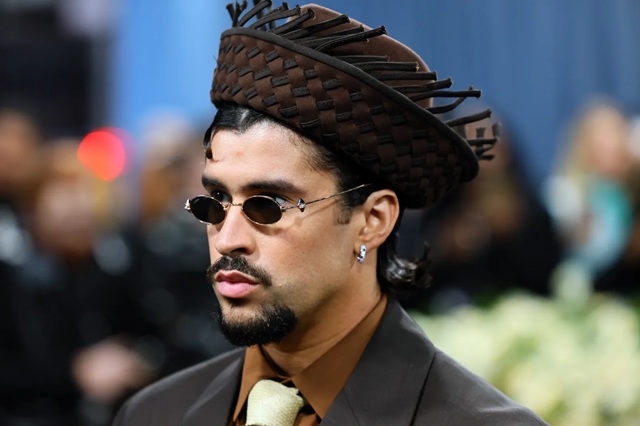
Bad Bunny’s Super Bowl half-time performance was historic not because of spectacle alone, but because of what it represented. As the first artist to perform an entire Super Bowl set in Spanish, the Puerto Rican rapper used America’s biggest sporting stage to spotlight Latin culture at a time when immigration remains one of the country’s most polarising political issues. The performance, widely praised and fiercely criticised in equal measure, was described by the Times UK as both celebratory and subtly political.
Rather than leaning into overt statements, Bad Bunny — born Benito Antonio Martínez Ocasio — offered a vivid portrait of Puerto Rican life. The stage was transformed into a series of familiar scenes: sugar cane fields, neighborhood bodegas, nail salons, domino tables and a modest family home. At one point, he crashed through the roof of that house to the sound of Daddy Yankee’s Gasolina. A real wedding ceremony unfolded mid-show. The underlying message was clear but understated: immigrants and their descendants come to the United States to work hard, build community and contribute to the country’s cultural fabric.
The atmosphere was joyful and communal. In bars and living rooms across the country, viewers responded warmly to the color, warmth and rhythm of the performance. Actor Adam Sandler, attending the game in California, described the show as “loose, happy” and said it made people “ecstatic.” But not everyone was impressed. Former US president Donald Trump condemned the performance on social media, calling it “absolutely terrible” and claiming “nobody understands a word this guy is saying.” A right-wing group, Turning Point USA, staged a rival “anti-woke” event nearby, though it drew little attention.
The backlash was unsurprising given Bad Bunny’s recent public positions. Only days earlier, he had used his Grammy Awards speech to criticise Immigration and Customs Enforcement (ICE) raids, and his Super Bowl performance contained symbolic references to Puerto Rico’s ongoing struggles. Dancers dressed as jíbaros — rural farmers in straw hats — climbed collapsing telegraph poles, alluding to the island’s chronic power outages. This led into El Apagón, a song that references the aftermath of Hurricane Maria and the long-standing neglect of Puerto Rico’s infrastructure.
That such a performance took place at the Super Bowl marks a remarkable rise for Bad Bunny. The 31-year-old grew up in Bayamón, the son of a truck driver and a schoolteacher. He sang in a church choir as a child and worked in a supermarket while uploading music to SoundCloud. His breakthrough came in 2017 with Ahora Me Llama, a collaboration with Colombian star Karol G. Since then, he has become Spotify’s most-streamed artist for four consecutive years, helping transform Spanish-language rap and reggaeton into a global commercial force.
Despite global fame, fashion campaigns with Gucci, and collaborations with artists such as Drake and Cardi B, Bad Bunny has consistently used his platform to challenge norms. He has spoken out in support of LGBT rights — unusual in the traditionally macho world of Latin rap — and has never shied away from political confrontation. His first clash with Trump came in 2017, when he criticised the federal response to Hurricane Maria. That tension resurfaced during the Super Bowl show, albeit wrapped in celebration rather than protest.
Bad Bunny’s respect for musical tradition was also central to the performance. Alongside reggaeton hits like Tití Me Preguntó, Monaco and Baile Inolvidable, the show featured a string quartet, plena percussionists and a salsa band. Lady Gaga joined him on stage for a performance of Die with a Smile, dancing salsa alongside him, while Ricky Martin made a surprise appearance — a symbolic passing of the torch from one era of Latin crossover stardom to another.
In recent years, Bad Bunny has also been vocal about the risks facing his fans. Last year, he avoided touring in the mainland United States, citing fears that ICE agents could target concert venues. “That was something we were very concerned about,” he said at the time. The Super Bowl performance, therefore, carried additional weight — a moment of visibility and affirmation for a community that often feels under scrutiny.
The closing moments of the show were deliberately conciliatory. “The only thing more powerful than hate is love,” appeared on the screen as Bad Bunny addressed the audience in English: “God bless America.” He went on to bless Latin American countries — and even Canada — extending an olive branch at a moment of deep national division.
As the Times UK noted, the NFL’s decision to hand the Super Bowl stage to Bad Bunny was itself a statement, recognising the cultural and economic impact of Latin America on the United States. Bad Bunny chose not to use the moment to attack the administration directly, instead opting for celebration over confrontation. In today’s America, that choice — and the reaction it provoked — spoke volumes.










