by Durga Velayudham
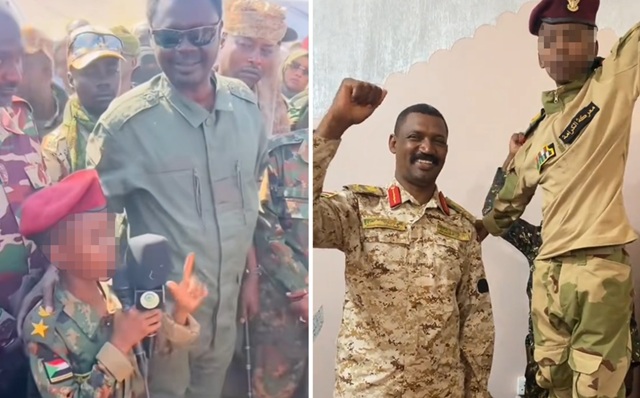
Since 2023, Sudan has been engulfed in a brutal conflict between the Rapid Support Forces (RSF) and the Sudanese Armed Forces (SAF). A recent Bellingcat investigation reveals a disturbing trend: children, often referred to as “lion cubs,” are not just present in the fighting but have become viral figures on TikTok, garnering millions of views and widespread attention. Many of the videos show the boys in military uniforms alongside armed fighters and senior officials, celebrating battlefield victories, delivering motivational speeches, or even carrying weapons. Experts warn that this visibility normalizes violence, incentivizes recruitment, and amplifies the reach of armed groups through social media.
Bellingcat’s research identified 12 TikTok accounts that repeatedly posted content featuring child soldiers. After submitting the accounts through TikTok’s internal reporting mechanism and following up via email, the platform removed seven accounts. The remaining five accounts, however, continued to host multiple videos featuring children, in violation of TikTok’s Community Guidelines, which prohibit content that harms, exploits, or endangers minors.
One of the RSF-linked “lion cubs” has become emblematic of this phenomenon. Bellingcat geolocated multiple videos showing the child celebrating the capture of the SAF’s 22nd Infantry Division base in Babanusa, West Kordofan, in early December 2025. Footage captures him moving amid armed RSF fighters, running toward the base amid gunfire, chanting slogans, and in one particularly graphic clip, filming himself among bodies on the ground. Satellite imagery confirmed the placement and scale of these objects, providing strong verification of the videos’ authenticity. Viral posts featuring this child reached millions of views, and audio from his videos has been reused in hundreds of derivative TikTok clips, including AI-generated animations. The child is celebrated by RSF fighters and senior officials, including commander Salih Al-Foti, who praises him publicly while claiming that minors “sometimes appear voluntarily” among RSF forces.
A contrasting viral figure comes from the SAF side. This child, also called a “lion cub” on TikTok, appears younger and operates largely in staged, ceremonial settings. Videos show him alongside SAF officials and government figures, including Sudan’s Minister of Culture and Information, Khaled Al-Aiser, reciting poems and making speeches that glorify combat and encourage resistance to the RSF. One clip, viewed nearly nine million times before removal, depicts him threatening RSF leaders and calling for the elimination of “traitors and cowards.” Bellingcat notes that these staged appearances are nonetheless highly visible and celebrated, creating a sense of fame and status for the child, and by extension, legitimizing the SAF’s use of minors for propaganda.
Both children’s Facebook pages, while less widely followed than their TikTok accounts, also featured videos of the boys armed and posing with soldiers, including footage of destroyed military equipment and captured positions. Bellingcat focused on TikTok and Facebook due to higher user engagement, but noted that child soldier content also circulates on other social media platforms, amplifying the reach of these viral figures.
Child protection and recruitment experts highlighted the dangers of this visibility. Michael Wessells, professor of Clinical Population and Family Health at Columbia University, told Bellingcat that celebrating children who fight creates a recruitment pipeline by honoring minors and normalizing their participation in hostilities. Mia Bloom, a specialist in child soldier propaganda, likened the viral status of these children to “Disney stars” of the Sudanese civil war, where fame incentivizes emulation and bolsters recruitment for armed groups. Dr. Gina Vale, who has studied Islamic State child soldier propaganda, noted that the portrayal of armed children is highly effective for recruiting and reinforcing group control over youth.
Bellingcat’s investigation occurs amid broader concerns about child soldier recruitment in Sudan. UN reports from 2023 to 2025 document widespread exploitation of unaccompanied and vulnerable children by both RSF and SAF-affiliated groups. Children have been observed manning checkpoints, training with youth militias, and participating in propaganda campaigns. Volker Türk, UN High Commissioner for Human Rights, expressed alarm over the increasing militarization of society, highlighting the risks to children as the conflict escalates.
Social media platforms have struggled to enforce protections. TikTok’s Community Guidelines explicitly prohibit content that glorifies violence, facilitates human trafficking, or exploits minors. Facebook’s Human Exploitation policy similarly bans content recruiting children for armed groups. Yet, Bellingcat found dozens of videos and viral clips remaining accessible, including one SAF “lion cub” video with over 3.5 million views. Experts including Marwa Fatafta of Access Now and Sarah T. Roberts of UCLA told Bellingcat that enforcement is uneven, particularly in conflict zones, and that child soldier content is often deprioritized compared to other forms of regulated abuse. Sheldon Yett, UNICEF’s representative to Sudan, emphasized that social media companies have a responsibility to protect children from exploitation, noting that viral content featuring child soldiers directly threatens their safety and well-being.
Bellingcat’s reporting shows that even when platforms respond, gaps remain. After flagging accounts and viral audios, TikTok removed some content but left multiple posts and accounts active. Facebook removed the specific pages after direct reporting, yet other related content persists. The combination of virality, repeated sharing, and global visibility creates a scenario in which children are both participants and symbols in a conflict, with their online fame reinforcing armed groups’ narratives.
The Bellingcat investigation highlights the alarming convergence of armed conflict, child exploitation, and social media amplification. In Sudan, young people are being turned into public icons of warfare, with their images, voices, and actions used to recruit others and legitimize violence. Experts warn that unless platforms enforce policies effectively and international actors intervene to protect minors, the “lion cubs” of Sudan’s civil war will continue to inspire imitation and perpetuate the recruitment of children into hostilities, transforming the next generation into both combatants and online celebrities.