


by Our Defence Affairs Editor
That was a high-stakes geopolitical gambit. More than 24 hours later, President Anura Kumara Dissanayake addressed the media, calling journalists to his office. His remarks, followed by a carefully curated question-and-answer session, were broadcast live across most TV channels in the country. The President, last evening, recounted the events in painstaking detail. “Humanity is our priority,” he said, “and we do not hesitate to take any decisions required to uphold it.”

Two days before joint air strikes on Tehran by US-Israel, which killed an Iranian leader on 26 February, the Government of Iran formally requested permission for three of its naval vessels to enter Sri Lankan ports for what was described as a goodwill visit between 9 and 13 March, including two warships near Colombo and a third already near India. The President insisted that Sri Lanka, as a neutral state, must handle such situations in accordance with international conventions, including the 1982 UN Convention on the Law of the Sea.
On 27 February, Iranian authorities informed Sri Lankan officials that one naval sailor on the IRIS Booshehr required urgent medical attention after an accident on board. The Navy and Air Force promptly evacuated the injured sailor, along with another crew member. Then, on 4 March, around 5:30 a.m., distress signals came in 19 nautical miles off Galle. That was from the IRIS Dena. Sri Lanka’s Navy and Air Force responded immediately.
Sri Lanka Navy units rushed to the scene. Officials confirmed that 32 crew members were rescued hours after the incident, many clinging to lifeboats amidst floating wreckage and oil slicks. “When we went there we saw only a few lifeboats, a few dead bodies,” a Sri Lankan Navy spokesman told reporters. “When our sailors reached there, we could see only a few oil patches.” In an hour-long live press briefing, the spokesman went on to insist that rumours of an attack were false, claiming there had been no assault at all. Ironically, within hours, U.S. authorities released footage of the strike and publicly claimed responsibility for the destruction of the vessel.
During the crisis, the Navy was conspicuously either ill-informed or silent. High-ranking officers avoided journalists, a blunt contrast to past crises when the service was aggressively forthcoming. Every query was deflected, with officials insisting that “the entire issue was being managed by the Ministry of Foreign Affairs.” This silence forced observers to rely on second-hand statements from government sources, revealing the administration’s unease and the political sensitivity surrounding the incident.
However, the attack, exclusively reported by the Sri Lanka Guardian, represents the first publicly acknowledged U.S. submarine strike of its kind since World War II—a brazen escalation in regional tension. According to U.S. Defence Secretary Pete Hegseth, an American submarine torpedoed and sank the IRIS Dena while the vessel was returning to Iran after multinational naval exercises in India. The strike reportedly occurred around 4:30 a.m. Colombo time, roughly 19 nautical miles off Galle, beyond Sri Lanka’s territorial waters. The warship carried around 180 crew members and sent distress calls moments before sinking.
The IRIS Dena, a Moudge-class frigate of the Islamic Republic of Iran Navy, had on Sun, Feb 15, 2026 – Wed, Feb 25, 2026 participated in the International Fleet Review 2026 and Exercise MILAN in Visakhapatnam, India. Security sources revealed the strike happened during its transit through the Indian Ocean, exposing gaping vulnerabilities in maritime security for ships engaged in multinational exercises. Initial speculation suggested an underwater torpedo strike, but Iranian and Sri Lankan authorities withheld confirmation. The U.S. acknowledgement now places Washington directly at the centre of a rapidly escalating crisis.

The attack coincides with broader tensions linked to the ongoing Iran conflict, raising urgent questions about military escalation in one of the world’s most crucial shipping corridors. “What is disturbing is that the attack happened in the middle of a major East–West merchant shipping lane, where more than 200 ships pass in East–West directions every day. Sri Lanka marked a ‘Traffic Separation Zone’ south of Dondra Head lighthouse five decades ago to control and police the large number of ships (especially very large oil tankers) moving in this area,” a top-level security officer told this writer. Adding, “This confirms the US submarine was tracking the Iranian Navy ship Dena for a very long time until they selected an ideal location to sink her with torpedoes.”
Meanwhile, Sri Lankan officials emphasised the vessel was outside national waters but insisted humanitarian aid was provided without delay. Search and rescue operations continued throughout the day, supported by naval ships and aircraft, as authorities struggled to determine the full toll.
The confirmed destruction of a frontline Iranian frigate by a U.S. submarine is an extraordinary and provocative act. With more than 140 sailors dead and diplomatic tensions spiking, the strike is certain to provoke international scrutiny and may redefine the Indian Ocean’s balance of power. This is the first known U.S. submarine attack on a surface warship since World War II, echoing the 1982 sinking of the Argentine cruiser ARA General Belgrano by HMS Conqueror. The Pentagon confirmed the IRIS Dena was obliterated by a single Mk 48 heavyweight torpedo—a relic of the Cold War whose destructive power remains a pillar of U.S. naval dominance.
Secretary of Defence Pete Hegseth described the strike as a “quiet death,” delivered by torpedo in international waters. Chairman of the Joint Chiefs of Staff, Gen. Dan “Razin” Caine, identified the weapon as the Mk 48, fired from an unspecified U.S. fast attack submarine. Infrared footage later released by the Pentagon shows a massive detonation at the stern, with the frigate’s hull engulfed below the waterline.
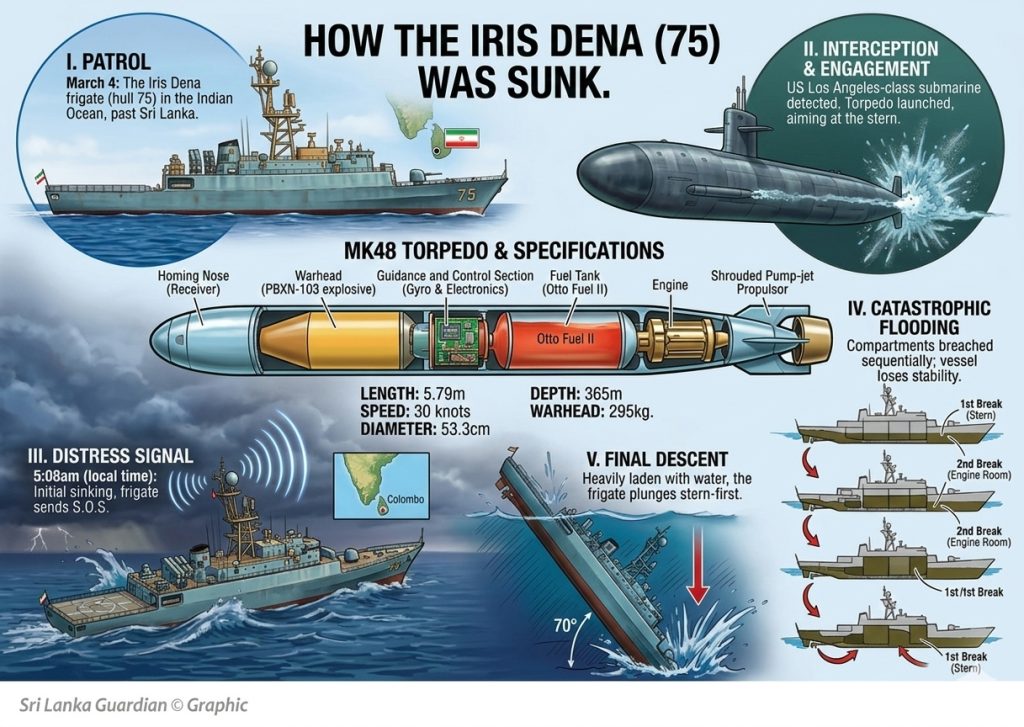
Sri Lankan authorities reported 84 dead, 32 rescued, 64 missing, with later confirmations exceeding 140 casualties. The IRIS Dena, based on the Alvand-class design, ranked among Iran’s most capable surface combatants. Its destruction comes amid Operation Epic Fury, the U.S. campaign targeting Iranian naval assets across the Middle East and elsewhere.
Meanwhile, Iran requested further port calls on 4 and 5 March, this time for the IRIS Booshehr. Sri Lankan authorities warned that docking in Colombo would endanger the city, redirecting the vessels to Trincomalee Port instead. The ships carried 208 personnel, including 53 officers, 84 cadets, 48 senior sailors, and 23 regular sailors. As President Dissanayake reaffirmed, Sri Lanka’s position was clear: the country acts independently, not as an instrument of any foreign power. However, he didn’t say anything about the arrangement of the weaponry that the ship had.
Strangely, the third ship would have gone unnoticed. Yet in February 2024, the IRIS Booshehr docked at Colombo alongside IRINS Tonb (L513), a 94.94-metre Hengam-class landing ship with a 250-member crew, as part of a maritime cooperation mission. President Dissanayake refused to comment on the third vessel, leaving its fate unknown amidst the wider naval operation.

Talking to this writer, Professor Rohan Gunaratna, Founder of ICPVTR, Singapore, stated: “As the US and Iran are at war, the US submarine attacking IRIS Dena in Sri Lanka’s Exclusive Economic Zone (EEZ) is not a violation of international law.”
“Warships are considered legitimate military objectives and can be targeted, attacked, or destroyed without warning. However, attacking merchant ships, hospital ships, or vessels in neutral waters is restricted,” he said, adding, “as an armed conflict exists and the ship is a military vessel, the U.S. attack does not violate the established laws and customs of war (International Humanitarian Law).
“Similarly, the Sri Lankan Navy searching for and rescuing survivors at sea is a mandatory obligation under international maritime law, primarily rooted in the duty to render assistance to persons in distress. This obligation applies regardless of the nationality, status, or circumstances (including illegal migration) of the persons in distress,” he observed.
Prof Gunaratna added: “The coastal state has sovereign rights within its EEZ primarily for economic purposes, such as fishing and natural resources, but foreign vessels generally enjoy freedom of navigation. Therefore, attacks in the EEZ are primarily governed by the laws of the high seas and the specific rules of the Law of the Sea, which operate differently depending on whether a state of war exists.”
Meanwhile, the country’s former Foreign Minister Ali Sabry noted that Sri Lanka’s decision to rescue the Iranian sailors and grant innocent passage reflects the country’s finest traditions. It honours decades of principled independence and non-alignment, asserting the Indian Ocean as a Zone of Peace. At a moment when many nations cave to expediency and external pressure, Sri Lanka’s choices are a rare display of courage, balance, and moral consistency.
Trincomalee’s importance cannot be overstated. While the quote “He who possesses Trincomalee will rule the Indian Ocean” is unverified, the port’s strategic value is undeniable. In colonial times, it was the site of brutal naval battles between France and Britain, with control fiercely contested due to its deep-water anchorage, able to hold the largest warships regardless of weather. Its proximity to the East–West Sea Line of Communication—the artery of global trade—and its natural defensive advantages make it nearly impregnable.
Beyond logistics, Trincomalee is central to regional power plays: controlling the port enables surveillance of southern India, regulation of Middle Eastern energy shipments to Asia, and projection of naval power across the Indian Ocean. Amid aggressive manoeuvres by global powers, including U.S. attempts to exploit Sri Lanka’s vulnerabilities for strategic gain, Trincomalee has become a critical chessboard in the Indian Ocean, where history and modern power struggles collide.
Sri Lanka had previously signed a trilateral agreement with the United Arab Emirates and India to develop the colonial-era oil farm near Trincomalee Port. The port has now decided to host an Iranian naval ship there, a move the UAE may view as conflicting with the pact. “I think this arrangement is very good. I am sure our government consulted the US and other relevant parties also before taking this decision,” Admiral Ravindra Wijegunaratne, former Chief of Defence Staff and diplomat, told this writer.
However, tensions are heightened as the UAE was attacked by Iran shortly after United States–Israel joint strikes, deepening enmity between the two nations. How Colombo navigates these pressures in the months ahead could set a precedent for smaller states caught between global powers.
Let us recall what Velupillai Prabhakaran, the brutal terrorist and leader of the LTTE, said in an interview with The Week magazine, India, on 23 March 1986—exactly 40 years ago: “The US administration has strategic and geo- political interests in the region. Sri Lanka with its natural harbour in Trincomalee, is most strategically located in the Indian Ocean.” He added, “The objective of the US imperialists is to gradually penetrate the country and eventually bring the island under its sphere of influence and domination. The escalating ethnic conflict has driven the Jayawardene Government to seek American assistance. The US has been directly helping Sri Lanka through her allies, i.e. Israel, Pakistan, South Korea and China. The US objective seems to be to perpetuate and escalate the ethnic crisis, so that she can gradually set foot on the island and establish a base in Trincomalee.”
Trincomalee continues to keep calm waters but high-stakes diplomatic turbulence.









