In a milestone for space exploration and off-world agriculture, researchers in Texas have successfully grown chickpeas in simulated lunar soil for the first time. Using soil mixtures containing up to 75 percent lunar regolith, the crushed rock and glassy dust that covers the moon, scientists produced harvestable crops, raising hopes that future moon bases could cultivate their own food rather than rely entirely on costly supply missions from Earth, according to reporting by Times UK.
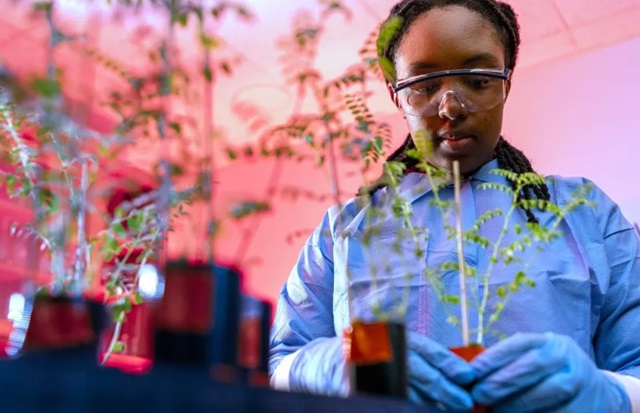
The experiment, published in Scientific Reports, used the Myles variety of desi chickpeas, chosen for their compact size and stress tolerance. Seeds were coated with arbuscular mycorrhizal fungi, a microorganism that aids nutrient absorption and limits the uptake of heavy metals like iron, aluminum, zinc, and copper, which are abundant in lunar regolith and toxic to plants. The fungi also acted as a “biological glue,” binding jagged soil particles and improving the regolith’s structural integrity and water retention.
Researchers planted the seeds mostly in mixtures of simulated lunar soil and vermicompost, a nutrient-rich material derived from earthworm-processed organic waste. While yields decreased as the proportion of lunar soil increased, individual seed size and weight remained comparable to those grown in normal potting mix. Even in 100 percent lunar soil, plants treated with fungi survived on average two weeks longer than untreated ones, though they did not flower.
The experiment also addressed the high alkalinity of raw lunar regolith, which has a pH of about 9.9, inhospitable to most crops. The addition of fungi and vermicompost lowered the pH to a more favorable 6.2–6.6. This breakthrough demonstrates that careful soil management and microbial partnerships could allow plants to thrive in extraterrestrial conditions.
Despite the success, the chickpeas are not yet suitable for consumption. Scientists are currently testing aluminium levels and other safety measures to ensure the crop is nutritious and safe for human diets. Jessica Atkin, a NASA fellow at Texas A&M University leading the project, emphasized that “before anyone makes moon hummus, we need to confirm they are safe and nutritious.”
The research comes as both the United States and China plan to return astronauts to the lunar surface within the next few years, with ambitions for permanent lunar bases on the horizon. Sara Oliveira Santos, a postdoctoral researcher at the University of Texas and co-author of the study, said: “In our goal toward establishing a lunar presence, we will need to learn how to grow food on the moon, since it will not be sustainable to ship food in spaceships.” This experiment marks a significant step toward self-sustaining human life beyond Earth.