


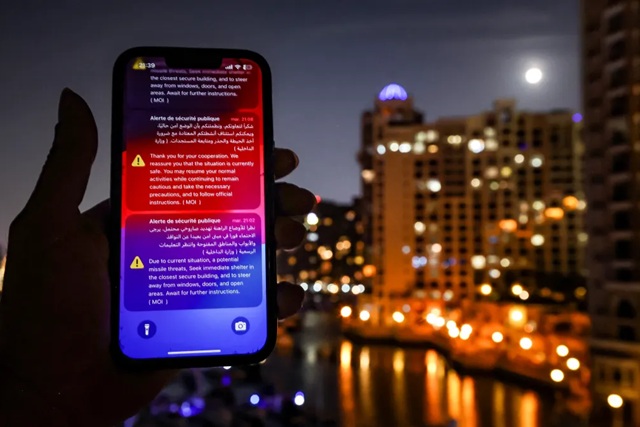
In one of Abu Dhabi’s largest malls, martial Emirati music echoed across near-empty corridors. Shop assistants folded trousers with listless efficiency while cleaners mopped floors, their movements almost ceremonial against a backdrop of silence. Just days earlier, missile alerts had sounded, warning residents of Iranian attacks, yet most who remained had begun to ignore them. Thousands of tourists and expatriates had already fled, leaving the city’s streets and attractions ghostly and still.
Two weeks prior, the Gulf states’ worst fears had materialized. Iran launched a series of Shahed drone strikes across the region, targeting Dubai’s skyscrapers less than 100 miles from its coast. The attack on a luxury Palm Jumeirah hotel, which erupted in flames, shattered the carefully curated image of the Emirates as a safe, insulated haven amid regional turmoil. For decades, the UAE had projected security and stability, a hub for tourism, trade, and finance. Now, that veneer seemed fragile.
“The Gulf states were known to be kind of an oasis in the Middle East,” said Dania Thafer, director of the Gulf International Forum. “And this war, especially if it continues, will greatly affect that brand. The economic ramifications can be very significant.” S&P Global projections for UAE growth in 2026, previously estimated at 4.3 percent, have now been reduced to just over 2 percent. High-profile events, including Formula One races in Bahrain and Saudi Arabia, were cancelled, while drone strikes damaged financial districts and disrupted digital banking services.
Across the Gulf, the attacks underscored the vulnerability of even the wealthiest states. A Fujairah oil plant was struck, and desalination facilities in Bahrain—crucial for providing water in the arid region—were targeted. Airports, ports, and shipping routes, central to global commerce, experienced disruptions, threatening ripple effects far beyond the Emirates. “Even limited disruptions in maritime traffic or airspace can have significant consequences,” said Ebtesam al-Ketbi, president of the Emirates Policy Center. Despite these challenges, she noted, the UAE has shown institutional capacity to maintain basic economic functions.
For residents, however, the psychological impact is acute. Unlike Israel, where air raid drills and missile warnings are routine, Emirati society had long expected security and normalcy. “People want this to be a safe place to live with their family. They don’t want their kids to be afraid,” said one analyst familiar with both regions. Missile interceptors, while effective in theory, offer limited reassurance when millions watch expensive drones neutralized by expensive defenses, exposing the imbalance between Iranian drone costs and Gulf military expenditures.
Authorities have also cracked down on those documenting the conflict. A British tourist in Dubai was arrested for filming missile strikes, facing up to two years in prison, while 45 others were detained for similar offenses. In Bahrain, at least six people were arrested for recording attacks, some threatened with severe penalties. Officials emphasize the pursuit of diplomatic solutions, though the speed and scale of Iranian retaliation caught Gulf governments off guard.
The war has also exposed tensions with the United States, long considered the region’s primary security guarantor. Gulf states invested over $100 billion in US weaponry, including F-15s, F-35s, and advanced missile defense systems. Yet they were reportedly not forewarned of the US-Israeli strikes that triggered the conflict. “It’s a two-tier system of allies in the Middle East,” a source close to Gulf governments told Times UK. “Israel is at the top. Gulf countries are underneath.” Even the 2020 Abraham Accords, which had improved ties with Israel, cannot mask underlying resentment, particularly as some Gulf observers contrast their vulnerabilities with Israel’s Iron Dome protections.
So far, the UAE and other Gulf states have refrained from retaliatory strikes. Yet military analysts warn that prolonged conflict could draw them further into hostilities. Recent US operations against Kharg Island in Iran, along with the deployment of 5,000 additional American marines and warships, signal a potential escalation. Saudi Arabia has called for negotiations while warning of consequences should Iran continue its attacks.
Despite these pressures, Gulf states remain dependent on American defense and support. “The UAE’s position has been that it is acting in self-defense, not as a participant in the war,” al-Ketbi said. “While it remains a close US partner, there are concerns about long-term strategy.” For Abu Dhabi, Dubai, and the broader region, the challenge is clear: maintaining the perception of stability, protecting economic lifelines, and adapting to a security environment where no city—regardless of wealth or investment—can be fully insulated from regional conflict.
The emptiness of Abu Dhabi’s malls and the silence in its streets serve as stark reminders that prosperity and safety are not guaranteed. The Gulf’s lifeblood—tourism, trade, and energy—remains at risk, as residents and governments alike navigate a new reality of vulnerability, uncertainty, and geopolitical upheaval.









