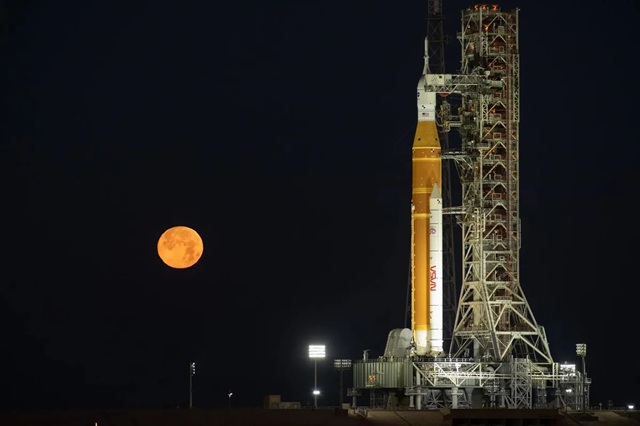
NASA is revising its Artemis moon-landing plans, reducing Boeing Co.’s Space Launch System (SLS) role while elevating SpaceX’s Starship rocket to carry astronauts to lunar orbit, according to people familiar with the matter. Under the original roadmap, SLS would have launched the Orion crew capsule built by Lockheed Martin Corp. toward the moon, where a Starship lander would dock to take astronauts down to the lunar surface. The updated plan calls for Orion to dock with Starship in Earth orbit, with Starship providing the propulsion to reach lunar orbit and ultimately land astronauts, giving Elon Musk’s rocket a pivotal role in the mission.
NASA Administrator Jared Isaacman is scheduled to meet with Boeing, SpaceX, Blue Origin LLC, and other Artemis partners to review progress and discuss the revised plan. While SLS may still launch Orion into Earth orbit, the shift marks a major change for a program long anchored by Boeing’s rocket, which has faced repeated delays and cost overruns, with the first flight only occurring in 2022 instead of the planned 2017 debut. NASA’s inspector general estimates that each of the first four SLS and Orion missions will cost more than $4 billion.
The revised plan also changes Orion’s lunar orbit. Originally, Orion would enter the near-rectilinear halo orbit (NRHO), but under the new proposal, Starship will place the capsule into a tighter low-lunar orbit, leveraging Starship’s capabilities beyond what SLS and Orion could achieve together. The update comes as SpaceX continues to face scrutiny for missed milestones and development delays, with NASA expecting potential further setbacks.
Blue Origin has submitted a revised lunar lander plan as well, and NASA supports both SpaceX and Blue Origin in accelerating development. A 2027 test mission is planned to dock astronauts with one or two lunar landers in Earth orbit, further indicating the agency’s intent to fast-track the return of humans to the Moon by 2028. Bloomberg reports that these changes reflect NASA’s broader strategy to balance technological innovation, schedule acceleration, and budget pressures while advancing the Artemis program.