


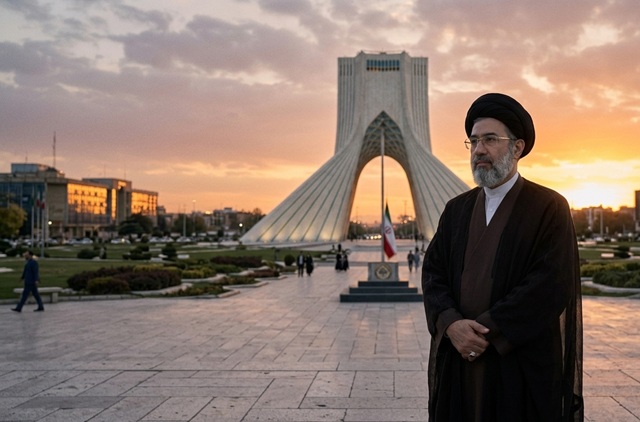
Iran’s Leader of the Islamic Revolution, Ayatollah Seyyed Mojtaba Khamenei, has marked the Persian New Year with a message that intertwines religious observance, national resilience, and a recounting of what he describes as “three wars” faced by the nation over the past year. Delivered on the eve of Nowruz and coinciding with Eid al-Fitr, Khamenei’s message to the Iranian people and Muslims worldwide paints a portrait of a country under pressure yet steadfast, framing recent turbulence as evidence of both foreign malice and domestic fortitude.
Khamenei began by congratulating Iranians on the rare concurrence of the springtime festival of Nowruz and the holy month of Eid al-Fitr, emphasizing the spiritual significance of both occasions. He extended these greetings to Muslims globally and highlighted what he called the “remarkable victories of Islam’s fighters,” while expressing condolences to families affected by foreign aggression and domestic unrest. These remarks set the stage for a retrospective of Iran’s recent trials and tribulations, which he described in three distinct conflicts.
The first, termed the “June War,” involved what Khamenei characterized as an attack by the “Zionist enemy,” aided by the United States, resulting in the deaths of prominent Iranian commanders, scientists, and approximately 1,000 civilians. According to Khamenei, the perpetrators expected the strikes to provoke popular revolt against the Islamic system, but the combination of national vigilance and the courage of Iran’s armed forces thwarted these intentions. He described the outcome as a demonstration of the resilience of both the people and the nation’s security apparatus, forcing the attackers to seek mediation after their plans failed.
The second conflict, identified as the “January Coup,” was linked to foreign-backed domestic unrest. Khamenei blamed the United States and Israel for instigating riots, arguing that economic pressures were intended to align Iranian public sentiment with foreign interests. Despite these disruptions, he asserted that the populace once again foiled attempts to destabilize the nation, emphasizing the importance of continued unity in the face of external manipulation.
The third war, ongoing according to Khamenei, began with the deaths of key national figures, including the revered late leader of the country. He recounted the loss of military commanders, intelligence operatives, and other citizens in what he described as a systematic effort by external actors to induce fear and chaos. Khamenei framed these sacrifices within the broader narrative of Iran’s resilience, noting that the population responded with widespread public engagement, maintaining morale and a defensive posture during the holy month. He cited public demonstrations, such as those on Quds Day, as examples of the population asserting its opposition to global interference and military intimidation.
Beyond recounting military and security challenges, Khamenei’s message addressed the socio-economic and spiritual dimensions of Iranian life. He expressed gratitude for citizens’ contributions to social cohesion and public services, highlighting volunteer work and charitable efforts that bolstered national solidarity. He cautioned against foreign attempts to exploit economic vulnerabilities or media narratives, urging domestic outlets to emphasize unity rather than weaknesses, portraying this approach as both a defensive and moral imperative.
Khamenei also provided a thematic outlook for the new year, declaring 1405 the year of “Resistance Economy in light of National Unity and National Security.” He emphasized the need to focus on public welfare, economic infrastructure, and wealth creation as strategic priorities, framing them as components of Iran’s broader defensive posture against foreign economic and political pressures. He highlighted efforts to gather public input through direct engagement, including informal interactions in Tehran, as a means to align policy with the lived realities of citizens.
In terms of foreign policy, Khamenei reiterated Iran’s emphasis on neighborly relations while underlining strategic and spiritual connections with countries sharing Islamic traditions and holy sites. He specifically mentioned Pakistan and Afghanistan as nations with which Iran seeks stronger cooperation, advocating unity among Muslim nations to counter external pressures. At the same time, he denied any Iranian involvement in attacks targeting Turkey and Oman, attributing these incidents to a “false flag” strategy by adversaries to foment discord in the region.
Spiritual reflection remained central in Khamenei’s address, intertwining personal, communal, and national dimensions. He urged Iranians to observe religious obligations while embracing the renewal symbolized by Nowruz, noting the duality of mourning the loss of national martyrs and celebrating life’s continuities, such as weddings and family gatherings. By blending religious observance with patriotic messaging, Khamenei framed resilience and unity as intertwined with faith, portraying them as essential to navigating both present and future challenges.
The message concluded with a broader invocation for divine guidance and blessings for Iran, neighboring nations, and Muslim communities worldwide, asserting that the coming year should be marked by triumph for the oppressed and setbacks for adversaries. Khamenei cited the Holy Quran to reinforce the moral and spiritual dimensions of resistance, underscoring the narrative that Iran’s endurance is part of a divine plan for justice and perseverance against tyranny.









