




Who decides the future of Iran? Who holds the authority to speak for a people under repression? These are questions that have guided the work of Emily Schrader, an American-born journalist, activist, and analyst who now lives in Israel. She trained as a skater in her youth, a discipline that, she says, taught her independence, focus, and endurance—qualities that would later shape her approach to reporting and activism. Over the past decade, she has established herself as a journalist and commentator on Middle Eastern affairs, particularly Iran, combining on-the-ground interviews, analysis of dissident movements, and scrutiny of international institutions. She is the founder of the Iran-Israel Alliance, a non-profit working to raise awareness about religious and minority communities in Iran, and co-founder of the Cyrus Fund, a technology initiative aimed at addressing internet connectivity and financial challenges inside Iran.
Recently, I sat down with her for a lengthy discussion, exploring her initiatives, her reporting, and her perspectives on Iran, Israel, media, and the political transformations she believes are necessary.
Emily Schrader introduces herself not through abstraction but through institutional and operational commitments, stating plainly, “Founder of the Iran-Israel Alliance, which is a non-profit that works to raise awareness about activists specifically, as well as different minority, specifically religions inside Iran, so the Christian community, the Baha’i community.” The formulation situates her work at the intersection of advocacy and transnational linkage, where she adds that “we do a lot of work to raise awareness and bring people together from Israel and Iran, the Israeli community and the Jewish community globally, and the Iranian community, both inside Iran and the diaspora.” Her emphasis remains on connection as a deliberate act, one that is both communicative and political in implication.
She extends this framework by identifying further roles, noting, “I am also the co-founder of the Cyrus Fund, which is a start-up, a tech start-up, that’s working on developing solutions to the problem of internet connectivity inside of Iran, and also working to find solutions to problems like the currency issue inside Iran that has been devalued there.” The articulation of technological intervention appears as a practical extension of political concern, where “we’re looking at other options with digital currency” and “we have two different ventures we’re working on now for those specific challenges.” Her account is cumulative rather than singular, as she adds, “I’m also on the executive board of the Institute for Voices of Liberty, which is a think tank focused ultimately on regime change in Iran and on elevating the voice of the people of Iran.”
Her description of collaboration within Iran itself foregrounds both reach and limitation. She states, “we have a lot of Iranian dissidents and activists in the diaspora who are a part of the organisation,” but immediately qualifies this by insisting that “we’re regularly speaking with and working with Iranians inside the country,” while acknowledging constraint in that “it’s a bit difficult because of the internet situation.” This difficulty does not interrupt continuity, as she frames her activity as part of a longer trajectory: “since we started, and even before, because this is my background in terms of activism, you know, myself and my other co-founder… we’ve done projects before to raise awareness and create more discussion in the West about what’s happening inside of Iran.” The insistence on continuity positions her work as iterative rather than episodic.
When discussing the idea of the Cyrus Accords, Schrader frames it as both historical reference and future orientation. She explains that it is “the concept similar to the Abraham Accords that there is a historic alliance between the people of Israel and the people of Iran,” grounding this in the figure of “Cyrus the Great… who allowed the Jewish people to return to the land of Israel and rebuild the temple in Jerusalem.” She remarks that this constitutes “like the historic, you know, 2,500 year debt,” adding that “that’s where the name comes from.” The articulation of history becomes a foundation for projection, as she defines the aim as “a peace agreement… mutually beneficial in all the ways that we’ve seen the Abraham Accords be successful,” listing “medical cooperation, tech investment, all fields we want to see collaboration.” Yet she situates this within conditional temporality, stating directly, “is it actually happening today? Obviously not. It would require a very different leadership inside of Iran.” The emphasis is therefore on aspiration rather than immediacy, as she clarifies, “that’s what we’re aiming for in the long term in this relationship.”
Her explanation of authorship avoids singular attribution. “There’s not one person,” she states, insisting that “it’s an initiative at this point… not like a formal written document.” The absence of fixed authorship is instead deferred to a future political moment, where “that’s something that will be determined… by the leaders at the time when we do come to the position in which we can put forward a peace agreement like that.” The notion of incompletion becomes central to the concept itself.
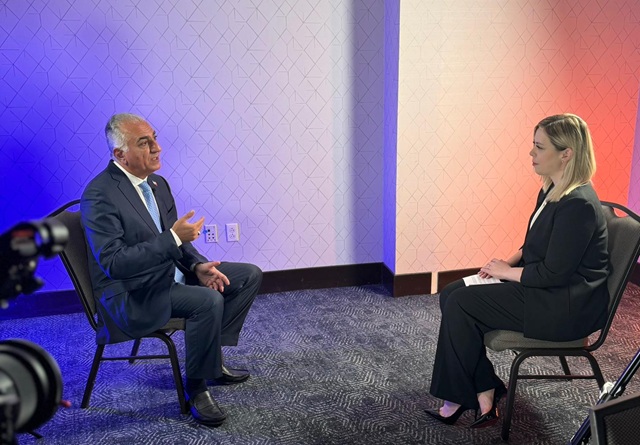
In a related articulation of Iran’s political future, Emily Schrader frames the question of leadership with an explicit boundary, stating, “first, it’s not for me to say who should lead Iran — I’m not Iranian and I’m not living there. It’s up to the people of Iran.” This distancing is immediately followed by an evaluative claim grounded in observation, where she adds that “as an outside analyst, it’s very clear that there is no other single figure who commands as much support from the Iranian people inside Iran,” identifying that “there is only one and they’re calling for in the streets and that’s Reza Pahlavi.” Her reasoning situates this within what she describes as a structural absence, arguing that “Iran also has a problem of leadership in that this regime is so extreme that the people don’t and won’t trust anyone from inside the system,” attributing this to “pervasive corruption” and the role of “reformists” who “have given cover to the regime.” From this, she derives the necessity that “it is necessary for at least a transitional leadership to form in exile,” presenting Pahlavi as the figure who “has worked with experts across Iranian groups and communities… to build a transition plan to minimise instability.” She emphasises that he is “the only person capable of leading such a transition,” while also noting his stated position that “he doesn’t want to be king — he wants to see a national referendum… followed by elections for a new and free Iran.” Her description concludes by framing him as “a staunch advocate for democracy” who “understands the mentality of the Middle East and what’s required to sustain democracy,” and she states directly, “I believe he by far the best choice for transitional leadership.”
From Gaza to Iran, the world sees distorted narratives: disinformation, biased media, and failed international institutions hide the truth about terror and violence.
Turning to her work in writing, Schrader describes a pedagogical impulse structured by simplification without reduction. She notes that “anytime you’re talking about the conflicts in the Middle East, it’s incredibly complex,” and therefore her objective was “presenting in a simple form… a format that most Gen Z would read today.” The strategy is defined through fragmentation: “a paragraph or a few sentences on each of the figures… each of the players… each of the events in history.” She frames the intended effect as preparatory, stating that “when a Jewish student or non-Jewish student get to university, they know what people are talking about.” Her concern lies with conceptual literacy, particularly in relation to terminology, observing that “when people use the word West Bank versus Judea and Samaria, you can tell something about where they’re coming from.” She insists that “it doesn’t mean one is right and one is wrong,” but foregrounds historical layering, noting that “Judea and Samaria is the name that was given… and only later… you saw the renaming,” while “West Bank actually came from Jordan… it’s the West Bank of the Jordan River.”
This approach extends to institutional arrangements, where she remarks that “under the Oslo Accords areas A, B, and C… nobody who’s 18 going to university knows what that means.” The absence of such knowledge becomes, in her account, a structural problem, as she describes her aim as enabling individuals to “understand who controls what… why things are the way they are.” The framework she outlines is not prescriptive in conclusion, as she states that readers should “draw their own conclusions about what they believe.” Her emphasis is therefore on exposure rather than directive argument.
Her reflection on criticism is framed in terms of dismissal rather than engagement. She states, “this is something that people do when they are intellectually lazy and they don’t want to actually look into the claims being made,” describing the label of propaganda as a method “to dismiss the person saying it.” She situates this within a broader pattern, noting, “we see it all the time… it’s not unusual,” and attributes intensity to context, observing that “this is a highly emotional and heated conflict.” Her response does not deny disagreement, as she adds, “people… are entitled to disagree with me. Absolutely.”
Her formative experiences are described in relation to perception and contradiction. She states that “when I went to university, I saw that there was so much obsessive hatred of Israel,” contrasting this with her own familiarity: “someone who knows this country… the things that they are claiming don’t square up with the reality on the ground.” She identifies a specific disjunction between discourse and experience. The role of hostility becomes formative, as she reflects, “it’s actually the… anti-Semitism that drove me to be more involved and to research this more myself.” The process she describes is one of self-education: “I didn’t have all the answers… so I had to learn them myself… read more about why people believe what they believe.”
Her account of campus incidents distinguishes between political critique and social targeting. She states that “they would do things like target Jewish events, not Israel events,” specifying that “they would go to Shabbat dinners… they would target Jewish campus life events.” This distinction is central to her reasoning, where she concludes, “that’s very different… that’s anti-Semitism.” The differentiation rests on the separation between state action and individual identity, which she articulates as “an American Jew who has no responsibility for the actions of a sovereign nation.”
Her migration to Israel is described through adjustment rather than rupture. She identifies “the cultural change” as “the hardest part,” noting that “it’s the Middle East… a very different mentality.” Language is presented as a practical barrier, as she recalls, “when I made Aliyah, not fluently, no… it took me some time.” Yet she moderates this by noting familiarity in other aspects: “the weather is actually very similar to where I came from in Los Angeles,” and adds that “that’s not the reality of how Israel actually feels when you’re here.” The distinction between representation and lived experience reappears.
Her critique of Israeli policy is framed externally rather than internally, as she states, “one of Israel’s biggest shortcomings has actually been making the case for Israel.” She argues that “not enough has been done to explain transparently and in real time what needs to be done, where, and why.” This is paired with a claim of reactive weakness, where “Israel has been pretty weak in terms of responding to media and accusations.” She situates this within anticipation, noting that “we know that there’s a lot of bias… so… Israel needs to take the necessary steps in advance.” The emphasis is on preparedness across domains, including “the diplomatic front, on the PR front, in addition to the military front.” Her framing introduces the idea of parallel conflicts, stating that “there’s an information war going on beyond the kinetic war.”
Her interpretation of regional dynamics centres on the role of Iran, which she describes as “the proxy of Hamas and Hezbollah and the Houthis,” identifying it as “the primary instigator of these types of… attacks.” She links this to broader consequences, stating that when “the Islamic regime in Iran is strong… many of these terror groups are being emboldened.” The language of causation extends to policy decisions, where she refers to “the release of $6 billion… with the Joint Comprehensive Plan of Action (JCPOA),” asserting that “this emboldened the regime.” The conclusion she draws is structural: “eliminating… the Islamic regime in Iran… is going to be crucial to securing all of the region.”
Emily Schrader’s reflections on journalism move from structural considerations to epistemological uncertainty, where she begins by stating, “I don’t think that there is such a thing as not having bias.” The assertion is not framed as an exception but as a universal condition: “every person on every issue has an opinion… they have their own perspective and they have a bias.” The distinction she draws is not between presence and absence of bias, but between its management and its consequence, asking whether “that bias prevent[s] them from reporting information that may be mitigating or contradictory to what their views are.” Her own position is articulated through conditional acceptance, as she says, “I don’t personally have a problem with that… I don’t have a problem admitting if Israel did something wrong.” The structure of her reasoning separates reporting from commentary, as she clarifies, “if I’m reporting what the news is… I report what the facts are,” whereas “if I’m writing an op-ed… I’m also expressing what my opinion is.” The division is procedural rather than ideological, grounded in the nature of the task being undertaken.
Israel is not an apartheid state—two million Arab citizens serve at every level of government—but persistent myths fuel global outrage and misunderstanding.
Her consideration of social media unfolds through duality. She states that “on the one hand, information gets out very quickly,” and that platforms enable access in ways previously unavailable, noting that “you’re able to reach heads of state and major public figures in a way that maybe we would never have been able to as journalists before.” Yet this expansion is immediately countered by distortion, as she observes “a huge problem of disinformation,” much of which she attributes to state activity, describing “countries like the Islamic Republic of Iran… artificially promoting narratives that aren’t necessarily reflective of what the public… believes.” The temporal dimension of visibility is emphasised when she notes that such narratives “will dominate… for several days,” producing what she calls “a skewed perspective of what’s happening.” Her concern is not merely the existence of competing narratives but their disproportionate amplification.
This disproportion is extended into her discussion of global coverage. She reflects on the “24/7 coverage of whatever it is that’s happening in Gaza,” contrasting it with other events that “get almost no coverage,” including famine, massacres, and attacks elsewhere. She frames this imbalance through comparative frequency, recalling that there were “25 times more mentions of Israel and Palestine… than… Russia and Ukraine.” The argument is not framed as denial of importance, as she explicitly states, “I’m not saying it’s not important… it is important,” but rather as a question of scale and distribution, where she argues that “to place that as so much more relevant… it just doesn’t make sense.” The emphasis remains on proportionality as a measure of representation.
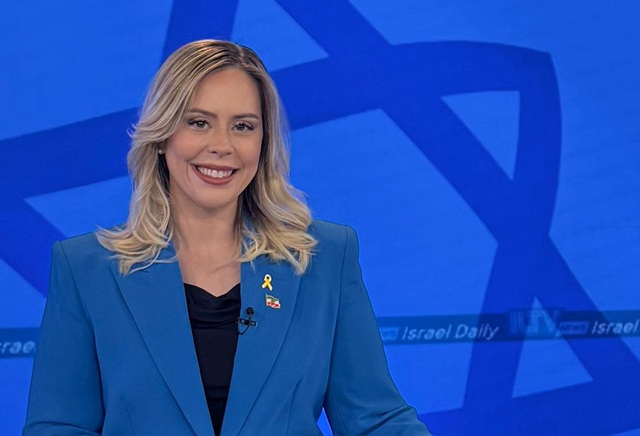
Her account of declining trust in media returns to structural and cultural explanations. She suggests that “part of the reason people are losing trust… is because… they feel like the media is motivated by… the media companies’ interests,” pointing to perceptions of selective reporting. This scepticism is described as partly justified, though not entirely, as she adds “part of it is justified, but part of it is not.” The second factor she identifies is the erosion of authority, where “there are no more gatekeepers,” a condition she describes as both “a plus” and “a minus.” The positive element lies in voice, as “everyone has a voice,” while the negative emerges from competence, as “not everyone knows what they’re talking about.” The result is described in cumulative terms: “you get a lot of uninformed opinions… a lot of questions and confusion… a lot of chaos… a lot of conspiracy.” The explanatory function of conspiracy is highlighted when she states that it is used “to explain the things that you don’t quite understand rather than… actually research issues.”
The emergence of artificial intelligence introduces, in her account, an additional layer of uncertainty. She states that “we’re having a new challenge of AI… no one… even many of the top journalists don’t know… whether content is real or not.” The uncertainty is temporal, as she specifies “at least initially,” but its implications are immediate, making it “very difficult to know what’s happening on the ground.” Her projection is not optimistic, as she concludes that “it’s probably only going to get worse before it gets better.” When prompted about regulation, she refrains from definitive prescription, stating, “I haven’t suggested a universal… I would need to research this more,” but maintains that “something needs to be done on a legal basis.”
Her discussion of violence and leadership within Iran is framed through continuity and comparison. She states, “this regime is the equivalent of the Nazi regime of our time,” and supports this claim by listing what she describes as repeated acts over “47 years of this behaviour.” She refers to “mass-murdered thousands of protesters,” noting that “the reality is that they’ve done the same thing for decades.” Her account is cumulative, moving through different periods: “after the Massa Amini uprising in 2022… after the protests in 2009… the student protests in 1980s.” She includes actions beyond domestic repression, stating that “they have hunted down dissidents on foreign soil… attempted to kidnap American journalists… attempted… to assassinate US officials.” The extension beyond national borders becomes central to her characterisation, as she describes it as “an expansionist regime that has tried to export this ideology.”
From this description she derives a position on leadership targeting, stating, “I don’t see any problem with taking out… the leader of this movement.” Her reasoning is tied to organisational structure, where she identifies the supreme leader as “the head of the IRGC,” which she notes is “a designated terrorist organisation” in multiple jurisdictions. She concludes that “that does make him a legitimate target… because he’s the head of a terrorist organisation.” The argument is procedural, linking designation to legitimacy within conflict.
When confronted with the idea that such actions might elevate the status of a leader, she rejects this interpretation. She states, “I don’t think it’s representative of the people of Iran,” asserting instead that “the majority of the people oppose him.” She extends this across demographic categories, including “religious, secular, male, female… older… younger.” The claim is that support is limited to “the few ardent supporters he still has.” Her comparison to other figures is used to dismiss the notion of elevation, as she says, “that’s like saying killing Yahya Sinwar elevates his status.” The conclusion she reaches is pragmatic: “it is still better that he is not on this earth being able to carry out ongoing violent action.”
Her response to comparisons between different historical and contemporary events rests on categorical distinction. She states, “what happened in Gaza is a war not a genocide,” and grounds this in causality, describing it as “a response to what happened on 7 October.” She further argues that “there was never… a concerted campaign to eradicate the Palestinian people,” distinguishing this from what she describes as historical genocides. She introduces demographic evidence, noting “we have 2 million Arab Israeli citizens who are equal citizens,” and uses this to argue that “there has never been a plan to eliminate the Palestinian people.” The comparison to other events is rejected on the basis of intention and method, as she contrasts “death marches” with “evacuation notice[s]… to evacuate an area where they need to operate militarily.” She concludes that “it’s comparing apples and oranges.”
Her reflections on proposed peace mechanisms remain tentative. She states that “it’s too soon to say whether or not the Gaza Board of Peace will be successful,” but identifies precedent as a concern, noting that “international entities don’t have such a good track record.” She cites specific examples, referring to “UNIFIL… tasked with disarming Hezbollah,” and concludes that “that did not happen.” The concern is repetition, as she states, “our fear… is that that will happen again with Hamas,” particularly given that “Hamas officials… say that they will not… disarm.” The uncertainty is maintained, though she affirms that “unquestionably Hamas should be disarmed.”
Emily Schrader’s discussion of international institutions is framed through a sustained questioning of credibility, where she responds to references to multilateral criticism by stating, “the United Nations… what credibility does the United Nations have these days.” Her reasoning unfolds through example, as she recalls that “in a few days after the Islamic Republic murdered 40,000 people… the Secretary General… sent a letter… sending his warmest greetings.” This juxtaposition is used to support her conclusion that “the UN has no credibility anymore,” though she qualifies this by noting that “it’s quite a noble cause to begin with… it’s not what it is today.” The tension between original purpose and present condition remains central to her account, and she situates Israel’s position within this environment by observing that “we see the UN once again… issuing yet another condemnation,” which she argues has “lost all its meaning.” The effect, as she describes it, is internal as well as external, since “that makes it actually more difficult… to deal… with situations in which I do believe that Israel does something wrong,” given that “24/7 Israel’s being accused of doing things that are wrong… where we have to defend ourselves because it’s not a legitimate criticism.”
Her explanation of this dynamic relies on specific incidents to illustrate broader patterns. She recounts a case in which “the United Nations once issued a criticism about Israel… not allowing visas for Palestinian athletes,” and describes her own investigation: “I looked into this issue… I spoke to people within the army… within the system.” The conclusion she presents is procedural, stating that “the head of the Sports Committee didn’t submit the visa applications until… the day before the team was supposed to leave,” and that “Israel doesn’t work… on Shabbat.” The implication she draws is that “there are constant conflicts like this… when you actually get into the issue it’s more complex than that and that’s not actually what happened.” The emphasis remains on discrepancy between initial accusation and subsequent detail.
Global media and international institutions routinely distort reality: disinformation dominates, UN credibility is gone, and narratives mask the truth of conflict and terror.
Her critique extends specifically to the United Nations Relief and Works Agency, which she had earlier identified as distinct in mandate. She returns to it with sharper language, stating that “multiple employees… were members of Hamas… some of them even took part in 7 October.” She continues with further examples, including that “the teachers group was celebrating 7 October… in real time,” and that “schools… have been found… with rockets inside them… we’ve seen… tunnels under… schools.” The accumulation of such claims leads her to conclude that “there’s a lot of collusion… I believe they’re irredeemably corrupt,” and therefore “this entire organisation needs to be disbanded.” The proposed alternative is not fully specified but framed in functional terms, as “something new that is actually going to be helpful… for moving forward in the future.”
Her proposed reorientation of refugee policy centres on definitions and duration. She asks, “why are people… who have been there for three or four generations… still considered refugees,” describing this as inconsistent with “how you build a functioning society.” She characterises the current structure as one that “encourag[es] the perpetuation of a conflict,” and questions the uniqueness of Palestinian status by asking, “why are Palestinian refugees different than all other refugees in the world.” She emphasises that “no other refugee group has refugee status inherited from birth,” and suggests that this produces “a society that’s rooted in victimhood.” Her argument turns on the incompatibility she perceives between claims of territory and continued refugee designation, stating, “you can’t have it both ways.”
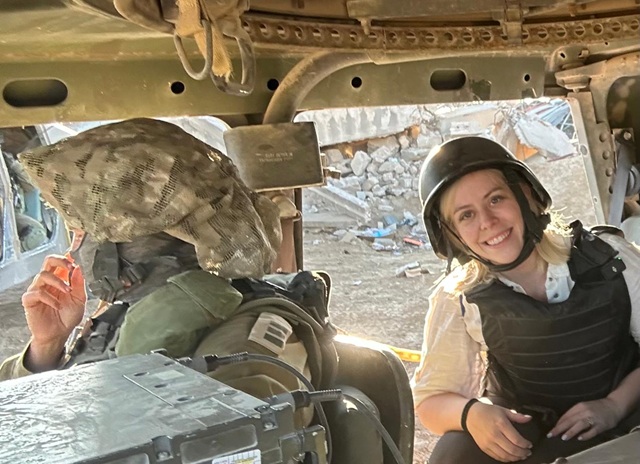
In addressing perceptions of Israel, Schrader identifies what she considers central misunderstandings. She states that “one of the biggest misconceptions… is that… Israel wants to eradicate all Palestinians,” adding that this is “simply not the reality here.” She introduces the term “apartheid” as “the one word that sums up the biggest myth,” and counters it by asserting that “at a state level we are all equal under the law.” Her explanation is supported by reference to demographic inclusion, noting “two million… Arab… citizens… who serve at every level… from supreme judges to military commanders.” She acknowledges the existence of “individuals who hold bigoted beliefs… incidents of discrimination,” but maintains that these do not constitute systemic policy, distinguishing between individual and institutional levels.
Her response to reports from international bodies reiterates her earlier scepticism. When confronted with references to findings of “systematical ethnic cleansing,” she rejects them, stating “no… because the United Nations… has no credibility anymore.” The reasoning returns to institutional behaviour, including the invitation of “figures… of the Islamic regime… to address the Human Rights Council.” She frames this as indicative of inconsistency, reinforcing her broader claim that such bodies lack authority in their assessments. This position is not isolated but integrated into her broader narrative about the difficulty of distinguishing between “legitimate criticism” and what she sees as persistent, unfounded accusation.
Her reflections on life in Israel introduce a different register, shifting from institutional critique to lived experience. She describes her years there by stating, “there is a lot more meaning here,” and connects this to conditions of insecurity, noting that “when you are faced with such existential threats on a daily basis… and when you witness the resilience and the courage of a society… that unites and… refuses to be destroyed.” The emphasis is on collective response, which she describes as extending “across faith… across ages… across religions and levels of religious observance.” The quality she identifies is persistence, expressed as “refuses to be destroyed by ongoing war and ongoing terrorism.” Her conclusion is affective but framed in terms of position, stating, “I’m very honoured to be Israeli… it’s a privilege to live here and to be able to see these issues first-hand.”
Throughout our discussion, Schrader returns to the relationship between observation and participation. She notes that living in Israel allows her “to report on them as a journalist and also to advocate,” linking professional role with political engagement. The duality is not presented as contradiction but as coexistence, where witnessing becomes a basis for articulation. Her closing reflections do not introduce new claims but consolidate earlier themes, particularly the emphasis on proximity, continuity, and involvement in what she describes as “the extremism that plagues… particularly this region.”











Nothing original !! – just quoting the American-Israeli view !!!!!