

“Who do you say that I am?” (Jesus Christ, Matthew 16:15). “Whatever you did for one of the least of these brothers and sisters of mine, you did for me.” (Matthew 25:40). “Blessed are the poor in spirit, for theirs is the kingdom of heaven.” (Matthew 5:3). These pronouncements are neither ornamental scripture nor abstract moral injunctions; they are questions that pierce the conscience, compelling the Church to examine its commitments, its ethical integrity, and its willingness to engage with suffering and difference. They insist that faith cannot be aloof from lived reality, particularly in societies like Sri Lanka, where religious plurality and social inequities demand both discernment and courage. It was in this spirit that I spoke with Sarath Iddamalgoda, reflecting on the life and work of Aloysius Pieris, one of the last genuinely respected Catholic priests in the country, whose intellectual authority was inseparable from moral conviction and lived witness.
Father Iddamalgoda emphasised that Pieris’ contributions to theology and the Church in Sri Lanka were profound, rooted in the ideals of the Second Vatican Council yet refracted through an Asian lens. “He shared the spirit of Vatican II with the people in Sri Lanka to bring about profound transformation within the Church to make it relevant to people in Asia,” Iddamalgoda recalled. “He wanted the Church rooted in Asian realities, its deep religiosity and poverty. As an Asian theologian, he taught the Asian people to think in Asian ways, in contrast to the European way, which was prevailing in Sri Lanka. He guided and inspired the Church in Sri Lanka to be grounded in its social, cultural, and religious realities. He taught us to adhere to the core teachings of the Church such as truth, love, justice, and the liberation dimensions rather than its peripheral teachings.” These reflections capture Pieris’ enduring project: to cultivate a Church not beholden to imported paradigms but attentive to the rhythm of Asian life, in all its spiritual richness and social urgency.
Iddamalgoda described his first encounter with Pieris during the 1980s in Negombo, at programmes devoted to ecclesial renewal known as Saba Navodaya. “We invited Fr Aloy to Negombo several times to give talks on this particular subject,” he said. “Even then, it was clear that his engagement was not merely intellectual. He was practical, he was pastoral, and he had the capacity to make theological ideas live in everyday experience.” In these interactions, Pieris revealed the contours of what would become his hallmark approach: theology inseparable from the spiritual, ethical, and social realities of the people it sought to serve.
Central to Pieris’ thought was the notion of “double baptism,” which Iddamalgoda elaborated with careful clarity. “There are two important aspects on which his theology is based. One is the Asian religiosity, and the other is acute poverty in Asia. He emphasised that all Christians must be rooted in the spiritual experience of God and be open to other religions in Asia. Christians were called to dialogue with and learn from these spiritual traditions rather than ignore them. The other calling was to enter into the struggle of the poor and make a commitment to justice, liberation, and human dignity and build up solidarity with the oppressed masses of Asia. Therefore, what Aloy means by double baptism is the commitment to ‘deep God-experience’ and ‘entering into the struggle of the poor.’” This formulation, while deceptively simple in words, carries radical implications. It insists that contemplation and action cannot be separated and that the credibility of theology depends upon its ethical enactment.
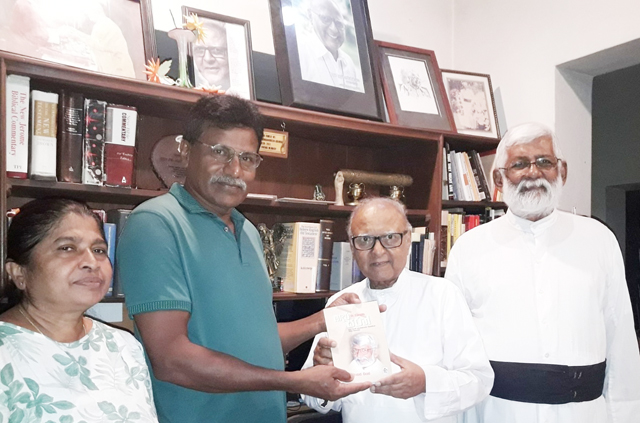
Pieris’ vision extended beyond doctrinal instruction to social and political awareness. As Iddamalgoda explained, he often drew parallels between Sri Lanka’s protracted conflict and other struggles, such as those in Kashmir, to highlight the universality of human suffering and the ethical imperative for solidarity. These comparisons were not mere intellectual exercises; they were intended to sharpen the conscience and cultivate a theological imagination capable of seeing the interconnectedness of justice, peace, and human dignity across borders.
In a country like Sri Lanka, with a multiplicity of religious cultures and histories of violent tension, Pieris’ commitment to interreligious dialogue was transformative. Fr. Iddamalgoda described this engagement as grounded in humility, learning, and shared action rather than mere tolerance. “Sri Lanka is a country where diverse religious cultures prevail. There have been at times severe religious conflicts as well. Fr Aloy introduced the possibility of a new way of life, based on dialogue, humility, and shared commitment to justice. His approach was dialogue, sharing life with people of other religions, learning from each other’s cultures, working together for justice and peace. For him, harmony is not achieved by tolerance alone, but by deep mutual engagement. He avoided religious superiority. His approach was not conversion. Instead, he promoted mutual enrichment.” Examples of this practical engagement were visible in projects such as the centre for hearing-impaired children in Dalugama, where Christians and Buddhists collaborated in service, demonstrating that ethical and spiritual solidarity can move from abstract principle to concrete social work.
Yet such pioneering approaches were not without resistance. Pieris’ insistence on rooting theology in Asian realities and on critiquing religious nationalism drew suspicion from elements within the hierarchical Church. Iddamalgoda observed, “The hierarchical Church did not welcome him. He was a threat to them. The only bishop who welcomed him and took advice from him on theological matters was Leo Nanayakkara, the former bishop of Badulla. He worked out his mission in the periphery of the Church.” Operating at the margins allowed Pieris to exercise moral and intellectual authority unencumbered by institutional conformity. It also positioned him to speak with authenticity to both the Church and society, proving that influence is often cultivated not through formal power but through sustained engagement with truth and justice.
In his daily life, Pieris embodied the simplicity and openness that his theology advocated. Iddamalgoda described Tulana, his residence and centre of intellectual and social activity, as “an open house for academics, students, and social activists as well. Many who had personal problems took refuge there. During the ‘beeshana samaya,’ young people whose lives were at risk were given protection by Fr Aloy at Tulana.” His home functioned not as a retreat from society but as an interface with its needs, an intersection of thought and action where spiritual reflection met ethical responsibility in palpable ways.
Pieris’ intellectual work is inseparable from this lived witness. His writings, particularly An Asian Theology of Liberation, articulate a vision of theology attentive to context yet rigorous in its engagement with tradition. As Iddamalgoda reflected, Pieris “taught us to think in Asian ways in contrast to European methods, to be rooted in our religiosity and social realities, and to prioritise the ethical imperatives of truth, love, justice, and liberation.” His project was not merely academic; it was an ongoing experiment in the Church’s capacity to be morally and spiritually credible in Asia.
The challenge he posed to the Church was enduring and provocative: to reimagine faith as inseparable from social reality, to listen deeply to other religious traditions, and to act decisively in solidarity with the poor and oppressed. The questions of Christ concerning identity, responsibility, and love are embodied in Pieris’ life not as abstract problems but as lived commitments, constantly tested and embodied in the institutions, projects, and relationships he cultivated. As Iddamalgoda reflected, Pieris’ influence was both broad and personal, touching theological reflection, ecclesial renewal, interreligious engagement, and human lives at their most vulnerable.
In remembering Aloysius Pieris, one is compelled to confront what it means for the Church to inhabit its faith with integrity. His legacy is neither static nor sentimental; it is a call to continuous reflection, dialogue, and action. It insists that theology cannot flourish without ethical commitment, that dialogue cannot exist without humility and learning, and that spirituality cannot be authentic if divorced from the struggles of those marginalised by society. His life, as Iddamalgoda observed, demonstrates that the Church’s credibility arises not from titles or hierarchy but from sustained engagement with the realities of human suffering and religious plurality.
Fr. Pieris now joins the lineage of senior Sri Lankan Catholic figures, including Fr. Ernest Poruthota, Fr. Tissa Balasuriya, and Fr. Marcelline Jayakody, whose footsteps and enduring contributions continue to resonate. His work challenges the Church in Sri Lanka and beyond to think more deeply, act more justly, and inhabit faith with intellectual rigor and ethical precision. He remains, in memory and example, a provocation to theologians, clergy, and laity alike: a reminder that faith, when authentically lived, demands a simultaneous embrace of spiritual profundity and committed action in the world.
May his soul rest in peace!