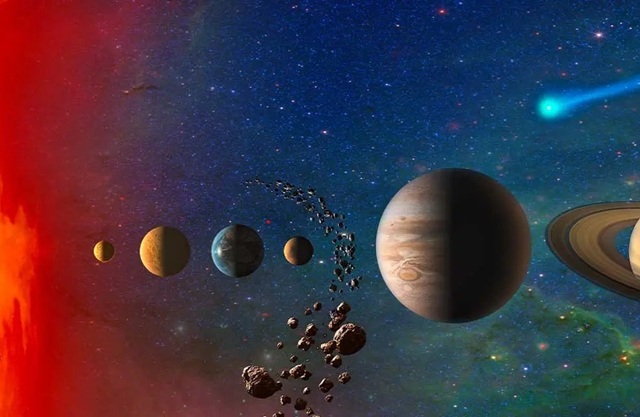
The formation of our solar system’s rocky planets—Mercury, Venus, Earth and Mars—may have been far more complex than previously thought. For decades, scientists assumed that these planets coalesced from a single disc of dust and debris orbiting the young sun. However, new research, reported in New Scientist, indicates that the inner solar system may have formed from two distinct rings of material rather than a single continuous disc.
Traditional single-disc models have struggled to explain the observed characteristics of the terrestrial planets. For instance, Earth appears to be composed of two distinct types of rock, a feature difficult to reconcile if all material originated from a uniform reservoir. Similarly, simulations using one disc often produce planets with inaccurate sizes and spacing: Mercury and Mars end up too massive, Venus and Earth too close together, and Earth and Mars exhibit unrealistically similar compositions.
Bill Bottke, of the Southwest Research Institute in Colorado, and his colleagues sought to address these discrepancies by running months of intensive computer simulations. “We spent six months at the computer, nothing was working, so we made a desperation play. We said, why don’t we try a second reservoir?” Bottke explained during a presentation at the Lunar and Planetary Science Conference in Texas on 16 March. The results were striking: introducing a second disc not only solved the size and spacing issues, but also better accounted for compositional differences between the planets.
The most successful simulations placed one disc at roughly half the distance from the sun to Earth, with a second disc positioned at about 1.7 times that distance. This dual-ring model produced terrestrial planets at the correct sizes and orbital separations. According to Jan Hellmann of the Max Planck Institute for Solar System Research in Germany, the model also aligns with the compositions of Earth, Mars, and the Moon. “We think that Earth predominantly formed from [inner solar system] material, and only the last bit came from the outer solar system,” Hellmann said, while noting that Mars formed largely from material in the outer disc, which explains its differing composition from Earth.
Despite the promise of the two-ring model, some questions remain. Bottke acknowledges that the model relies on very specific initial conditions, and slight variations in the disc’s shape could dramatically alter planetary outcomes. “Slight changes in the shape of the disc can give you major differences in where the terrestrial planets go,” he said. Determining why the solar system would have naturally adopted these precise conditions is an ongoing challenge for planetary scientists.
The implications of this work extend beyond planetary formation. If the dual-disc hypothesis holds, it could help explain other enduring mysteries within the solar system, from the distribution of unusual asteroids to the presence of unexpected rock types on the Moon. The research team is currently using extensive supercomputer resources to refine the model and explore its broader consequences. Bottke said the team is “trying every reasonable possibility” to ensure the model can reproduce the inner solar system’s features reliably.
This approach also sheds new light on the processes that shaped Earth itself. By showing that the planet likely incorporated material from two separate regions of the early solar system, the findings provide a framework for understanding not only Earth’s chemical diversity but also the delivery of water and other volatile compounds critical for life.
The work reported in New Scientist challenges long-held assumptions about planetary formation and demonstrates that the inner solar system may have been far less uniform than previously believed. As researchers continue to refine their simulations, the dual-disc model promises to reshape our understanding of how planets emerge, evolve, and acquire the materials that ultimately support life.