


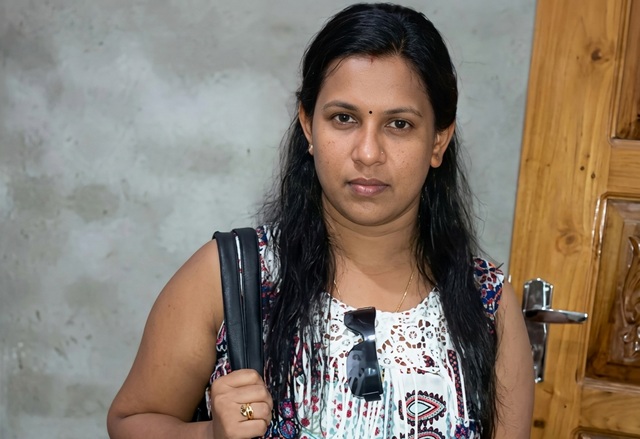
In complex investigations, facts are expected to lead the narrative. Yet sometimes, the narrative begins to lead the facts. When that happens, certain names rise above others — not necessarily because of proven significance, but because of how they are used, manipulated, and spread. Such is the case with Pulasthini Mahendran, also known as Sara Jasmine. How did her name become the only one circulated across media following the Sainthamaruthu incident?
On the same day, Saheeda — the sister of two individuals linked to the Mawanella Buddha statue vandalism — was arrested. She claimed that a group of fifteen women, including herself, had pledged ‘bayat’ (allegiance) in 2018. This raises a broader concern regarding the scale and spread of indoctrination, a concern arguably more important than the number of DNA tests conducted. Yet, this dimension receives little sustained attention compared to the repeated focus on a single name. Whether Saheeda remains under arrest is unknown, but the potential existence of fourteen female suicide bombers should command more concern than Sara Jasmine. Still, her name continues to surface — in court references, media discussions, political commentary, and public speculation. A simple question remains unanswered: why is only her name parroted repeatedly, and by whom?
At Sainthamaruthu, multiple individuals died, including close family members of Zahran Hashim: his mother, father, sister, brother, sister-in-law, his son, and six children. Yet their names are rarely mentioned, their roles are not debated, and their identities are not repeatedly revisited. Silence surrounds them. Not a word is spoken about the wife of the Ibrahim brothers, who detonated her suicide vest, killing herself, her pregnant child, and two other children. Why this imbalance? Sara’s name, on the other hand, is repeatedly invoked in Parliament, even among politicized Church leaders. Their presence was immediate, expected, and directly tied to the core network. Why are Zahran’s mother, sister, or sister-in-law never mentioned? Why is the spotlight only on Sara Jasmine, a twenty-four-year-old Hindu convert?
The basis for her prominence is often attributed to her marriage to a suicide bomber. Yet other suicide bombers also had spouses, so why are their names not highlighted? There is no evidence or even common-sense logic to suggest that any of these individuals had operational authority, planning responsibilities, or command roles. Pulasthini met Hashtoon, the Katuwapitiya suicide bomber, in 2015, was married to him that same year, went to Abu Dhabi to stay with her mother six months later, and returned four months after that. Sara’s mother testified before the Presidential Commission that after her return, her daughter was taken by Zahran’s wife to a house in Narammala, where Sara’s mother received the last call from her on 19 February 2019 at 12:30 p.m., asking her not to call again. Over time, however, the narrative surrounding her evolved. She was portrayed as a wife, a witness, a key link, and even as someone with answers about the so-called “mastermind.” This is not a progression of evidence; it is a progression of narrative weight.
When law enforcement arrived in Sainthamaruthu, they were shot at, and those inside detonated themselves. For any identification process, a name must exist before DNA can be associated, a candidate must be selected before testing, and a narrative must exist before repetition. At which point did Sara Jasmine’s name become dominant, and why was it this name alone? Who introduced it to the investigation? Were all other possible identities tested with equal rigor? What criteria elevated this individual above all others? Where is the evidence of operational involvement? There are several reasons why a single name can assume disproportionate importance.
Complex networks are difficult to explain. A single identifiable person becomes a convenient focal point, someone through whom the entire story can be told. Whether that person is dead, alive, or a fugitive makes the story more sensational and easier to manipulate, twisting the minds of the public for the benefit of those controlling or promoting the narrative. Sara, with a traceable background and known associations, fits this role perfectly. Uncertainty amplifies attention. Unlike others presumed dead, Sara’s status remained unclear for a time. That ambiguity transformed her into more than a victim; she became a question. Questions attract repetition, repetition breeds doubt, and seeds of mischief are planted. She was not part of the immediate family structure of the core group and entered it only through marriage. Narratively, this made her appear as a bridge between different individuals and locations, though a bridge in narrative is not the same as a central pillar in evidence.
Once a name enters police reports, court documents, media headlines, and televised discussions, it begins to generate its own momentum and circulate independently. Each repetition reinforces the last, creating an impression of significance that may exceed the underlying evidence. Over time, the question subtly shifts from “Who is she?” to “She must be important — why else is she mentioned so often?” The repeated use of her name is not random. It serves different purposes: investigators use her as a link between locations and individuals; legal narratives use her to demonstrate association within a network; media use her as a human-centered story; political voices use her as a symbol of unresolved questions and breakthroughs; public discourse turns her into a focal point for speculation. One name carries multiple meanings depending on who is using it.
Repetition is not evidence, and emphasis is not proof. There is a critical distinction between being connected, being present, and being central. This distinction must not be blurred. The narrative, what people repeatedly hear and see, contrasts sharply with the legal and evidentiary record. Repeated references to Sara Jasmine, continued emphasis on DNA, speculation about broader links, and frequent media discussion around one individual do not equate to legal findings. Over 23,000 indictments were filed in relation to the Easter Sunday investigations, extensive court proceedings and evidence submissions were made, multiple accused were formally identified and charged, yet there were no indictments naming Suresh Sallay and no charges established against him. Narrative outcome was high repetition and public focus, while evidentiary outcome showed no corresponding legal linkage.
If one individual’s name continues to dominate discussion, a fair and necessary question arises: is this prominence based on proven evidentiary value, or on narrative utility? Were all others subjected to the same level of scrutiny, identification, and public emphasis? When larger questions — such as who knew about an attack but did not prevent it — remain unasked, the loud repetition of the Sara Jasmine narrative risks diverting attention from more uncomfortable, critical questions. The case of Pulasthini Mahendran is not just about one individual; it reveals deeper truths about how investigations are understood, communicated, and remembered. Those calling for justice must also address the broader issues of extremism and indoctrination, including the role of women in pledging allegiance and being drawn into violent acts of suicide. Equally important are the unanswered questions regarding prior warnings and whether more could have been done to prevent the loss of 269 lives. Answers to these questions are far more critical than repeated focus on DNA or evolving narratives.
This case demonstrates how a name can evolve into a symbol, how a person can become a narrative anchor, and how repetition can shape public perception. Combined, these elements can manipulate minds and divert attention. Additional figures introduced into the story serve to reinforce this effect, even when 23,000 indictments could not. In any serious inquiry, one principle must remain firm: facts must lead, not follow, the narrative. Ultimately, it is evidence, not repetition, that must guide judgment. Until that standard is consistently applied, the question remains: why one name, and not the others? When one name is repeated enough, it can begin to define the story. The real question is whether it reveals the truth or replaces it. Names do not circulate on their own. They are introduced, repeated, and sustained through channels, often for reasons not made visible. It is for the public to question, not simply accept. A single name should never be allowed to divert justice under the pretext of justice.










