
Once I began writing critically about the war in Iran, I received some sensible, well-meant bits of advice. One was that I failed to understand that the overwhelming military advantage of Israel and the United States would soon compel Iran to capitulate. This counsel, the “god is on the side of the bigger battalions” aphorism, was on point. The balance of military power matters in war—an enterprise that, at its core, involves killing people and destroying things. Another piece of advice was that I should not assume Iran could block the Strait of Hormuz or sustain attacks on US bases and the Gulf monarchies’ energy installations for more than a few days.
We’re now in week five of the war, and it’s apparent that this statistics-driven view of Iran’s capabilities has proved wrong. Israel and the United States have certainly wreaked far more destruction on Iran than the other way around. Yet as Clausewitz reminded us, military power is a means for achieving political ends. But what political ends have Israel and the United States achieved so far given their massive superiority? CENTCOM says it has struck 10,000Iranian targets; but the Islamic Republic remains standing, continues to hit back, and hasn’t caved.
Israel has assassinated at least a dozen of Iran’s top leaders, including Supreme Leader Ayatollah Ali Khamenei and the man who, after Khamenei’s death, became pivotal to managing the war: the Secretary of the Supreme National Security Council, Ali Larijani. Both were replaced rapidly—Khamenei by his son, Mojtaba, and Larijani by Mohammad Bagher Zolghadr. Larijani’s role in shaping wartime strategy seems to have been assumed by Mohammad Bagher Ghalibaf, the speaker of the parliament and a former commander of its air force who has close ties to the Islamic Revolutionary Guard Corps.
Iran learned from last June’s US-Israeli attack, during which Israel killed several senior officers and created a leadership vacuum. This time around, it had in place a succession process for key posts. Slain senior commanders and political leaders have been replaced quickly—and their replacements have successors waiting in the wings. A decapitation strategy has not, therefore, precipitated a regime collapse. Iran has also dispersed military command authority to prevent centralization from crippling the conduct of the war.
There’s also no sign that these assassinations have created splits within the Iranian government or produced factions pushing for concessions to the United States. President Trump keeps insisting that his administration has been holding direct and indirect talks with Iran and that its leaders have been “begging to make a deal.” If you repeat something incessantly—Trump does so to convince the American public that the United States is winning—you may end up convincing yourself; but that won’t change the reality.
Contrary to Trump’s repeated claims, Iran has shown no signs of being desperate, or even eager, to cut a deal. It hasn’t softened its tough terms for ending the war. And the more Trump mentions “regime change,” the less Tehran believes he’s really interested in a political settlement. Iran’s leaders also remember that Trump abandoned the Geneva negotiations even though they were willing to make far-reaching, unprecedented concessions on nuclear enrichment. Unsurprisingly, they see Trump’s current talk about negotiations as another ruse—or as evidence that he’s the one seeking an exit.
When people quote Clausewitz, they generally recall his dictum that war is the pursuit of politics by violent means, or his “fog of war” analogy. Another Clausewitzian concept gets far less attention than it should: “friction.” Its underlying idea is that though war has a scientific dimension (maps are used meticulously, supplies are distributed based on careful calculations, forces are positioned and repositioned after meticulous planning), numerous unforeseen things can occur once those detailed plans encounter the battlefield.
This insight is relevant for understanding the Iran war.
It has been widely assumed in the US and Israel that Iran would rapidly deplete its missiles and drones and that its attacks would start to plummet. The US military claimed recently that Iran’s missile launches had declined by 90 percent; Israel insisted that it had destroyed 70 percent of Iran’s missile launchers. But Iran has rationed its stocks, and as of March 15, its average launch rate for drones and missiles hadn’t declined—despite assessments by military experts as early as March 5 that it was running out of firepower.
Another mistaken expectation was that the Islamic Republic was so despotic, and its leaders’ hands so drenched in blood, that it would crack under the strain of war and succumb to a revolution from below. Trump and Israeli Prime Minister Benjamin Netanyahu certainly thought that would happen; that’s why they called on the Iranian people to take to the streets and seize power. It was nonsensical, however, to make such appeals while relentlessly bombing Tehran and other cities. Even Iranians predisposed to revolt were too busy seeking shelter and staying alive.
Moreover, by early March, Israel and the US had attacked several refineries and oil storage depots in and around Tehran, producing toxic soot and “black acid rain” that made it hard to breathe. The Iran University of Science and Technology wasdemolished, a desalination plant was struck, and Trump threatened to “blow up” more of them. A war ostensibly aimed at liberating the Iranian people began to look like a war against them.
The US-Israeli calls on Iranians to rebel also reflected an unwillingness to rethink the assumption–one incompatible with the non-stop “evil regime” narrative emanating from Tel Aviv and Washington–that the Islamic Republic lacks support within Iranian society and rules through repression alone. In consequence, large pro-government demonstrations were dismissed as nothing but state-orchestrated propaganda exercises.
Trump and Netanyahu were confident that their superior military strength would carry the day, so much so that they failed to consider the possibility that if they escalated vertically–that is, by increasing the intensity of their bombing and missile strikes–Iran wouldn’t just sit still. It, too, would escalate, but horizontally: by striking American bases and military assets (radar sites, aerial refueling tankers, and battle-management aircraft) across the Persian Gulf region as well as the Gulf monarchies’ airports, refineries, oil storage sites, and LNG plants. That’s precisely what Tehran has done, driving up the price of oil, diesel, fertilizer ingredients (urea and ammonia), aluminum, helium (essential for semiconductors), and other commodities. Economic forecasters, eyeing the risk of higher inflation and unemployment, warn of a recession and even project that oil prices could reach $200 per barrel if the war stretches into the summer.
Trump and Netanyahu also assumed that Iran would exhaust its stocks of drones and missiles faster than they would burn through their interceptors, but the opposite has occurred. Israel also placed excessive faith in its (first-rate) air defense systems and failed to take into account that Iran’s missiles might prove far more effective than anticipated in penetrating Israel’s air defenses and strike important targets, including towns, ports, and refineries. Israeli military censorship has almost certainly understated the damage Iran has inflicted.
One striking aspect of this war has been the Trump administration’s detachment from reality. The president declared that Iran’s closure of the Strait of Hormuz “doesn’t really affect” the US (“We have so much oil. We have tremendous oil and gas, much more than we need”) to the degree that it affects other countries. Secretary of State Marco Rubio offered a version of the same argument. The US, he said, had been “impacted a little bit” (though he did note that Washington nevertheless had a stake in preventing price hikes from hurting its allies.) You don’t need a doctorate in international trade to grasp that the global oil market is integrated—price hikes in one place soon register in other places. And consider the view of Americans looking at gasoline prices at the pump, which have jumped by 30 percent or more (and diesel prices by 40 percent). How much trust will they have in their leaders’ “What, me worry?” refrain?
The same can be said about Trump’s claim that Iran, as “a present” to the US, has been allowing more ships to exit the Strait and had even “apologized” for not letting more of them through. He either does not know, or knows but won’t say, that every tanker that now transits the Strait does so with Iran’s permission. Very few are getting through. Even with Saudi Arabia’s and the UAE’s land-based pipelines that bypass the Strait, and the oil released by the International Energy Agency, flows from the Persian Gulf region have dropped by 60 percent.
Trump also makes contradictory statements continually. Sometimes he disavows regime change; at other times he claims that it has already been achieved–twice–and that the US is interacting with “a whole new set of people.” No one in his administration dares dispute–one assumes not even in private–Trump’s wild-eyed claims, for example that Iran has already been militarily “decimated.” In consequence, Trump inhabits an imaginary world. Groupthink runs rampant: top officials reinforce each other’s claims even when the evidence contradicts them. Secretary of War Pete Hegseth’s cowboy-style briefings seem increasingly manic—designed primarily to please the boss. Hegsethboasts that the United States hasn’t yet really begun to “hunt,” threatens bigger “strike packages,” and warns Tehran that the US negotiates using bombs.
Now, there are plans for amphibious landings to seize Kharg Island, Iran’s main oil terminal. Kharg is among the worst places imaginable for such an operation. The narrowness of the Strait makes maneuvering warships difficult. And Iran, which occupies the high ground above the island, can direct waves of drones and missiles at Marines as they attempt to land on the coast.
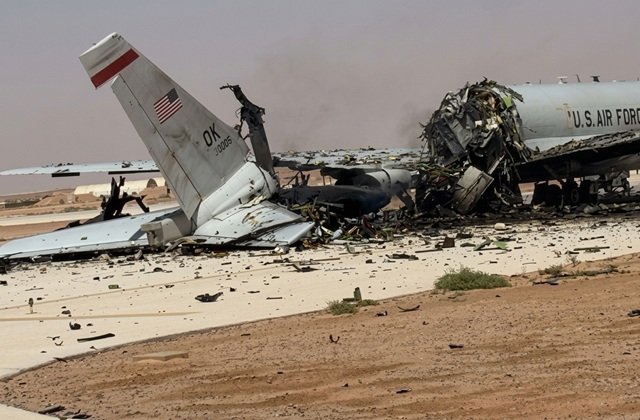
More recently, Trump seems determined to deploy troops onto Iran’s mainland to seize its enriched uranium. But Iran has a land area larger than that of Spain, France, and Germany combined. The troops from the 82nd Airborne and two Marine Expeditionary Units en route to the Gulf will number only around 7,000—and then too by mid-April. The United States does not have in the region anywhere near the number of ground combat forces required to wage war inside Iran. Even if Iran’s claim to have mobilized one million troops may be bravado, it can muster far more than the US would have available for an invasion. The US bases needed for surveillance and for strike and supply missions to support the invading American force have suffered extensive damage, perhaps to the tune of $800 million and counting.
No one knows when or how this war will end, but this much is certain: There was no clear and present danger that justified the death, destruction, and economic upheaval it has already caused.