


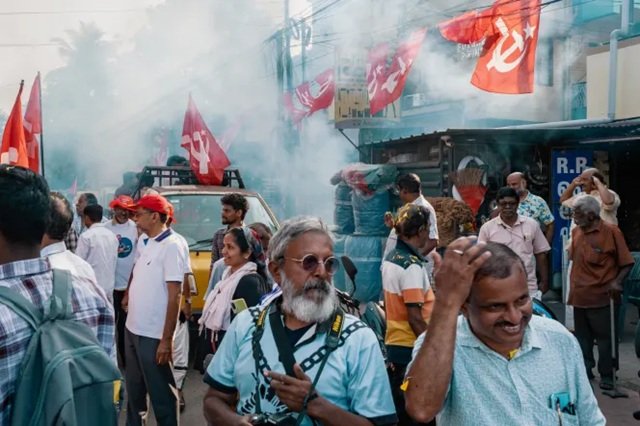
In the bustling streets of Thiruvananthapuram, still widely known as Trivandrum, red flags ripple through dense crowds as supporters chant slogans of continuity and triumph. Children in maroon berets bearing a single gold star — reminiscent of Che Guevara — weave through the throng, while fireworks crackle overhead. At the center of it all stands V. K. Prasanth, a candidate of the Communist Party of India (Marxist), declaring with confidence that the ruling left will secure a historic third term in power.
This vivid political theatre, captured and reported by The Sunday Times and The Times, reflects a state at a crossroads. Kerala, perched along India’s southwestern coast, has long defied economic orthodoxy, building a reputation as a “development miracle” under decades of communist influence. Now, as voters prepare to head to the polls, the question is whether that model still holds — and whether its boldest claim, the eradication of extreme poverty, stands up to scrutiny.
Just a few kilometres from the communist rally, another crowd gathers, this time for Priyanka Gandhi, a leading figure of the opposition United Democratic Front. The political contest is tight, with opinion polls showing a neck-and-neck race between the ruling Left Democratic Front and the Congress-led alliance. Meanwhile, the rise of Narendra Modi’s Bharatiya Janata Party threatens to reshape a state that has historically resisted Hindu nationalist politics.
Kerala’s political intensity is unmistakable. Residents describe a culture where political awareness begins early and permeates daily life. Street corners become debating grounds, and schoolchildren perform plays critiquing campaign narratives. “They’re living in politics,” said one teacher, reflecting a broader reality: in Kerala, ideology is not abstract but deeply embedded in society.
This political engagement is rooted in history. Kerala became the site of the world’s first democratically elected communist government in 1957, inspired in part by revolutionary movements such as the Bolshevik Revolution. Its unique demographic composition — with significant Muslim and Christian populations alongside Hindus — has also insulated it from the majoritarian politics seen elsewhere in India.
Over decades, this distinct trajectory has produced remarkable social outcomes. Kerala boasts a literacy rate exceeding 90 percent, a figure it has sustained for more than three decades. Its healthcare system is among the strongest in India, with infant mortality rates comparable to developed nations. Access to food, education, and basic services is widespread, contributing to a quality of life that far exceeds national averages.
The most striking claim came in late 2025, when the state government announced it had effectively eliminated extreme poverty. According to India’s multidimensional poverty index, just 0.5 percent of Kerala’s population falls into this category, a figure dramatically lower than elsewhere in the country. The achievement, if accurate, would mark a historic milestone in global development.
Central to this effort has been Kudumbashree, a vast women-led cooperative network with more than four million members. Working at the grassroots level, it identified tens of thousands of households in extreme poverty and implemented tailored interventions — from housing support to income generation schemes — designed to lift each family above the poverty line. The initiative has also fostered entrepreneurship, enabling women to launch micro-enterprises ranging from food production to small-scale manufacturing.
Economists have long debated Kerala’s success. Amartya Sen, the Nobel laureate, famously highlighted the state as an example of how investments in health and education can drive human development even in the absence of high income levels. In the 1970s, Kerala lagged behind much of India economically despite its strong social indicators.
Yet by the early 2000s, its fortunes had shifted. Income levels began to surpass the national average, driven in part by remittances from millions of Keralites working abroad, particularly in Gulf countries. Over time, migration patterns diversified, with increasing numbers heading to Western nations such as the UK, Canada, and Australia. These remittances transformed the economy, injecting capital into households and fueling consumption and investment.
The state also adapted ideologically. While rooted in socialist principles, Kerala’s communist leadership gradually embraced private investment and integration into the global economy. This pragmatic shift allowed it to maintain relevance in a rapidly changing economic landscape, blending welfare policies with market-oriented growth.
However, beneath the narrative of success lie significant challenges. Kerala’s public debt has surged dramatically over the past decade, rising to approximately 4 trillion rupees by 2026. Although the pace of increase has slowed, the scale of indebtedness remains a concern for economists and opposition parties alike.
Unemployment presents an even more pressing issue. The state has the highest graduate unemployment rate in India, at around 42 percent. For many young people, educational attainment has not translated into job opportunities, leading to frustration and, in some cases, tragedy. Reports indicate a disproportionately high number of suicides among unemployed youth, underscoring the human cost of the crisis.
These tensions are evident on the campaign trail. While some residents praise the government’s welfare programs and economic stability, others express disillusionment. Stories of families burdened by loans and unable to secure employment challenge the narrative of universal progress. For some lifelong supporters of the left, doubts are beginning to surface.
The opposition has seized on these vulnerabilities, criticizing the government’s fiscal management and questioning its poverty claims. Cultural performances at rallies, including traditional satirical dances, mock the ruling coalition’s economic record, blending humour with political critique.
At the same time, the BJP’s growing presence signals a shift in Kerala’s political landscape. Though historically marginal in the state, the party is making inroads, particularly among younger voters. Analysts suggest that changing aspirations, economic anxieties, and evolving social dynamics are contributing to this transformation.
Despite these pressures, Kerala remains a global outlier. Its ability to achieve high human development indicators with relatively modest resources continues to attract international attention. The model challenges conventional assumptions about the relationship between economic growth and social welfare, offering lessons — and raising questions — for policymakers worldwide.
As election day approaches, the stakes are high. A victory for the communists would reinforce Kerala’s status as a unique political experiment, while a shift in power could mark the beginning of a new chapter. Either way, the state’s experience serves as a reminder that development is rarely linear, and that even the most celebrated models must continually adapt to survive.
For now, amid the chants, rallies, and competing visions, Kerala stands as both a success story and a puzzle — a place where ideology, economics, and human aspiration intersect in ways that continue to captivate observers far beyond India’s borders.









