
Easter Sunday recalls an adversity that only a few still living can remember, when the Second World War came to the doorstep of Ceylon, present-day Sri Lanka. Eighty-four years have passed since that fateful April of 1942, when the Imperial Japanese Navy launched its Indian Ocean offensive, Operation C, striking at Britain’s vital sea lines of communication across the Bay of Bengal and bringing war decisively into the island’s skies and waters.
It was the moment Winston Churchill later described as the “most dangerous moment of the war,” when Vice Admiral Chuichi Nagumo’s powerful carrier strike force, the “Kidō Butai”, advanced toward Ceylon.
A supporting force under Vice Admiral Jisaburo Ozawa achieved considerable success in commerce raiding, sinking over 100,000 tons of Allied and neutral shipping in the Bay of Bengal. Yet it was Nagumo’s main force that delivered the decisive blows, sinking the aircraft carrier Hermes, the cruisers Cornwall and Dorsetshire, the destroyers Vampire and Tenedos, and several merchant and auxiliary vessels. Over 800 Allied personnel were killed, while Japanese losses remained remarkably light.
And yet, despite this tactical success, Japan failed in its primary objective: the destruction of the British Eastern Fleet. Forewarned and dispersed under James Somerville, the fleet avoided annihilation and survived as a “fleet-in-being,” preserving Allied presence in the Indian Ocean.
Forewarned, Yet Unprepared
The tragedy of April 1942 lies not in surprise, but in misjudgment. Signals intelligence had already indicated a Japanese carrier raid. Reconnaissance flights detected the approaching fleet. Radar installations, newly deployed at Colombo and Trincomalee, were operational. The island’s air defences had been hastily reinforced, expanding from a negligible baseline to over a hundred anti-aircraft guns, supported by Hurricanes, Fulmars, and Catalina reconnaissance aircraft.
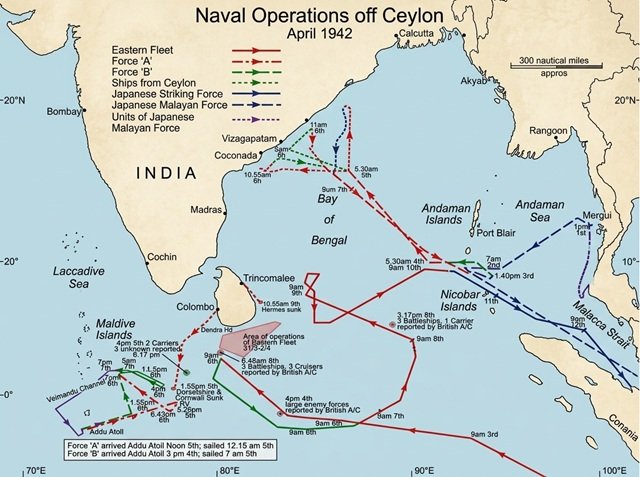
Yet these elements never fused into an effective defensive system. British planners underestimated the scale of the Japanese force. Intelligence suggested two carriers; in reality, Nagumo commanded five. This misreading shaped decisions at every level, from fleet deployment to air defence readiness.
Colombo: A Warning Unheeded
On 5 April, Easter Sunday, Japanese aircraft struck Colombo. Despite early warning, the defence system faltered. Radar failed to trigger an effective response, and reconnaissance aircraft misidentified incoming formations. Fighters scrambled too late, engaging the enemy only after the raid had begun.
The result was a fragmented and largely ineffective defence. Twenty-seven Allied aircraft were destroyed, while Japanese losses remained minimal. Harbour damage was limited, but the psychological impact was profound. Panic spread through Colombo, and civilians fled inland in large numbers.
More critically, the raid exposed systemic weaknesses, failures in coordination, communication, and command.
Cruisers Lost at Sea: Air Power Ascendant
The destruction of HMS Cornwall and HMS Dorsetshire on 5 April marked one of the clearest demonstrations of the new reality of naval warfare.
Detected by Japanese reconnaissance, the cruisers were struck by a concentrated dive-bomber attack launched by Nagumo. Despite evasive manoeuvres and heavy anti-aircraft fire, they were overwhelmed within minutes. Bomb hits were numerous and precise, leaving no opportunity for recovery.
The rapid loss of both ships, with 426 men killed, underscored a stark truth: without air cover, even fast and heavily armed warships were fatally vulnerable. Sea power had, decisively, become air power.
Trincomalee, Hermes, and a Fatal Misjudgment
The 9 April raid on Trincomalee followed a similar pattern: warning received, defence mounted, yet outcome unchanged. While the harbour itself escaped serious and lasting damage, events at sea proved catastrophic.
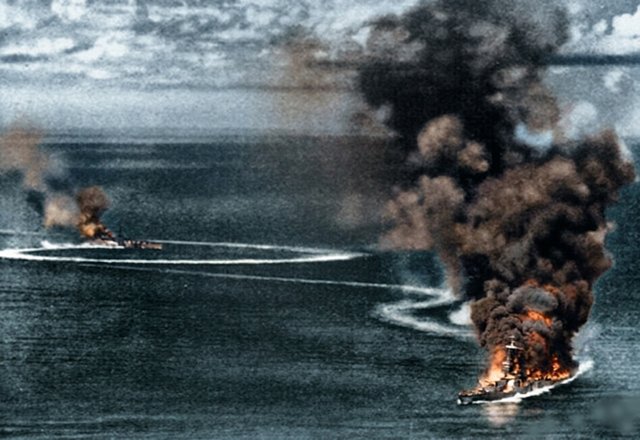
HMS Hermes, the world’s first purpose-built aircraft carrier, had been ordered to leave harbour and remain south of Trincomalee. However, this decision, though prudent in intent, proved flawed in execution. Rather than clearing decisively out of danger, Hermes was operating relatively close to shore, at reduced speed, and crucially without fighter protection.
From an operational perspective, this was a critical misjudgment.
Given her speed and endurance, Hermes could likely have escaped destruction if she had been ordered to proceed directly south at maximum speed, well clear of the search arcs flown by the Japanese that morning. Instead, she remained within a predictable sector, effectively placing herself in the path of enemy reconnaissance.
At approximately 0755, a Japanese floatplane from the battleship Haruna sighted Hermes. The consequence was immediate. Vice Admiral Chuichi Nagumo launched a large strike of dive bombers.
At 1050, the attack commenced. Without air cover and with limited anti-aircraft capability, Hermes stood little chance. Dive bombers attacked in rapid succession, scoring multiple direct hits. Within minutes, she was ablaze, listing heavily, and soon capsized and sank. HMAS Vampire, operating nearby, was similarly overwhelmed and destroyed. This was not merely a case of being caught at sea; it was, fundamentally, a case of being in the wrong place at the wrong time, under misjudged orders.
A Small but Historic Counterstroke
Amid these losses, there was one brief, often-overlooked moment of offensive action. Aircraft of No. 11 Squadron RAF, Bristol Blenheim bombers, located elements of the Kidō Butai and carried out a high-altitude attack. The bombing was ineffective and caused no damage.
Yet its significance lies elsewhere. For the first time in the war, Chuichi Nagumo’s carrier force, veteran of the Attack on Pearl Harbour, had itself come under air attack at sea. Though tactically insignificant, it marked a symbolic moment: the seemingly invulnerable Japanese carrier force had been found and challenged, however briefly.
A Pattern of Failure
Across Colombo and Trincomalee, a clear pattern emerged. The British were not blind, but they failed to act coherently on what they knew. Intelligence was available but not synthesised. Defensive assets existed but were not effectively integrated. Command was divided between sea and shore, leading to disjointed decisions.
Ships were dispersed without adequate protection. Air cover was misallocated or delayed. Opportunities to adopt a defensive stance were repeatedly lost.
In contrast, the Japanese demonstrated a high level of operational integration. Their ability to combine reconnaissance, timing, and concentrated striking power allowed them to dictate the course of battle, even when surprise was absent.
A Fleeting Triumph
Yet Operation C was ultimately a transient success. The same carrier force that dominated the waters off Ceylon in April 1942 would be shattered just two months later at the Battle of Midway. There, the balance of naval air power shifted decisively.
The Indian Ocean raid thus represents both the high-water mark of Japanese carrier warfare and the beginning of its decline.
For the British, the lessons were stark: unity of command, accurate intelligence assessment, and the integration of air and naval power were essential. Above all, the events underscored a fundamental truth of modern warfare: control of the sea depends on control of the air above it.
Postscript: The Search for HMAS Vampire
Among the losses of April 1942, HMAS Vampire remains a mystery to date. Of her crew of approximately 119, nine ultimately lost their lives, including her Commanding Officer, William Thomas Albers Moran. The wreck, wherever it lies, is a war grave, hallowed ground beneath the sea.
For over eight decades, its exact location has remained unknown. This is not for lack of effort or evidence. Survivor accounts, wartime records, and hydrographic surveys have all pointed to a likely area near the edge of the continental shelf, where the seabed drops steeply into deeper waters. A 2018 multi-beam survey even suggested a shape resembling the bow of a destroyer.
The challenge lies in the complexity of the terrain and the limitations of the technology at hand. Driven by both professional expertise and personal conviction, the author, himself a former senior naval diver and Commander of the Navy, has pursued this search with determination. With support from the Ministry of Defence, the Australian High Commission, and naval authorities, a joint survey was undertaken in July 2025 using side-scan sonar. The effort, conducted under moderate sea conditions, did not conclusively identify the wreck.
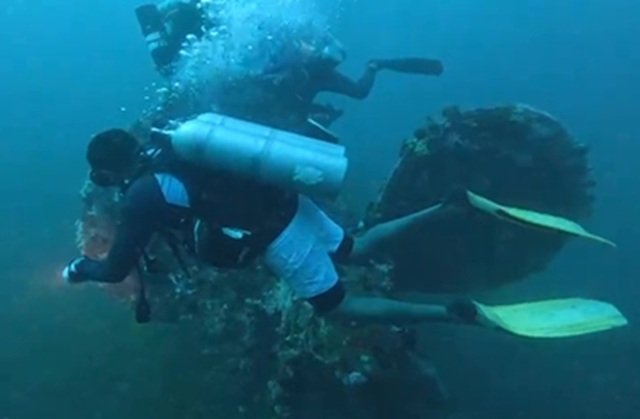
Yet the search is far from over. The weight of evidence continues to indicate a defined area along the continental slope. With improved technology and renewed effort, the mission will continue. The goal is not merely to solve a historical puzzle, but to honour those who served and to bring closure to a long-unfinished story.
When Vampire is finally found, it will not simply mark the end of a search. It will restore to history and to memory the final resting place of those who never returned.