


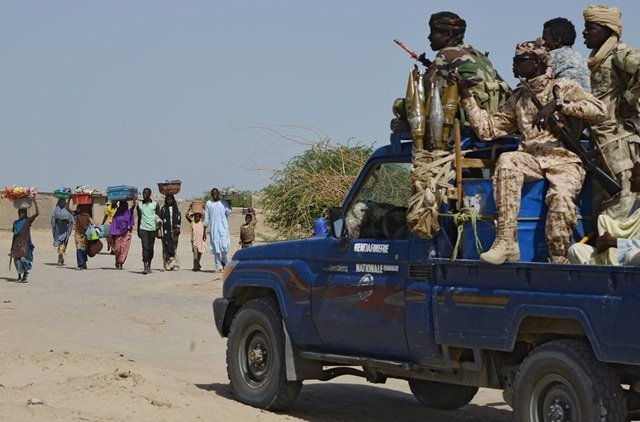
In Nigeria’s northeastern city of Maiduguri, a stark contradiction defines daily life: officials insist that the long-running war against Islamist insurgents is effectively over, while the surrounding region continues to experience deadly violence, displacement, and recurring attacks. A feature reported by Times UK paints a picture of a city caught between official optimism and a grinding conflict that refuses to end, where declarations of victory coexist with the realities of insecurity and fear.
The report opens with an unsettling portrait of surveillance and suspicion in Maiduguri, a city at the centre of Nigeria’s fight against Boko Haram and its offshoot Islamic State West Africa Province (ISWAP). The author describes being followed by a man later identified as an agent of Nigeria’s Department of State Services, the country’s domestic intelligence agency. The agent’s presence, at times almost comically conspicuous, reflects a deeper climate of caution and control surrounding foreign journalists reporting on security conditions in the region.
This atmosphere of scrutiny, the Times UK feature suggests, is not incidental but tied to Nigeria’s sensitivity over its international image at a time when global attention has once again turned toward the country’s internal security crisis. The report references political commentary from abroad, including claims from US President Donald Trump regarding violence in Nigeria, which have intensified diplomatic discomfort and placed additional pressure on officials to present a narrative of stability.
Within this context, the Nigerian government has projected confidence that the insurgency is largely contained. In Maiduguri, officials repeatedly assert that the conflict is under control, even “already won,” despite evidence of continued attacks across Borno State. The Times UK report highlights a statement from Nahum Kenneth Daso, a spokesman for the Borno State police, who argues that ongoing assaults are merely attempts by insurgents to maintain relevance. His remarks reflect a broader official position that downplays the operational strength of militant groups in the region.
However, the scale of violence described in the report complicates that assertion. According to figures cited in the feature, approximately 4,470 people were killed in the past year in attacks linked to Boko Haram and ISWAP, marking the highest annual death toll in a decade. These groups continue to control or contest territory across parts of Borno State and regularly conduct raids on villages and military installations. Far from being a post-conflict environment, the region remains one of active and persistent insurgency.
The Times UK article describes Maiduguri itself as a paradoxical space: heavily fortified and relatively calm compared with surrounding areas, yet still embedded within a wider warzone. On its streets, Chinese-built infrastructure, including roads, rail links, and solar projects, has contributed to a sense of normality in some districts. Children attend school again after years of disruption, and everyday commerce continues in markets that appear, on the surface, to function without fear. This fragile normality, however, masks the volatility beyond the city’s perimeter.
That volatility becomes tragically clear in accounts of repeated attacks on civilian areas. The report describes how, shortly after a visit to a local market, a suicide bombing carried out by a member of Boko Haram struck the same location, killing 23 people and injuring more than 100 in a series of coordinated blasts across Maiduguri. The incident underscores the persistent reach of insurgent networks and the unpredictability of violence even within areas considered relatively secure.
Against this backdrop, the government’s insistence on progress appears increasingly disconnected from the lived reality of residents. The Times UK feature highlights what it characterises as a pattern of “implausible denial,” not only in official statements about security but also in the broader political communication strategy surrounding governance in Nigeria. The report draws parallels with a separate public relations controversy involving Daniel Bwala, a special adviser to President Bola Ahmed Tinubu, whose widely criticised media appearance in London became emblematic of strained official messaging.
The article suggests that this tendency toward optimistic framing persists even in the face of ongoing casualties and displacement. Military bases continue to come under attack, soldiers are killed in ambushes, and humanitarian conditions remain fragile. At the same time, international actors, including diplomatic missions, have issued travel advisories reflecting worsening security conditions in parts of the country, reinforcing the gap between external assessments and domestic official narratives.
Yet the report also resists reducing the conflict to simple binaries of control and chaos. In interviews conducted at rehabilitation centres for former militants, the Times UK feature reveals a more complex picture of the insurgency’s human dimension. Former members of Boko Haram and ISWAP describe experiences shaped less by ideology than by coercion, poverty, and survival. Some recount being abducted as children and forcibly conscripted, while others admit joining armed groups in search of stability or basic resources.
These testimonies complicate conventional explanations of insurgency as purely ideological extremism. One former fighter, recently disengaged from militant activity, reportedly expressed ambivalence about life outside the conflict environment, stating that conditions within insurgent camps, despite their violence, had once felt more predictable than life in civilian rehabilitation. Such accounts highlight the cyclical nature of violence, where reintegration remains fragile and the risk of return to armed groups persists.









