


by Luxman
Peter Magyar has emerged as the most significant challenger to Hungary’s long-entrenched political order in more than a decade, positioning himself as the man capable of ending Viktor Orban’s 16-year grip on power. Once embedded within the ruling Fidesz political machine, Magyar now leads the opposition Tisza party with promises to confront corruption, restore institutional independence, and repair strained relations with the European Union. His rise has been as dramatic as it has been controversial, marked by personal scandal, political reinvention, and a rapid transformation from insider to insurgent.
The turning point in his public image came not from a policy speech or parliamentary confrontation, but from a scandal that threatened to derail his career entirely. A Hungarian website published a grainy image of an unmade double bed, accompanied by rumours that a compromising sex video involving Magyar, allegedly featuring drug use, would soon surface. The intent, widely perceived as political sabotage, was to damage the credibility of a man already gaining momentum against the prime minister. Magyar responded swiftly and publicly, declaring on Facebook: “Yes, I am a 45-year-old man, and I have a sex life,” while offering to undergo a drug test. The post went viral, viewed millions of times, and effectively neutralised the controversy before it could gain traction. The alleged video never appeared, but the episode marked a shift: instead of weakening him, the attempt to discredit Magyar appeared to strengthen his public profile.
Observers of Hungarian politics argue that his ability to survive and even benefit from the scandal revealed a core political instinct. Having grown up within Hungary’s political elite environment and spent years inside the Orban system, Magyar understood how narrative control shapes public perception. His rapid response ensured he defined the story before his opponents could, a tactic that analysts say reflects lessons learned from his years within Fidesz’s inner circles. His ability to convert crisis into momentum became a defining feature of his campaign.
Magyar’s political background is deeply intertwined with the system he now opposes. He rose through the ranks of Fidesz, held positions linked to state companies, and served in diplomatic roles in Brussels. An EU diplomat who worked with him described him as argumentative and combative in meetings, saying he could “hold meetings hostage” with persistent questioning and procedural resistance. At the same time, he was seen as a committed conservative, aligned with Fidesz’s anti-migration stance and traditional family values. This combination of ideological alignment and internal friction both propelled and constrained his early political career.
His personal life became increasingly entangled with his political trajectory. Magyar was once married to Judit Varga, a rising Fidesz politician who later became justice minister, a position that eclipsed his own career ambitions. The couple divorced in 2023, shortly before Varga stepped down amid a political scandal involving an alleged child abuse cover-up that also led to the resignation of Hungary’s president. During the fallout, Magyar initially defended both women but later sharply turned against the government, accusing Prime Minister Orban of political shielding and selective accountability. In a further escalation, he released a secretly recorded audio file in which Varga appeared to discuss internal government handling of a sensitive case, deepening the public controversy and cementing his break from the ruling elite.
Since then, Magyar has positioned himself as both a product of the system and its most credible critic. He has drawn on insider knowledge of government operations while building an opposition movement that recruits professionals from outside traditional politics. Candidates include doctors, academics, and public sector experts who present themselves as reformers capable of dismantling entrenched corruption. One Tisza candidate, a surgeon who has worked in the United Kingdom, described hopes of bringing British-style healthcare practices to Hungary under a potential Magyar-led government, reflecting the technocratic aspirations of the movement.
Despite his reformist messaging, Magyar’s political strategy has not abandoned nationalist rhetoric. On the campaign trail, he has occasionally echoed Orban-style themes, even comparing Hungary’s current political struggles to historical occupations, including the Ottoman Empire’s rule over the country centuries ago. At rallies, he has framed his campaign as a restoration of national sovereignty, arguing that Hungary must be “taken back brick by brick.” Yet on specific policy questions, particularly those involving Ukraine and European Union expansion, Magyar has been notably cautious. While he has pledged to restore stronger ties with Brussels, he has avoided taking firm positions on Ukraine’s EU membership or Hungary’s role in the ongoing conflict, areas where Orban’s government has taken a more defined and controversial stance.
This ambiguity has prompted skepticism among some European observers. One diplomat suggested that while Magyar’s rise has generated optimism among those hoping for change in Budapest, it remains unclear whether he has fully transitioned into a consistently progressive leader or is still calibrating his positions to maximise electoral advantage. Analysts note that his campaign focus remains heavily concentrated on domestic issues such as corruption, living standards, public services, education, and transport, where public dissatisfaction with the current government is most acute.
Supporters, however, see his insider background as a strength rather than a liability. A historian and commentator described Magyar as a catalyst who exposed long-known systemic issues from within, giving voice to frustrations that had previously remained fragmented and politically muted. His ability to speak both as a former insider and current critic has helped him connect with voters who are disillusioned but uncertain about alternatives.
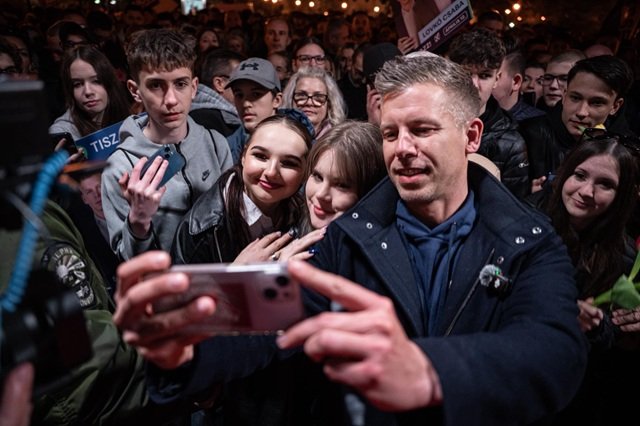
Magyar himself has acknowledged the intensity of his rapid political ascent and the personal toll it has taken. He has spoken of visiting hundreds of towns across Hungary, meeting large numbers of citizens, and attempting to reshape his public image through direct engagement. Yet his temperament remains a subject of scrutiny, with journalists and political observers noting moments of impatience and confrontation, particularly when challenged by critical questioning. Even his social media habits, including frequent comments on articles about him, reflect a highly engaged and sometimes combative communication style.










