by Our Correspondent in Colombo
Seven years after the Easter Sunday massacre, Sri Lanka is no closer to the truth—only deeper inside a carefully constructed theatre of distortion. What began as one of the most horrific terrorist attacks in the country’s modern history has since evolved into something far more insidious: a sustained manipulation of grief, faith, and public perception. Justice has not merely been delayed; it has been selectively redirected, strategically obscured, and, in some cases, deliberately sabotaged.
From the outset, the narrative was hijacked.
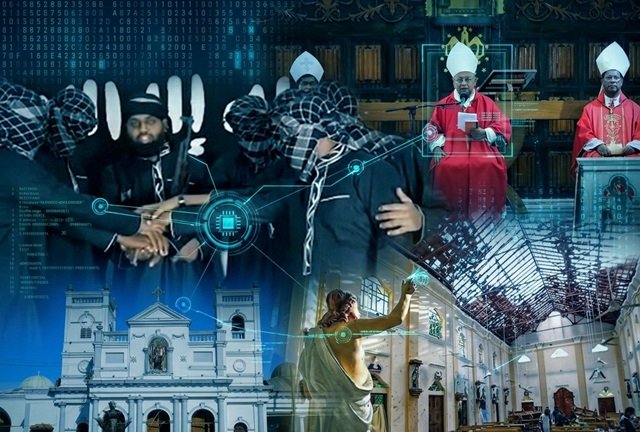
In the immediate aftermath of the April 21, 2019 attacks, when the country was still reeling from the brutality of coordinated suicide bombings led by Zahran Hashim and his extremist network, clarity was critical. Instead, confusion was injected. One of the earliest and most consequential interventions came from Cardinal Malcolm Ranjith, who publicly suggested that the attacks may have been part of a “Western conspiracy.” At a time when evidence-based investigation was essential, this claim did not enlighten—it distracted.
That moment marked the beginning of a dangerous shift.
Rather than supporting a unified, fact-driven pursuit of justice, sections of the Catholic Church began mobilising their own networks, interest groups, and media channels. The tragedy was no longer just a national wound—it became a political instrument. Mourning was slowly repackaged into mobilisation. Justice became rhetoric. And truth became negotiable.
This transformation did not happen in isolation. It unfolded alongside a growing body of evidence—both local and international—that pointed clearly towards Islamist extremism inspired by global jihadist networks. Investigations by Sri Lankan authorities, as well as international agencies, including detailed affidavits from the Federal Bureau of Investigation, laid out the operational, ideological, and financial links behind the attacks. The conclusions were not ambiguous.
And yet, they were not accepted.
Instead, alternative narratives continued to be amplified—less grounded in evidence, more aligned with political convenience. The question is not why these narratives exist; the question is who benefits from them.
Because while the Church leadership, led vocally by Cardinal Ranjith, continues to speak of justice and accountability, there remains a deafening silence on matters closer to home. Vast sums of money were received by Church institutions in the aftermath of the attacks—donations from across the world in solidarity with victims. But where is the transparency? Where are the audit reports? How much was actually distributed to victims’ families? How much was allocated to media campaigns, international advocacy, or foreign travel?
These are not peripheral questions. They are central to credibility.
One cannot demand accountability from the state while avoiding accountability within one’s own institution. Yet, this contradiction persists—unaddressed and unchallenged.
Meanwhile, the investigative process itself has taken troubling turns. The arrest of former intelligence chief Suresh Sally—a figure whose name did not appear in earlier investigative findings—raises serious concerns about the integrity of law enforcement actions. Taken into custody by the Criminal Investigation Department (CID) under controversial circumstances, authorities took more than 72 hours to justify the arrest. Initially, they claimed investigations were ongoing. Later, in court, a CID officer declared him the “third suspect” in the case.
Such inconsistencies are not procedural errors—they are symptoms of a system under pressure.
A system where justice risks becoming selective.
This selective application is further complicated by the role of individuals within the Church itself. Rohan de Silva, whose complaint reportedly triggered the arrest of the former intelligence chief, presented findings that conspicuously targeted specific individuals while omitting critical context. Notably absent was any mention of the ongoing defamation case filed by the same intelligence official against Father Cyril Gamini, who had publicly made unproven allegations. That case remains active, with legal proceedings still underway.
Selective outrage, it appears, is not limited to politics.
Even more revealing is the origin of Father Rohan de Silva’s complaint. It was based, in part, on a documentary aired by Channel 4—a production that itself featured Cardinal Ranjith and individuals now actively involved in overseeing ongoing investigations. The overlap is difficult to ignore. It raises a fundamental question: are these investigations genuinely independent, or are they being shaped by those who have already publicly committed to specific narratives?
The answer may lie in the rhetoric.
In a message issued ahead of the seventh anniversary of the attacks, Cardinal Ranjith warned that “agents of the devil” were actively obstructing investigations. He claimed that forces were working to divert inquiries and conceal the truth, hiding behind “a wall of political posturing.” It is a powerful statement—emotionally charged, morally absolute, and rhetorically effective.
But it also serves another function.
It pre-emptively delegitimises dissent.
When critics, investigators, or alternative perspectives can be framed as “agents of the devil,” the space for rational discourse collapses. Debate is replaced by moral condemnation. Complexity is reduced to binary opposition. And in that environment, truth becomes secondary to allegiance.
This is not justice. It is narrative control.
Beyond institutional and religious influence, the information landscape has been further polluted by a surge of unregulated digital voices. YouTubers and social media commentators—many operating without journalistic standards or accountability—have assumed the role of investigators, judges, and commentators. Their conclusions are often predetermined. Their sources are rarely transparent. And their motivations, while not always visible, are frequently aligned with broader narrative agendas.
The result is a fragmented public sphere where misinformation thrives.
Yet, beneath this noise, certain facts remain indisputable. The Easter attacks were not spontaneous. They were not mysterious. They were the result of a well-documented extremist network inspired by ISIS ideology. Intelligence warnings were issued—hundreds of them. Reports were filed. Names were known. Muslim officers within Sri Lanka’s intelligence services were among the first to raise alarms, motivated not by politics, but by a commitment to protect their country and their faith from distortion.
This was not a failure of intelligence.
It was a failure of action.
And it is precisely this failure that risks being buried beneath layers of manufactured controversy.
Seven years on, Sri Lanka is no longer searching for truth—it is choosing what to believe. It can continue down this path—where tragedy is exploited, narratives are weaponised, and truth is sacrificed for influence. Or it can confront the uncomfortable reality that justice requires more than speeches, more than symbolism, and certainly more than selective outrage.
It requires transparency—from the state, from institutions, and from those who claim moral authority.
It requires accountability—not just for those who carried out the attacks, but for those who failed to prevent them, and for those who continue to manipulate their aftermath.
Most importantly, it requires courage—the courage to reject convenient lies, to question powerful narratives, and to demand truth without compromise.
Because the greatest tragedy of Easter 2019 is no longer just what happened on that day.
It is what has been allowed to happen ever since.