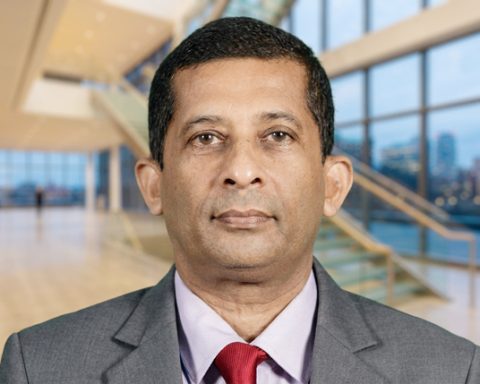
The ongoing controversy over Agriculture, Lands, Irrigation and Livestock Minister K.D. Lal Kantha’s three-storeyed luxury house has intensified pressure on the Janatha Vimukthi Peramuna (JVP)-led National People’s Power (NPP) government struggling to cope-up with the devastating coal scam, blamed on Energy Minister Kumara Jayakody forcing him to resign.
Jayakody, one of those who financed the NPP/JVP campaign in the run-up to the 2024 national polls ,resigned on 17 April, along with Prof. Udayanga Hemapala, Secretary to the Energy Ministry. Their resignations happened eight months after the Frontline Socialist Party (FSP), a breakaway faction of the JVP, revealed the alleged coal scam. The Lal Kantha affair received significant public attention though the primary issue at hand is the massive coal scam that ripped through the government.
Jayakody will continue as a National List member of the ruling party. The NPP/JVP won an unprecedented 159 seats, including 18 National List slots at the November 2024 parliamentary elections.
The Opposition dismissed government claims that the resignations were meant to facilitate the Presidential Commission of Inquiry into the procurement of coal, since the commissioning of the country’s only coal-fired power plant during the onset of Mahinda Rajapaksa’s second term. In the wake of the much delayed resignations, NPP/JVP heavyweight Foreign Minister Vijitha Herath, addressing the media at the Information Department, pathetically vouched for Jayakody’s integrity.
Let us discuss the accusations directed at Lal Kantha who had served the SLFP-led Cabinet for a short period, years ago, in terms of an agreement between the SLFP and the JVP. Lal Kantha had never been accused of corruption and was, in fact, one of those lawmakers who raised the issue both in and outside Parliament. Political parties may have forgotten that the UNP got rid of Lacille de Silva, Director General of Administration, Parliament, during Ranil Wickremesinghe’s premiership, in the 2001-2003 period, alleging he passed on information to Lal Kantha to attack the government.
The NPP Executive Committee member, as well as JVP politburo and Central Committee heavyweight, has publicly defended his right to own a luxury house amidst a section of the social media pushing for police investigation into the lawmaker’s wealth.
Unlike the owner/owners of the mysterious Malwana mansion, built on a 16-acre land overlooking the Kelani river, Lal Kantha didn’t try to disclaim the house ownership at Jusse Road, Welivita, in the Kaduwela area. The Malwana house was built towards the end of Mahinda Rajapaksa’s second term as the President. The hullabaloo over the ownership of the Malwana mansion, and construction costs, dominated the 2015 presidential election campaign. On the basis of the Malwana mansion, the UNP and the JVP built a strong case against the Rajapaksas, accusing the family of corruption.
It would be of pivotal importance that the JVP backed Maithripala Sirisena’s 2015 presidential polls candidature. The campaign was built on an anti-corruption platform that earned the appreciation of the public who disregarded the unprecedented development work successfully carried out by the Rajapaksas, while also fighting a war to defeat the most ruthless terrorist organisation that was out to break up the country.
During a US-India backed violent protest campaign, in March-July 2022, an organised gang set the stately Malwana mansion ablaze. The general consensus was that the Malwana mansion belonged to Basil Rajapakasa, though he vehemently denied having anything to do with it.
Yahapalana Justice Minister Dr. Wijeyadasa Rajapakshe, PC, is on record as having declared that the Malwana mansion would be renovated and used to accommodate a state institution. Lal Kantha’s newly acquired wealth has to be examined and discussed, taking into consideration his long standing claim that as a fulltime member of the JVP he entirely depended on his wife’s monthly salary and help provided by friends and associates. If that was the case, Lal Kantha couldn’t have ended up among the richest group of politicians, within less than two years after the last presidential election, held in September 2024.
Lal Kantha couldn’t have been unaware of the possibility of the Opposition, particularly the Sri Lanka Podujana Peramuna (SLPP), attacking him and the NPP/JVP over his Kaduwela house. Responding to critics, the Anuradhapura District lawmaker has claimed, on YouTube, that he sold a property he owned in Anuradhapura and used that money to acquire the Jusse Road land.
The outspoken Minister is also on record as having said that the existence of his new house, to which he moved in late 2024, was disclosed by him. However, incisive Youtuber Dharma Sri Kariyawasam has claimed that he made the revelation on 01 October, 2025, while another You-Tuber, Abeetha Edirisinghe, rammed up pressure on the NPP by lodging a complaint with the police, via the special number 1818. Edirisinghe’s SL Leaders YouTube posted a video of him lodging the complaint.
What made the complaint really interesting was Edirisinghe’s declaration based on ‘Dark Room’ YouTube allegations that wealthy businessman Nissanka Senadhipathi, who had been one of the closest associates of the Rajapaksas, provided the wherewithal required to acquire land, build and then furnish the Jusse Road mansion. Defending his position, Lal Kantha claimed that he acquired a piano for his daughter, about 15 years ago, while declaring he enjoyed the capacity to raise large sums of funds if necessary. A smiling Lal Kantha explained how he could effortlessly collect Rs 500,000 each from 100 associates/friends. Programmes posted by Dharma Sri Kariyawasam and Abeetha Edirisinghe are must-watch for those genuinely interested in knowing the explosive story, from different angles.
Close on the heels of debates on Lal Kantha’s mansion, the media reported the Minister’s last available asset declaration, sent to the Commission to Investigate Allegations of Bribery or Corruption (CIABOC), dealt with over Rs 80 mn worth of property, vehicles and gold, etc. The JVP heavyweight’s annual income has stunned even the staunchest supporters of the ruling party. Lal Kantha, through his lawyer, demanded Rs 10 bn in damages from ‘Hiru’ for wrongly estimating his properties, etc., at Rs 460 mn.
Both Dharma Sri Kariyawasam and AbeethaEdirisinghe propagated that police wanted the public to complain to special the number 1818, created to accept such complaints in case they felt suspicious about newly acquired property, regardless of who owned them.
Unexpected disclosure of Lal Kantha’s unprecedented wealth obviously stunned the public who genuinely believed in the unshakable NPP/JVP stand on corruption. Lal Kantha, who had joined the JVP in 1982, before becoming a full time member, in 1987, had no qualms in defending his new lifestyle, having repeatedly and bitterly complained about the difficulties experienced by him and his family.
In his defence, Lal Kantha emphasised that he hadn’t been accused of robbing the taxpayer or public sector corruption. However, the NPP/JVP all-out attack on all previous governments, over waste, corruption, irregularities and mismanagement, and branding all their MPs corrupt, cannot adopt such a stance. The Kaduwela mansion has sent shockwaves through the electorate. Dharma Sri Kariyawasam, in his response to Lal Kantha, repeatedly stressed that his wealth was being questioned by those who exercised their franchise in support of the NPP/JVP at the national elections and Local Government polls, in 2025.
Growing public resentment over what various interested parties, including the NPP/JVP called ill-gotten wealth of members and henchmen of previous governments fuelled Aragalaya (31 March-14 July 2022). Those who set houses and other property, belonging to various then government politicians and their associates ablaze, operated on the presumption that they were beneficiaries of ill-gotten wealth. The NPP/JVP powered the campaign, alongside the breakaway JVP faction, styled as Peratugami Pakshaya (Frontline Socialist Party) as well as the UNP.
Ranwala and others
Against the backdrop of Auditor General Samudrika Jayarathne’s devastating report on coal procurement for the 2025/2026 period and Lal Kantha’s declaration that he owned a three-storeyed house, the resignation of Asoka Ranwala, as the Speaker of Parliament, over his failure to prove his declared academic qualifications seemed uncalled for. Jayarathne signed that report on behalf of the National Audit Office (NAO).
The Gampaha District MP resigned on 13 December, 2024, just 22 days after being appointed the Speaker. The main Opposition Samagi Jana Balawegaya (SJB) relentlessly attacked Ranwala over his fabricated or unverified educational qualifications, specifically a Ph.D. from a Japanese university and a degree from the University of Moratuwa.
The NPP/JVP tried to defend Ranwala but quickly succumbed to SJB pressure. We never managed to establish whether Ranwala resigned on his own accord or the NPP/JVP asked him to resign to save the party. Similarly, the resignations of Energy Minister Jayakody and Prof. Hemapala, who cut a sorry figure before the Committee on Public Enterprises (COPE) recently, must have been demanded by the ruling party. Had the NPP bosses acted prudently, much earlier, after he was indicted before the Colombo High Court on a previous corruption case, they could have easily asked Jayakody to resign his ministerial portfolio before the Parliament debated the no-confidence motion against him.
Another case that really embarrassed the ruling party was accusations directed at Dr. Jagath Wickremeratne, who succeeded Ranwala as House Speaker. The Polonnaruwa District MP was the next to face fire, following a dispute with the Deputy Secretary General of Parliament Chaminda Kularatne who is also the Chief of Staff of the House. Kularatne hit back hard after Parliament sacked him over alleged irregularities. In a petition, dated 2 February, 2026, sent to CIABOC, Kularatne disclosed the circumstances the Speaker reacted angrily after he brought to the NPPer’s notice illegal actions and corruption, as well as his (Kularatne) recommendation in his capacity as the Right to Information (RTI) officer, to release certain information sought by civil society activists. Kularatne further claimed that the situation deteriorated further over an incident that happened on 18 June, 2025, or a date closer to that date, in the room where Speaker Wickremeratne had his lunch. Kularatne refrained from revealing the incident.
There hadn’t been a previous instance of a senior parliamentary official moving the CIABOC against the Speaker. The allegations directed at the Speaker, in respect of abuse of vehicles, taking two fuel allowances, misuse of equipment belonging to the Media Unit of Parliament, inadequate payment for lunch obtained for Chameera Gallage, Speaker’s private secretary, who had lunch with him, illegal payments made to retired Ministry Additional Secretary S.K. Liyanage, who was appointed to inquire into Kularatne’s conduct, suppression of release of information in terms of RTI, and uncalled for interventions in administration.
Kularatne’s complaint to the CIABOC failed to result in an expeditious inquiry, though a complaint lodged against a sacked parliamentary official appeared to have received much more attention. The NPP has responded cautiously to Kularatne vs Wickremeratne battle as pressure mounted on the ruling party over the coal scam that threatened to cause further increase in already unbearable electricity tariffs. The Auditor General’s report, in no uncertain terms, has implicated the Energy Ministry and Lanka Coal Company in the sordid operation that resulted in low-grade coal ending up at the Lakvijaya coal-fired power plant that earlier met about 30 to 40% percent of the country’s power requirements at essentially low cost, barring hydroelectricity.
The report declared that the term tender for the supply of coal was awarded to Trident Champhar, an Indian company that hadn’t been registered at the time it bid for Sri Lanka’s largest tender and procedures in respect of loading and unloading the cargo. To make matters worse, Minister Jayakody, who had been implicated in the coal scam, was recently indicted on corruption charges in the High Court of Colombo. There hadn’t been a previous instance of a sitting member of the Cabinet being indicted for corruption. Therefore, the NPP government cannot be happy over its steamroller majority in Parliament having defeated the no-confidence motion moved against Jayakody who remained confident in the parliamentary group’s support at the behest of the top party leadership.
The NPP/JVP finds itself in an extremely embarrassing and pitiful situation over the coal scam. The damning report issued by the Auditor General pertaining to the coal scam has to be examined taking into consideration the failure on the part of the government and the Constitutional Council to reach a consensus on filling the vacant Auditor General’s post in 2025. The post of Auditor General remained vacant from early April 2025 to early February 2026.
Role of NAO
The NAO functions as an independent body answerable to Parliament. The recent NAO report that dealt with coal procurement exposed the utterly corrupt system in place, regardless of assurances given by the government. The report proved that irregularities can be perpetrated and corrupt practices continued, regardless of assurances given by the current dispensation.
Over the past several years, tangible measures were taken to strengthen the NAO. Parliament certified the National Audit (Amendment) Act, No. 19 of 2025 on 22 September, 2025. That act introduced reforms meant to enhance public sector accountability, enforce audit findings, and streamline the surcharge process. The no nonsense report proved that in spite of interference and undue influence exerted on the NAO, those responsible did their job without fear or favour.
SJB lawmaker Mujibur Rahman, during the debate on the no-confidence motion against Minister Jayakody, alleged in Parliament that COPE (Committee on Public Enterprises) Chairman Dr. Nishantha Samaraweera directly intervened when the NAO was in the process of finalising the report. The former UNPer called for an investigation to establish whether the Galle District NPP MP visited the NAO on several days to meet those handling the investigation.
We are not aware whether the COPE Chief, who called for the NAO to inquire into allegations in respect of coal procurement, visited the NAO.
However, the NAO report on the coal scam, now available online for all to study, underscores the pivotal importance of the anti-corruption fight.
In September 2025, the SJB asked the CIABOC to probe how some NPP/JVP Ministers amassed so much property. The SJB raised the issue with the focus on Trade, Commerce, Food Security and Cooperative Development Minister Wasantha Samarasinghe (like Lal Kantha, he, too, represents the Anuradhapura District) amassed Rs 275 mn. The SJB’s complaint to CIABOC sought investigations on Ministers Sunil Handunetti, Bimal Rathnayake, Dr. Nalinda Jayathissa and Kumara Jayakody, and Deputy Minister Sunil Watagala.
Lal Kantha, who has now acknowledged having as much as Rs 80 mn worth property, was not among the lawmakers targeted by the SJB. Having falsely propagated an anti-corruption campaign to deceive the public, the NPP/JVP stand literally exposed before the public. The coal scam and Lal Kantha fiasco have caused irreparable damage to such an extent, their anti-corruption campaigns may not carry any weight with the public at future elections.