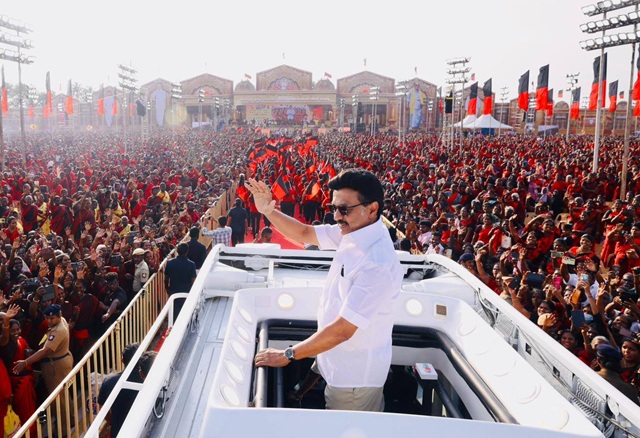
Tamil Nadu Chief Minister and DMK chief M.K. Stalin has cast the upcoming Assembly election as far more than a routine political contest, describing it as a defining confrontation between what he calls the “Tamil Nadu Team” and the “Delhi Team.” In an extensive interview with Frontline India, Stalin outlines a political landscape shaped by escalating Centre-State tensions, disputes over fiscal control, and what he terms a broader struggle to preserve federalism, social justice, and the Dravidian model of governance. The election, he suggests, is being fought not only at the ballot box but also in the institutional arena, where Tamil Nadu’s autonomy, resources, and political identity are at stake.
At the heart of Stalin’s critique is his allegation of “fiscal authoritarianism” by the Union government, which he claims has steadily weakened the State’s financial autonomy and constrained welfare delivery. He argues that funds due to Tamil Nadu have been withheld or reduced, impacting key development programmes and forcing the State government to compensate through its own revenue strategies. The DMK chief links this directly to broader concerns over federalism, pointing to disputes involving the Governor’s office and tensions around legislative authority. Recalling recent confrontations, including opposition to a proposed constitutional amendment tied to women’s reservation and delimitation, Stalin describes the Centre’s actions as an attempt to reshape India’s federal structure in a way that undermines southern States.
Delimitation, in particular, emerges as a central concern in Stalin’s political framing. He warns that constituency restructuring could disproportionately affect States like Tamil Nadu, which have achieved lower population growth and stronger development indicators. The issue, he suggests, is not merely technical but deeply political, with implications for representation and federal balance. Against this backdrop, Stalin highlights the role of opposition alliances in resisting what he views as central overreach, noting coordinated protests and symbolic acts of defiance. According to him, these developments reinforce the idea that Tamil Nadu’s political struggle extends beyond state boundaries into a national debate over democracy and institutional power.
Domestically, Stalin also addresses questions surrounding the cohesion of the Secular Progressive Alliance, led by the DMK. While reports have suggested friction during seat-sharing negotiations and dissatisfaction among some allies, Stalin dismisses the idea of internal instability. He insists that the alliance remains united by a shared objective: protecting Tamil Nadu’s rights and advancing what the DMK calls the Dravidian Model of governance. The entry of new partners, including the Desiya Murpokku Dravida Kazhagam (DMDK), has prompted debate over seat allocation, with critics questioning the strategic rationale behind granting them significant representation despite their weakened electoral standing. Stalin, however, frames these developments as a reflection of growing confidence in the ruling coalition, arguing that parties are joining an alliance they see as electorally dominant.
The DMK chief also defends the inclusion of politically sidelined leaders from rival factions, including figures formerly associated with the AIADMK such as O. Panneerselvam, Manoj Pandian, and Vaithilingam. Their participation under the DMK’s “Rising Sun” symbol, he suggests, reflects realignment within Tamil Nadu’s political landscape rather than opportunistic coalition-building. Stalin maintains that such integrations strengthen the alliance’s electoral reach and demonstrate its capacity to absorb diverse political voices under a shared governance framework.
Much of Stalin’s confidence rests on the government’s welfare record, which he presents as central to its electoral appeal, particularly among women and young voters. He cites monthly financial assistance schemes for women heads of households, free transport initiatives, school breakfast programmes, and higher education support schemes as transformative policies that have reshaped socio-economic conditions in the State. Youth-focused programmes, including skill development initiatives and large-scale distribution of laptops to students, are highlighted as investments in long-term human capital. Stalin argues that these measures have expanded the DMK’s support base significantly, particularly among women, whom he describes as the backbone of the party’s electoral strength.
Framing the election in ideological terms, Stalin reiterates his characterization of the contest as one between secularism and communalism. He insists that Tamil Nadu’s political culture remains resistant to religious majoritarianism, attributing this resilience to decades of Dravidian social reform movements. According to him, the struggle is not merely electoral but civilisational, with the State positioned as a barrier against what he describes as homogenising national narratives such as “One Nation, One Language” or “One Nation, One Culture.” He argues that Tamil Nadu’s political identity is rooted in pluralism and social justice, making it fundamentally incompatible with majoritarian governance models.
Stalin is sharply critical of the role of the Governor’s office in State politics, alleging that it has been transformed into a partisan extension of the ruling party at the Centre. He traces the erosion of constitutional neutrality to what he describes as a broader pattern of institutional capture, arguing that constitutional posts have increasingly been used for political ends. While acknowledging historical debates over federal authority, he asserts that the current situation represents an unprecedented escalation. In his view, restoring balance requires a reassertion of State autonomy within India’s federal structure, a position he aligns with longstanding Dravidian political thought.
On economic governance, Stalin rejects criticism that welfare spending undermines fiscal stability. Instead, he describes such spending as an investment in human development that drives long-term growth. He contrasts this with what he characterises as large-scale corporate debt waivers at the national level, arguing that public scrutiny is unevenly applied. Despite financial constraints, he claims Tamil Nadu has maintained strong economic performance, citing double-digit growth figures and ambitions to transform the State into a $1 trillion economy by 2030. This, he argues, demonstrates that welfare and growth are not contradictory but mutually reinforcing.
Addressing concerns about law and order and social justice, Stalin rejects claims of rising insecurity, particularly against women and marginalised communities. He argues that Tamil Nadu remains one of the safer States in India while acknowledging the need for continued vigilance and stronger enforcement mechanisms. Comparing national trends, he points to BJP-ruled States as examples of governance failures in maintaining communal harmony and women’s safety, reinforcing his argument that Tamil Nadu’s model prioritises stability and inclusion.
In concluding his assessment, Stalin situates the election within a broader national crisis of democratic institutions. He warns that the concentration of power at the Centre, combined with efforts to standardise language, culture, and governance, threatens India’s diversity and federal spirit. However, he expresses confidence that Tamil Nadu’s electorate will resist these pressures through the ballot. As he frames it in the interview with Frontline India, the outcome will not only determine the State’s political leadership but also signal whether India’s federal democratic structure can withstand what he describes as increasing centralisation.