Editorial
Alas, while a monk originally from Vietnam was walking for peace from Anuradhapura to Colombo—a journey we may not fully agree with, especially given how a private television channel known for narrative-building and political manipulation rather than balanced journalism has amplified and possibly distorted the event in line with broader government messaging—the country is simultaneously confronted with a far more disturbing revelation: the arrest of over 20 monks on allegations of drug trafficking. This marks one of the largest and most shocking cases in which individuals wearing monastic robes are implicated in what appears to be a highly organized and illicit criminal enterprise.
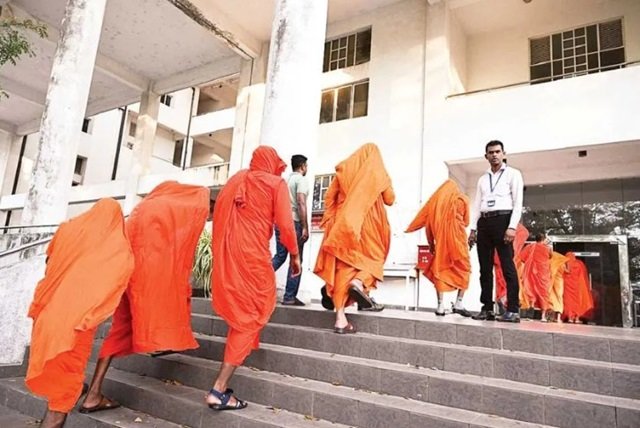
What is unfolding is not merely a scandal of individuals but a rupture in the moral architecture that many believed was untouchable. According to police narcotics investigations and widely reported findings, a group of individuals in monastic robes were detained at Katunayake Airport with a massive consignment of suspected narcotics, including kush and hashish valued at over 1.1 billion rupees. The scale alone is staggering, but what intensifies public shock is the alleged misuse of religious identity as a cover for international trafficking routes. The narrative emerging from the investigation suggests a coordinated operation involving travel to Thailand, structured concealment, and systematic distribution plans upon return to Sri Lanka.
The allegations further describe a disturbing pattern: younger monks reportedly recruited from remote temples under the guise of religious excursions, only to be exposed to environments far removed from spiritual discipline. Reports claim that during the Thailand stay, robes were abandoned temporarily, and participants engaged in activities that contradict the expected conduct of monastic life. Even more alarming are claims that unsuspecting individuals were allegedly used as carriers, instructed to transport sealed parcels described falsely as harmless items such as toiletries and gifts. The contrast between perceived sacred duty and alleged criminal manipulation is precisely what makes this case so socially explosive.
Yet to treat this as a sudden anomaly would be intellectually dishonest. It exposes a deeper structural vulnerability in religious institutions that have long operated with layered authority but limited financial and administrative transparency. The centralization of religious power in established chapters, particularly those historically rooted in Kandy, has often been viewed as a stabilizing force. However, critics argue that such centralization has also created opaque corridors of influence where accountability is uneven and oversight mechanisms are weak. When authority becomes concentrated in symbolic institutions rather than transparent systems, gaps inevitably emerge, and those gaps can be exploited.
The issue is not simply about a few arrested individuals; it is about how institutions respond when sanctity is allegedly used as camouflage. Family ties, caste-linked temple networks, and informal hierarchies within the monastic ecosystem have long shaped access, promotion, and movement. While these structures are often defended as cultural continuity, they also risk becoming parallel systems of privilege that resist scrutiny. In such an environment, financial flows within temples, donation handling, and external sponsorships can escape rigorous auditing, leaving room for misuse that remains hidden until a public rupture occurs.
What intensifies public frustration is the perception that warnings have existed for years but were never fully addressed. Voices from within the religious community have occasionally pointed to disciplinary decay, inconsistent enforcement of monastic codes, and the gradual erosion of Vinaya discipline. Yet these concerns were often absorbed into silence, overshadowed by institutional prestige and the assumption that the robe itself guarantees moral integrity. The current allegations shatter that assumption and force a confrontation with uncomfortable questions about how deeply governance failures may run.
Authorities, according to reports, have emphasized that this is one of the largest narcotics seizures linked to air transport in recent history, and the first involving such a large group allegedly associated with monastic identity. The police narrative suggests a structured operation rather than isolated misconduct, raising the possibility of broader networks that extend beyond national borders. If proven, this would not only represent a criminal enterprise but also a profound exploitation of societal trust in religious figures.
At the same time, religious leadership bodies have reacted with strong condemnation, calling for the immediate removal and legal punishment of individuals impersonating or misusing monastic status. Senior ecclesiastical authorities have stressed that such acts damage the global reputation of Buddhist institutions and undermine the historical role of monks as moral guides. Their statements also emphasize the need for stricter mechanisms to expel offenders from the religious order and to reinforce disciplinary frameworks rooted in traditional doctrine. Yet statements alone cannot resolve what appears to be a systemic governance crisis.
The deeper tension now emerging is between spiritual symbolism and institutional reality. The Buddhist robe, revered by millions, carries an expectation of restraint, discipline, and detachment from material corruption. When that symbol is allegedly linked to global drug trafficking routes, the psychological shock is immense. It forces society to question whether reverence has been mistaken for immunity, and whether spiritual authority has been left insufficiently protected from criminal infiltration.
The scandal forces a broader reckoning with institutional design. Without transparent financial oversight, independent auditing of temple resources, and depersonalized governance structures that reduce reliance on informal hierarchies, the system remains vulnerable. Without separating spiritual authority from administrative opacity, and without addressing the deep entanglement of local power networks that operate beyond scrutiny, such crises risk repeating. The challenge is not to dismantle religious tradition, but to confront how its institutional frameworks may have drifted into zones where accountability is no longer clearly defined, and where trust becomes the easiest currency to exploit.