


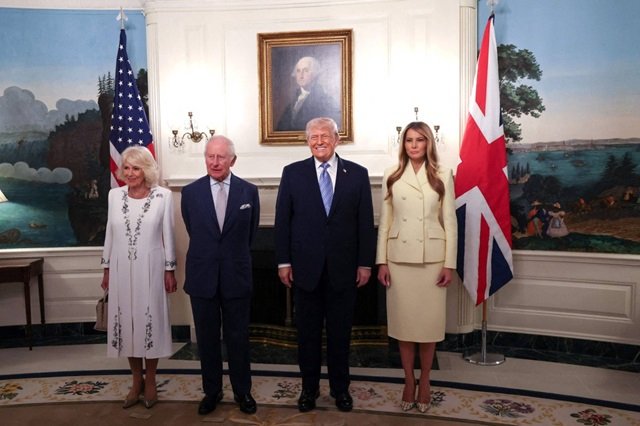
Britain’s King Charles and Queen Camilla have begun a closely watched four-day state visit to the United States, landing in Washington on Monday for what is already shaping up to be one of the most politically charged royal trips in decades. The visit, the most consequential of Charles’ reign so far, comes at a symbolic moment marking 250 years since the U.S. Declaration of Independence, but it unfolds against a backdrop of diplomatic strain over the ongoing Iran war and shifting transatlantic priorities.
The royal couple was received at Joint Base Andrews in a brief arrival ceremony before proceeding to the White House, where they were greeted by U.S. President Donald Trump and First Lady Melania Trump. The encounter carried its familiar blend of ceremony and personal warmth: handshakes, cheek kisses, and a short private tea session that underscored Trump’s well-known admiration for the monarchy, even as his administration’s foreign policy has diverged sharply from the British government led by Prime Minister Keir Starmer.
Despite the cordial optics, the visit is unfolding under a cloud of geopolitical tension. Trump has publicly expressed frustration with London’s response to the U.S.-Israeli military campaign against Iran, a conflict that has become a defining fault line in Western alliances. British officials have stopped short of endorsing the offensive, a position that has reportedly irritated Washington and fueled speculation about broader strains in the so-called “special relationship.”
For King Charles, the trip is both ceremonial and strategic. Buckingham Palace has framed it as a celebration of shared history and democratic values, but behind the pageantry lies a delicate diplomatic balancing act. The monarchy remains formally apolitical, yet royal visits often serve as soft-power instruments, reinforcing alliances at moments when governments are at odds. This visit is no exception.
Later on Monday, Charles and Camilla attended a garden reception at the British ambassador’s residence in Washington, where they were greeted by a mix of political figures, diplomats, and media executives. The event featured performances of both national anthems, a symbolic reminder of the intertwined identities and long, sometimes turbulent history between the two nations.
The itinerary for the week is tightly packed with high-profile engagements. On Tuesday, King Charles is scheduled to address the U.S. Congress in a speech expected to last around 20 minutes. According to palace sources cited in reporting by Bloomberg, the address will emphasize unity, shared democratic values, and the enduring partnership between the two countries. While the speech has been drafted on the advice of the British government, much of its tone and phrasing reportedly reflects the King’s personal views, including a message that Britain and the United States have repeatedly overcome differences over the past two and a half centuries.
The address will also frame the alliance as a stabilizing force in global affairs, with Charles expected to describe it as “one of the greatest alliances in human history.” The message is carefully calibrated at a moment when policymakers in both capitals are grappling with uncertainty over the Iran conflict and its wider geopolitical consequences.
The political sensitivity surrounding the visit has been heightened by recent tensions between Washington and London. President Trump, while personally friendly toward the royal family and known to refer to Charles as a “great man,” has grown increasingly critical of the British government’s stance on the Iran war. According to officials familiar with internal discussions, there has even been quiet consideration within parts of the U.S. defense establishment about reviewing Britain’s position on issues such as the Falkland Islands dispute, signaling how quickly diplomatic disagreements are spilling into broader strategic calculations.
Prime Minister Starmer, meanwhile, is believed to view the visit as an opportunity to stabilize relations and reaffirm the importance of the transatlantic alliance at a time of mounting geopolitical fragmentation. For London, the stakes extend beyond symbolism: trade cooperation, intelligence sharing, and defense coordination all sit within a relationship that officials privately acknowledge is under more strain than at any point since the Suez Crisis in 1956.
The royal schedule also includes a state dinner at the White House, expected to be a highly choreographed display of diplomatic unity despite underlying disagreements. On Wednesday, the King and Queen will travel to New York City, where they are expected to participate in commemorations for victims of the September 11, 2001 attacks ahead of the 25th anniversary. The visit is intended to reinforce the shared security narrative that has long underpinned U.S.-UK relations, particularly in the post-9/11 era.
The final leg of the trip will take the couple to Virginia, where King Charles will focus on environmental initiatives, including meetings with conservation groups. This aspect of the visit reflects a consistent theme of his public life: a decades-long commitment to environmental issues, which he is expected to highlight as a non-political area of global cooperation.
Yet even as ceremonial events proceed, broader diplomatic undercurrents are difficult to ignore. Analysts note that the Iran conflict has accelerated existing tensions within Western alliances, exposing differences over military intervention, regional strategy, and energy security. Against this backdrop, royal diplomacy functions less as a tool of policy alignment and more as a stabilizing ritual, attempting to maintain continuity where governments are increasingly divided.
The visit is also taking place in a politically sensitive domestic environment in Washington, following a recent security incident involving the White House Correspondents’ Association dinner, which has left parts of the capital on heightened alert. Security concerns have added another layer of caution to an already tightly managed itinerary.
Beyond foreign policy, the monarchy is also working to avoid domestic controversies from overshadowing the trip. The long-running scandal involving Prince Andrew continues to cast a shadow over the royal household, though officials have made clear that it will not feature in any public engagements during the visit. Andrew’s connections to the late Jeffrey Epstein remain a source of scrutiny, but palace aides are determined to keep the focus on diplomacy rather than internal royal disputes.










