The global race to dominate artificial intelligence has entered a decisive new phase, not in a laboratory or boardroom, but inside a courtroom in Oakland, California. As reported by Die Ziet, the legal battle between Elon Musk and OpenAI chief Sam Altman is rapidly becoming one of the most consequential tech trials in recent history, with implications that stretch far beyond personal rivalry. At stake are billions of dollars, the governance of one of the world’s most powerful AI companies, and the broader question of whether transformative technologies should be guided by public good or private profit.
The spectacle inside the courtroom reflects the magnitude of the conflict. Elon Musk, widely known for his commanding presence in business and technology, appeared in a rare position of vulnerability as he faced intense questioning under oath. Dressed in a black suit and tie, he was repeatedly instructed by the judge to answer questions directly, a striking contrast to his usual role as an industry leader setting the agenda. At one point, visibly frustrated, Musk insisted that OpenAI had been “stolen,” framing his lawsuit as an effort to reclaim the organization’s original mission.
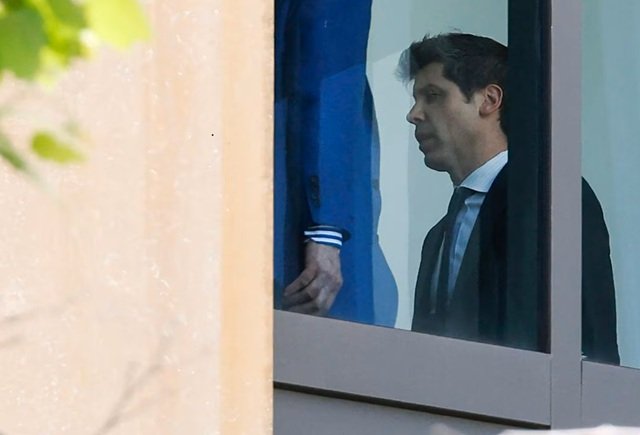
Just a short distance away sat Sam Altman, composed and attentive, observing the man who was once his ally. The two figures, who co-founded OpenAI in 2015 with the ambition of building artificial intelligence for the benefit of humanity, now find themselves on opposing sides of a legal battle that could reshape the technology landscape.
Musk’s lawsuit seeks an extraordinary $134 billion in damages. He accuses Altman and other OpenAI leaders of violating the founding agreement by converting the organization from a nonprofit entity into a profit-driven enterprise. According to Musk, this shift represents a betrayal not only of contractual obligations but of a broader ethical commitment to ensure that advanced AI serves humanity rather than corporate interests.
OpenAI’s legal team has rejected these claims, arguing that Musk’s motivations are far from altruistic. They portray him as a competitor seeking to undermine a rival, pointing to his own artificial intelligence venture, xAI, as evidence of conflicting interests. In their view, the lawsuit is less about preserving ideals and more about gaining a strategic advantage in an increasingly competitive market.
The significance of the case extends well beyond the individuals involved. OpenAI has become a central player in the global AI boom, particularly following the release of ChatGPT in 2022, which brought generative AI into mainstream use. The company’s partnerships, including major investments from Microsoft, have tied it closely to the broader technology ecosystem. Any disruption to OpenAI’s operations could therefore ripple across industries and financial markets that are increasingly dependent on AI-driven innovation.
The roots of the dispute lie in the early days of OpenAI. Founded as a nonprofit, the organization was intended to operate differently from traditional tech companies, prioritizing safety and public benefit over profit. However, as the costs of developing advanced AI systems grew, the founders faced a difficult reality. Building and maintaining the necessary infrastructure—powerful computing systems, specialized chips, and vast data centers—required resources on a scale that nonprofit funding alone could not sustain.
Tensions emerged over how to address this challenge. In 2017, Musk proposed integrating OpenAI into Tesla as a means of securing funding and scaling its capabilities. The idea was ultimately rejected, leading to a power struggle that resulted in Musk’s departure from the organization in 2018. In the years that followed, OpenAI restructured itself, creating a for-profit subsidiary to attract investment while maintaining a nonprofit parent organization.
This hybrid structure has become a central issue in the trial. Musk argues that it effectively undermines the nonprofit’s control, allowing profit motives to dominate decision-making. OpenAI, meanwhile, maintains that the structure was necessary to achieve its goals and remain competitive in a field dominated by well-funded corporate rivals.
Court proceedings have provided a rare glimpse into the inner workings of one of the world’s most influential technology organizations. Lawyers from both sides have presented emails and internal documents that reveal candid discussions about strategy, finances, and ambitions. Some of these communications suggest that key figures within OpenAI were aware of the potential for significant financial gain, complicating claims that the organization’s mission remained purely altruistic.
The cross-examination of Musk has been a focal point of the trial. OpenAI’s attorneys have sought to highlight inconsistencies in his statements and challenge his credibility, portraying him as driven by financial interests despite his claims to the contrary. Musk has pushed back forcefully, accusing the lawyers of attempting to trap him with misleading questions. At times, the exchanges have grown tense, reflecting the high stakes and personal nature of the dispute.
Additional controversies have surfaced during the proceedings, including questions about Musk’s alleged ketamine use during key moments in OpenAI’s history. While Musk denied any knowledge of specific substances, the line of questioning underscores the aggressive tactics employed by both sides in their efforts to sway the court.
Beyond the personal drama, the case raises broader questions about the future of artificial intelligence. If Musk succeeds, the ruling could limit the ability of organizations to transition from nonprofit to profit-driven models, potentially reshaping how emerging technologies are developed and funded. Such a decision could also complicate OpenAI’s plans for a public offering, which is widely seen as crucial for securing the capital needed to continue its rapid growth.
On the other hand, a victory for OpenAI would reinforce the idea that flexibility is essential in an industry where innovation requires enormous investment. It would allow the company to move forward with its expansion and maintain its position at the forefront of AI development, even as competitors like Anthropic and Google intensify the race.
Observers suggest that Musk may have less to lose in the outcome. Even if he does not prevail, the trial itself imposes significant costs on OpenAI, diverting attention and resources at a critical moment. The negative publicity could also affect the company’s reputation as it seeks to attract investors and navigate an increasingly competitive environment.
As the trial continues, attention is expected to turn to testimony from Altman and other senior figures, including Greg Brockman. Their accounts will likely play a crucial role in determining how the court interprets the events that led to this high-stakes confrontation. A verdict is anticipated in mid-May, but the broader impact of the case will likely be felt for years to come.
In the end, the courtroom battle between Musk and Altman is about more than a single company or dispute. It reflects a deeper struggle over the direction of technological progress and the values that will shape it. As artificial intelligence becomes ever more central to the global economy, the outcome of this case may help define who controls the future—and for whose benefit it is built.