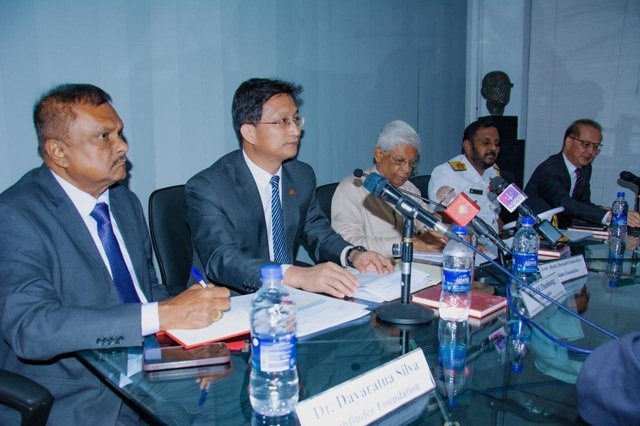
The “Colombo Maritime Dialogue” convened yesterday (13 May) in Peliyagoda, bringing together diplomats, policy experts, and maritime scholars from across Asia to discuss evolving security and development dynamics in the Indian Ocean Region. The event was organized by the Pathfinder Foundation, which has increasingly positioned itself as a platform for regional strategic dialogue. Delegations and participants from China, India, Singapore, Pakistan (participating online), and Bangladesh attended, reflecting the widening regional footprint of maritime policy discussions centered on the Indian Ocean.
The dialogue opened with remarks from Bernard Goonetilleke, Chairman of the Pathfinder Foundation, alongside Prof. Yan Shijing, Vice Chairman of the Council and former Vice President of Sichuan University. The presence of academic and policy voices highlighted the event’s attempt to blend strategic analysis with academic diplomacy. The forum also featured participation from Embassy of China in Sri Lanka, represented by Ambassador Qi Zhenhong, who delivered remarks emphasizing maritime cooperation and regional partnership as central pillars of future engagement in the Indian Ocean.
The theme of the dialogue—“Fostering Win-Win Cooperation in the Indian Ocean Region through Enhanced Mutual Understanding, Development-Oriented Collaboration, the Integration of Security and Development, and the Diversification of Discourse”—set the tone for discussions that sought to balance security concerns with economic and developmental priorities. The framing reflected a growing trend in regional diplomacy where maritime space is increasingly viewed not only through a security lens but also as an arena for infrastructure development, trade connectivity, and resource management.
Ambassador Qi Zhenhong underscored the importance of sustained maritime cooperation, describing the dialogue as a valuable opportunity to engage with what he called “old and new friends” in Sri Lanka. Referring to the island nation as the “Pearl of the Indian Ocean,” he highlighted its longstanding strategic position along key global shipping routes. He expressed confidence that exchanges among experts would strengthen cooperation between China and Sri Lanka and contribute to what he described as the sustainable development of the Indian Ocean Region.
The Ambassador further emphasized that maritime space has historically functioned as a conduit for trade, cultural exchange, and economic interdependence. He noted Sri Lanka’s geographic positioning as a critical node in East–West maritime connectivity, reinforcing its relevance in contemporary shipping and logistics networks. In his remarks, he acknowledged that maritime cooperation is increasingly intertwined with economic growth and public welfare outcomes, suggesting that ocean governance now plays a central role in national development strategies across the region.
A significant portion of his address focused on existing and expanding bilateral cooperation between China and Sri Lanka, particularly in port infrastructure, shipping logistics, marine economic initiatives, and disaster mitigation systems. He also referenced ongoing scientific collaboration in marine research, portraying it as part of a broader effort to deepen technical and institutional ties. These developments, he suggested, reflect a steady expansion of maritime engagement that integrates economic investment with capacity building initiatives.
The Ambassador also referred to high-level political engagement, noting discussions during a recent visit by Anura Kumara Dissanayake to China in 2025, where both sides reportedly agreed to strengthen maritime cooperation under principles of mutual trust, equality, and shared benefit. Planned areas of collaboration reportedly include marine environmental protection, maritime domain awareness, search and rescue operations, disaster relief coordination, and broader technical capacity development. These initiatives were framed as part of a long-term partnership aimed at strengthening resilience and economic integration in the maritime domain.
At the same time, Ambassador Qi emphasized a broader geopolitical message, stating that the Indian Ocean should not become “an arena for major-power contest,” but rather a space for cooperation and shared development. This remark reflects ongoing strategic sensitivities in the Indo-Pacific, where maritime routes and island states are increasingly central to global power competition. His comments implicitly called for restraint and dialogue-based approaches to regional governance, positioning maritime cooperation as a stabilizing force amid competing geopolitical interests.
The Colombo Maritime Dialogue thus served as both a technical forum and a platform for strategic signaling. While discussions centered on sustainable maritime development and regional cooperation, the presence of multiple regional stakeholders underscored the complex interplay of economic ambition and geopolitical positioning in the Indian Ocean. For Sri Lanka, which continues to navigate its role between major regional powers while managing domestic development priorities, such engagements highlight both opportunity and strategic exposure.