Chinese President Xi Jinping’s decision to invoke the “Thucydides Trap” during a major summit with the United States in Beijing was far more than a passing historical reference. It was a carefully calculated geopolitical message aimed at Washington and the wider world, signaling both China’s desire to avoid open conflict and its increasing belief that the balance of global power is tilting in Beijing’s favor.
The phrase, rooted in the writings of the ancient Greek historian Thucydides, refers to the danger that arises when a rising power threatens to displace an established hegemon. In Thucydides’ account of the Peloponnesian War, the rise of Athens generated fear in Sparta, ultimately pushing Sparta toward war before Athenian power became unstoppable. In modern geopolitical thought, the concept has become shorthand for the structural tensions that can lead to confrontation between a dominant superpower and an ascending rival.
The theory gained widespread prominence through political scientist Graham Allison, whose influential book explored whether the United States and China could avoid falling into this historical pattern. By reviving the concept during talks with American leaders, Xi placed the current U.S.-China rivalry directly within one of the most consequential frameworks in international relations.
According to political analysis published by the Spanish newspaper El País, Xi’s use of the reference carried several layers of meaning. On the surface, the message was conciliatory. Beijing sought to emphasize stability, strategic balance, and the avoidance of direct confrontation between the world’s two largest powers. Chinese officials have repeatedly framed bilateral relations in terms of maintaining “constructive strategic stability,” language intended to reassure markets, allies, and investors amid intensifying competition.
For China, stability remains economically advantageous. Avoiding a major geopolitical rupture allows Beijing to continue narrowing the gap with the United States while sustaining trade, manufacturing expansion, and technological development. It also reinforces China’s preferred international image as a responsible global actor committed to preserving order rather than destabilizing it.
The timing of Xi’s comments was particularly significant because they came during a period of growing turbulence in global politics and uncertainty inside the United States. Former President Donald Trump, once again central to American political life ahead of upcoming elections, also has reasons to avoid a disruptive confrontation with China. Economic instability or a severe geopolitical crisis could carry heavy domestic political costs in an election year. That mutual interest in short-term stability partly explains why the summit produced a relatively measured tone despite mounting strategic rivalry.
Yet El País argues that Xi’s reference to the “Thucydides Trap” carried a deeper and more assertive message beneath the diplomatic language. On the same day he invoked the ancient Greek analogy, Xi also delivered a clear warning regarding Taiwan, cautioning that mishandling the issue could push the two superpowers into direct conflict. While Beijing has consistently defended its claim over Taiwan, the wording this time was reportedly more explicit and forceful than in previous statements.
That sharper tone reflects a broader transformation in China’s strategic self-confidence. Beijing increasingly views the United States not as an unchallengeable hegemon but as a declining power weakened by political polarization, erratic leadership, and military overextension. Chinese officials and state media frequently portray the West as entering a period of decline while the East rises economically and politically. In Xi’s rhetoric, these geographic references often function as indirect symbols for the United States and China themselves — modern Sparta and Athens.
From Beijing’s perspective, recent global developments appear to reinforce that narrative. China believes it successfully weathered Washington’s trade pressure campaigns while strengthening ties with countries across Asia, Africa, Latin America, and the Middle East. The continuing instability surrounding key global shipping routes and energy corridors, including tensions near the Strait of Hormuz, has also highlighted China’s resilience and its growing role within electrified global supply chains where Chinese manufacturing dominates many critical industries.
Meanwhile, the United States is increasingly portrayed by Chinese analysts as strategically exhausted, draining military resources abroad while struggling to maintain its influence. In this interpretation, China’s rise is no longer hypothetical. It is already underway.
That does not mean Beijing sees itself as invulnerable. China continues to face serious domestic problems, including demographic decline, economic weaknesses tied to consumption and debt, and an opaque military purge that has removed senior officials from the armed forces. Though little is publicly understood about the internal political dynamics behind those purges, they suggest tensions and instability within parts of the Chinese system itself.
Even so, Chinese leaders appear convinced that the long-term strategic balance favors Beijing. El País noted that Chinese policymakers increasingly believe time is working in their favor. Maintaining stability with Washington benefits China more than it benefits the United States because it grants Beijing additional space to expand its economic and geopolitical influence while America grapples with internal divisions and international fatigue.
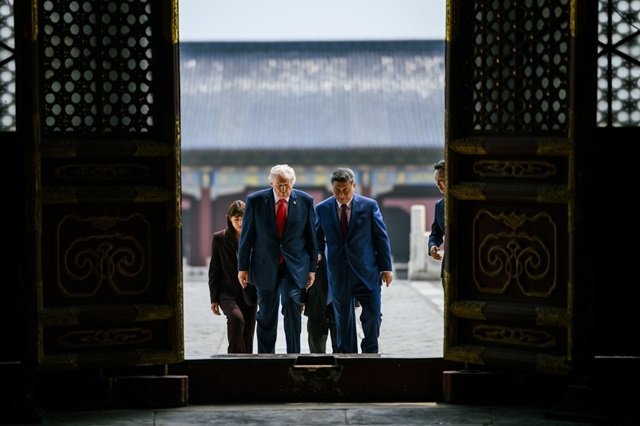
The symbolism surrounding the Beijing summit itself also reflected these shifting dynamics. Chinese officials reportedly treated Trump warmly and ceremonially, aware that displays of grandeur and diplomatic prestige resonate strongly with the American leader’s political style. Yet some analysts observed subtle indications that Beijing no longer feels compelled to flatter Washington from a position of inferiority.
One widely discussed detail involved the reception protocol at the airport. Trump was greeted by China’s vice president, a senior official but not a member of the powerful Politburo Standing Committee that effectively governs the Chinese Communist Party. El País contrasted this with the reception given to Barack Obama in 2009, when the Chinese vice president welcoming him was himself a Standing Committee member: Xi Jinping.
The comparison carried symbolic weight. At that time, China was still widely viewed as the rising but secondary power seeking accommodation with the United States. Today, Beijing increasingly acts as though it believes parity has already been achieved — or perhaps surpassed in some areas.
That evolution is visible most clearly in China’s position on Taiwan. Beijing continues to insist that reunification is inevitable and has become increasingly willing to demonstrate military and diplomatic resolve on the issue. The firmness surrounding Taiwan suggests that while China still prefers to avoid open conflict with the United States, it no longer sees compromise as necessary to secure recognition or legitimacy.
The underlying message of Xi’s historical reference therefore appears deeply strategic. China does not want war with the United States, but it increasingly believes it can compete without fear. In the language of Thucydides, Athens no longer feels weaker than Sparta.
Whether the two powers can ultimately escape the trap that Xi invoked remains uncertain. But the fact that China’s leader chose to frame the relationship in those terms at such a sensitive geopolitical moment signals how profoundly the global order may already be changing.