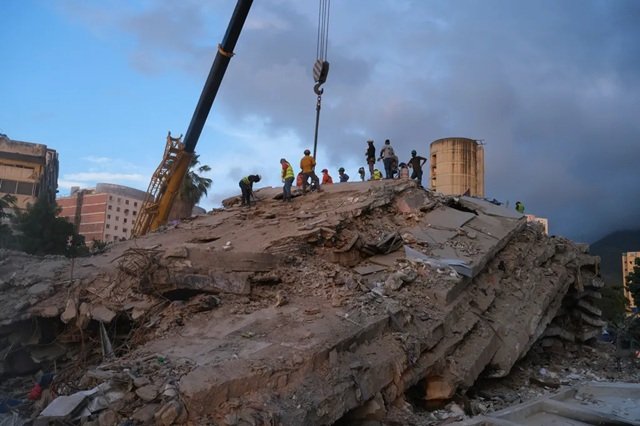
When an earthquake struck northern Venezuela on 24 June, several 12-storey apartment blocks in OPP Caribe, a state-backed housing settlement on the coast near La Guaira, swayed before collapsing into piles of concrete and steel. Thousands of residents were buried beneath the debris, turning a development once presented as a model of socialist housing into the scene of a mass-casualty disaster. The collapse also shattered the faith of residents who had supported the government of Hugo Chávez and his successor, Nicolás Maduro, in the belief that the state would provide them with secure homes and a better life.
In an extensive report published by the German news magazine Der Spiegel under the headline “Wie Chávez’ Vorzeigesiedlung zur Todesfalle wurde” (“How Chávez’s showcase settlement became a death trap”), journalist Marian Blasberg documents the destruction of the settlement and the allegations surrounding its construction, management and political role. The account centres on survivors who say that the authorities failed to respond adequately to the disaster, despite years of demanding maintenance and assistance.
Among them is Gabriela Pérez, a resident of OPP 26 whose mother and four of her five children died in the collapse. By August, 138 people had been confirmed dead in sections A, B and C of the building, while 39 remained missing, according to a list Pérez helped maintain. She now sleeps in the ruins of a Chinese restaurant, returning to the rubble to identify bodies recovered by volunteers. “I gave my life for this government,” she said. “But now, when we needed them, nobody was there.” Her account captures the anger of residents who had worked for the ruling movement but felt abandoned when their homes collapsed.
The official death toll from the earthquakes stood at 6,509, while civil society organisations estimated that more than 40,000 people remained missing. Two months after the disaster, damaged buildings still lined the coast, with exposed steel frames and warnings marking sites where bodies lay beneath the rubble. Survivors described searching for relatives with their bare hands because rescuers initially lacked basic equipment, including hammers, picks, cutting tools, lights, boots and gloves.
Pérez said she waited for paramedics, firefighters and other assistance, but the first officials to arrive were police officers who directed residents towards the old town on higher ground, citing a tsunami warning. No tsunami followed. She suspected that the warning had been used to give powerful figures time to protect their own families and valuables, an allegation that the report does not establish independently. On the second day, a woman employed by the Ministry of Public Works took a digger in an act of civil disobedience to help the rescue effort. French and Mexican teams subsequently arrived, but their thermal scanners were unable to function properly because of heat smouldering beneath the debris.
Pérez said the mayor, whom she knew through her work at the municipal office, promised to obtain machinery after she pleaded for help. The equipment did not arrive the following day or the day after. Four days after the earthquake, volunteers entered her apartment through a tunnel and found her mother and several children. Her youngest daughter, four-year-old Antonieta, was recovered from a neighbouring apartment the next day. A video of Pérez publicly demanding rescue machinery, emergency protection and an explanation for the use of public funds went viral.
The settlement had been conceived as a central expression of Chávez’s “21st-century socialism”. Following repeated natural disasters along the Venezuelan coast, including the devastating landslides of 1999 and floods in 2010, Chávez made affordable housing a priority through the Misión Vivienda programme. In February 2011, he decreed the expropriation of 41 strategic plots, including parts of a golf course, a yacht club and land behind a former Sheraton hotel. The project was intended to move poorer families away from precarious hillside settlements and redistribute access to valuable coastal land.
The Oficina Presidencial de Planes y Proyectos Especiales (OPPPE), an organisation directly answerable to Chávez, received an assignment to build 43 high-rise blocks containing 11,199 apartments. The government sought to complete the development within three years, with Chávez publicly pressing for deadlines ahead of the 2012 elections. Residents began moving into the apartments in late 2013, months after his death from cancer. State-subsidised refrigerators, mattresses and televisions helped furnish their homes, while residents participated in social programmes and mobilised neighbours for government demonstrations.
Yet the report describes how the housing programme also became a mechanism of political control. Pérez said residents were pressured to attend rallies and support the ruling movement in exchange for housing, food parcels and other benefits. “No vote, no apartment. No food boxes. No television,” she said, describing what she considered an explicit threat. Residents also said they never received proper property titles, leaving them unable to sell or rent their homes freely and making it difficult to establish ownership after the destruction.
The 2024 presidential election exposed the political consequences of that dependence. According to the report, opposition candidate Edmundo González won by a substantial margin, but voting centres around OPP Caribe were among the few where Maduro did not need to manipulate the result because residents feared losing their homes and benefits. Their silence after Maduro declared himself the winner reflected the pressure they said they had experienced.
Questions about construction standards have intensified since the collapse. Julio Romero, whose parents’ company rented machinery to the government for the clearance operation, argued that the buildings were plainly not earthquake-resistant. He alleged that excessive sand had been mixed into the cement and that cheap recycled steel had been used for structural supports. Residents had also reported cracks in walls, failing lifts and water-supply problems, but requests for inspections and repairs went unanswered. Romero said the projects had been rushed through without adequate ground studies, competitive tenders or effective financial and technical oversight, pointing to reports that some contracts went to inexperienced companies or firms without the necessary registration or authorisation.
The disaster has unfolded amid a dramatic political shift. Der Spiegel reports that Maduro was captured by a US special operations team in January and was awaiting trial in New York on drug-trafficking charges. His deputy, Delcy Rodríguez, subsequently changed laws to allow foreign companies greater access to Venezuelan oil and relaxed state controls over minerals, while closing the OPPPE. As survivors continue searching for missing relatives, many remain uncertain whether proposed loans to help them find new homes will be accessible without the property documents they never received.
For Pérez, the immediate concern remains the people still buried beneath the settlement. At night, relatives and neighbours climb the rubble with candles and consult lists of the missing. Peggy Viles, who lost her son, lights candles alongside other families and offers prayers as the search continues. “Your souls,” she tells the dead, “are already in a better place.”