A government’s commitment to democracy is best judged by the laws it enacts. The incumbent administration came to power pledging to repeal the draconian laws introduced by its predecessors and strengthen democracy, but it is now doing the very opposite of what it promised. Having amended the Constitution to raise the retirement ages of superior court judges, including serving judges, despite protests by lawyers’ associations, other professional organisations and civil rights groups, the government is now pressing ahead with two more controversial pieces of legislation.
The proposed Protection of the State from Terrorism Bill (PSTB) and the Organised Crime Bill (OCB) could well serve as textbook examples of bad laws in the making. They have attracted strong criticism from human rights organisations and legal professionals over sweeping detention powers, inadequate judicial oversight and the potential erosion of civil liberties. Critics have also warned that the OCB could reintroduce, under a different guise, some of the most repressive features of the Prevention of Terrorism Act (PTA).
The proposed counterterrorism legislation allows wide scope for abuse and poses serious threats to human rights, as Amnesty International (AI) has rightly pointed out. Despite some improvements on the previous white paper of the law issued in late 2025, the PSTB, which will replace the repressive and longstanding PTA, retains an overly broad and ambiguous definition of terrorism that leaves room for arbitrary interpretation and the potential criminalisation of dissent, protest, and the activities of civil society organisations, AI has said. Depending on the Supreme Court’s determination, the PSTB is set to be debated by Parliament in the coming weeks. The government is determined to steamroller it through the House.
Stressing that when a controversial counterterror law weaponised by governments against dissent is abolished, the new Bill must break with legacy abuse, AI has pointed out that Sri Lanka’s history of abusing such legislation makes robust, enforceable safeguards essential, and these remain inadequately addressed in the bill, sparking serious human rights concerns. The present-day JVP leaders know the anti-terror laws for what they really are. They commemorate their comrades arrested, detained, tortured and killed during the UNP government that abused anti-terror laws. Among the victims of the extrajudicial executions during the JVP’s abortive insurgency in the late 1980s was JVP leader Rohana Wijeweera himself .
One may recall that during the parliamentary debate on the Batalanda Commission report, last year, some NPP MPs were visibly moved by the accounts of the JVP members killed in torture chambers operated by the UNP administration, which abused anti-terror laws to suppress dissent and retain its hold on power. Now, the JVP-led NPP government is pressing ahead with equally draconian anti-terror laws.
Critics of the OCB have argued that it contains vague and overbroad definitions of serious crimes and criminal-group membership, permits prolonged detention under executive orders, weakens safeguards against forced confessions, expands surveillance and search powers, restricts media freedom, undermines judicial discretion, and provides for criminalising association, peaceful protest and legitimate dissent without adequate public consultation or protection. Critics have argued that bigamy, of all things, is among the ordinary offences categorised as serious crimes by the OCB, whose scope appears to extend well beyond conventional organised crime. The Human Rights Commission of Sri Lanka has recommended that the Bill be withdrawn and substantially revised.
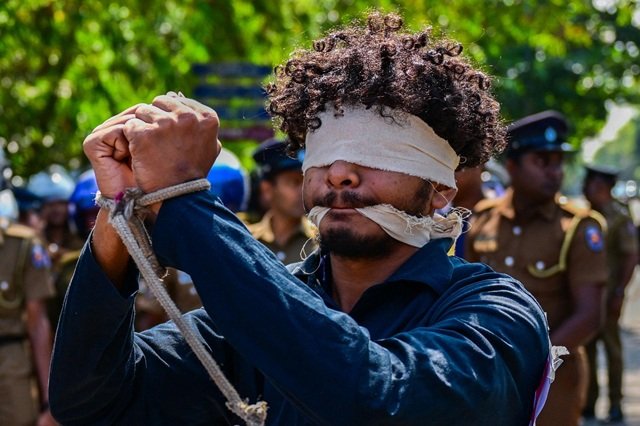
There is no gainsaying that Sri Lanka needs new laws to deal with terrorism and other crimes in a changing world. However, such laws must conform to international standards and contain adequate safeguards against abuse. No government should be allowed to enact repressive legislation to further its political interests under the pretext of protecting the state and the people. Sri Lankan political parties are notorious for their Jekyll-and-Hyde duality, and whenever their interests are threatened, they have no qualms about giving Hyde free rein. Hence the need to prevent governments from arming themselves with excessive powers. This is particularly important where the JVP, whose history has been marked more by Hyde than Jekyll, is concerned. Given the deplorable manner in which the current administration is using law enforcement authorities to suppress dissent, it is not difficult to envisage how dangerous the situation will become if the PSTB and the OCB are enacted in their present forms.