


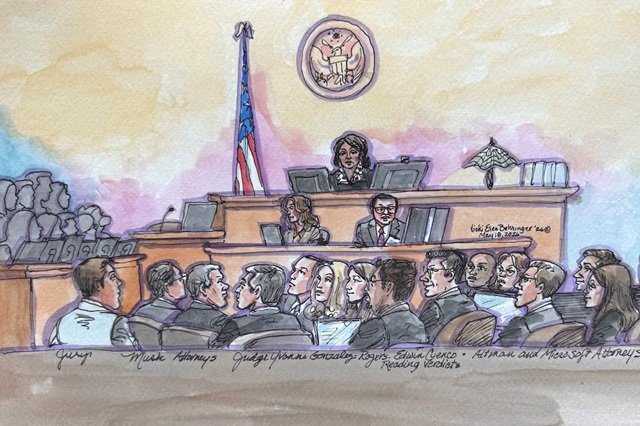
The most consequential artificial intelligence trial of the decade ended not with a dramatic legal reckoning, but with a procedural collapse. Elon Musk’s high-profile case against OpenAI, the company he helped found, was dismissed after a jury concluded that the lawsuit had been filed too late. OpenAI emerged victorious, at least for now, while the deeper ethical and legal questions surrounding the company’s transformation from a nonprofit mission into a multibillion-dollar commercial powerhouse remain unresolved.
The outcome marked a significant setback for Musk, who had accused OpenAI co-founders Sam Altman and Greg Brockman of betraying the organization’s original purpose. According to Musk, OpenAI was created with the intention of developing artificial intelligence for the benefit of humanity rather than private profit. He argued that the company’s leaders abandoned those principles once commercial opportunities became too lucrative to resist.
Yet neither the jury nor the judge ruled on whether Musk’s allegations were true. Instead, the case was dismissed on what Musk described as a “calendar technicality.” The court concluded that the claims had expired because too much time had passed between the alleged wrongdoing and Musk’s legal challenge. The verdict effectively avoided the central issue entirely: whether OpenAI improperly transformed itself from a nonprofit entity into a profit-driven corporation while enriching its executives in the process.
The legal defeat highlighted a weakness in Musk’s own strategy. OpenAI’s lawyers argued that Musk had long known about discussions regarding commercialization and that he himself had once entertained similar ideas during the company’s early years. They also suggested that Musk’s lawsuit was motivated less by principle than by competition. Since launching his own artificial intelligence company, xAI, Musk has become one of OpenAI’s most direct rivals in the race to dominate the rapidly expanding AI industry.
In court, Musk repeatedly framed the dispute as a moral battle over the future of humanity. He warned that AI development without ethical safeguards could become catastrophic, even deadly. But OpenAI countered that Musk only chose to intervene after ChatGPT became a global phenomenon and OpenAI’s market dominance became impossible to ignore.
For Sam Altman, the ruling represents a major strategic victory. OpenAI can now continue its expansion plans without the immediate threat of a damaging legal judgment. The company remains the leading force in consumer AI thanks to the extraordinary success of ChatGPT, and expectations are growing that OpenAI could move toward a stock market debut later this year.
Still, the trial damaged the carefully cultivated image Altman once enjoyed as the thoughtful public face of responsible AI development. Testimony and courtroom revelations painted a less idealistic picture of Silicon Valley’s most influential figures, exposing rivalries, ego clashes and internal power struggles. Musk’s accusations repeatedly focused on how OpenAI’s leadership allegedly profited from an organization originally presented as a public-interest initiative.
The proceedings also reinforced a broader perception that the AI industry’s most powerful players are increasingly consumed by competition over wealth and market dominance rather than the transformative promises they once emphasized. While companies like OpenAI, Anthropic and Google race to build ever more advanced systems, critics argue that debates about safety, public benefit and long-term social consequences are being overshadowed by commercial ambitions.
Despite the courtroom loss, Musk’s legal team made clear that the fight is far from finished. Outside the Oakland courthouse where the three-week trial unfolded, Musk attorney Marc Toberoff issued a blunt response to the verdict: “Appeal.”
Toberoff insisted that OpenAI’s evolution represented a fundamental abuse of public trust. He argued that organizations should not be allowed to raise money and attract support as charitable nonprofits only to later convert themselves into enormously profitable corporations that enrich the same executives and board members who once promoted a humanitarian mission.
That unresolved issue now sits at the center of a much larger debate with implications extending beyond OpenAI itself. Legal experts and technology observers are increasingly asking whether existing nonprofit laws are equipped to handle modern AI companies whose research requires vast amounts of capital. The absence of a definitive ruling in the case leaves uncertainty about how far nonprofit organizations can go in restructuring themselves into commercial enterprises.
Supporters of Musk warned that the outcome could create a dangerous precedent. Some argued that entrepreneurs might now see a path to launch nonprofit ventures under the banner of public good before later converting them into profit-generating corporations with minimal legal consequences.
The controversy arrives at a moment when artificial intelligence has become one of the defining global issues of the 21st century. AI systems are already reshaping labor markets, education, healthcare and legal systems at extraordinary speed. Governments worldwide are struggling to regulate technologies whose capabilities appear to evolve faster than political institutions can respond.
At the same time, public opinion remains deeply divided. Supporters believe AI could revolutionize medicine, solve complex scientific problems and unlock new economic growth. Critics fear automation-driven job losses, misinformation, surveillance and the concentration of unprecedented power in the hands of a few technology companies.
The Musk-OpenAI case ultimately exposed a deeper tension within the AI revolution itself. The technology was once promoted as a tool capable of addressing humanity’s biggest challenges, from disease to energy shortages. But increasingly, the public conversation is dominated by billionaire rivalries, corporate valuations and battles for market share.
That shift may prove more significant than the trial’s procedural outcome. Even without a definitive ruling on OpenAI’s conduct, the case has intensified scrutiny of how artificial intelligence companies are governed, funded and held accountable. It has also reinforced the sense that the future of AI may be determined not only by scientific breakthroughs, but by the power struggles unfolding behind closed boardroom doors.
For now, OpenAI walks away with a legal victory. Musk walks away with another public feud unresolved. And the world is left with the same unanswered question that hovered over the trial from the beginning: who ultimately controls the future of artificial intelligence, and in whose interests will it operate?









