The number of police stations attacked by JVP rebels during the uprising that began on April 5, 1971, was 74. Out of these, 57 police stations were attacked and damaged. A total of 35 police areas came under rebel control. They also captured five police stations in Uragaha, Deniyaya, Kataragama, Warakapola, and Rajangana, and managed those areas for a short period.
Among these, the Deniyaya police station was captured on April 9 and remained under rebel control for 15 days, until April 24. Government forces recaptured Deniyaya on April 24 after driving out the rebels. The writer, who conducted field research in Deniyaya, interviewed families of the deceased as well as several surviving activists connected to the movement.
By the end of the 1960s, the electoral constituencies in Matara District included Matara, Kamburupitiya, Akuressa, and Deniyaya. Ariyaratne, Metthananda, and Francis Abeywickrama of Ihalagama and Mawarale contributed to the spread of the JVP in Deniyaya in 1967. The first full-time JVP member in Deniyaya was Majendra alias Mahinda from Wellawaya. In the late 1960s, activists in the Deniyaya area included Morawaka Yasapala Gamage, a graduate of the University of Kelaniya; Kotawila Dewasiri Thero; Morawaka Bhaddiya Thero; and Susil Wickrama of Maharagama.
Panadura Reginald Cooray, a graduate of the University of Sri Jayewardenepura and a JVP activist in Deniyaya, was expelled from the party in the early 1970s following an internal factional conflict, after which Jayatissa Ranasinghe became the leader. Cooray’s expulsion was linked to his alignment with Dharmasekara during the Wijeweera–Dharmasekara split. His father served as an assistant estate superintendent at the Deniyaya estate at the time.
The writer also interviewed Ananda Ranjith, alias “Podi Ranji,” of Kodagoda Addara Amarasinghe, who was a key figure in promoting the JVP in the Deniyaya area in 1968. Born on 26 December 1950 in Divelawatta, Kirulapone, Ranjith Amarasinghe became a full-time JVP member operating in the Hambantota and Badulla districts in 1970. Prior to that, he had worked in several areas, including Deniyaya in the Matara District.
At that time, the Matara District had several police divisions: Matara, Gandara, Dickwella, Weligama, Akuressa, Mawarala, Morawaka, Hakmana, Kamburupitiya, and Waralla. The Waralla police station was later relocated and renamed Deniyaya. The Deniyaya police division included Kirilipana, Urubokka, and Beralapanathara.
The district-level JVP leader for Matara was Susil Wickrama. He was among the JVP leaders who attended the decisive meeting at Vidyodaya Sangharama on April 2, 1971, where the final decision to launch the April uprising was made. He was later killed during a security operation while transporting weapons toward Matara Fort during the uprising.
The leader of the Deniyaya front during the uprising was Jayatissa Ranasinghe. Born and raised in Deniyaya, he joined the JVP and became a full-time member in late 1969. He later became secretary of the Deniyaya Police Committee and led the 15-day control of Deniyaya. He was killed by military gunfire at Sinharaja Site on May 31, 1971.
Jayatissa Ranasinghe studied at Deniyaya Central College and worked as a field assistant on a plantation estate. He was described as a very likeable person and reportedly even left his girlfriend for the revolution.
He had two brothers. One of his younger brothers worked as a field officer on an estate owned by the Kolavenigama Rajamaha Viharaya. The estate once covered 1,798 acres and has now been reduced to around 100 acres. Its current trustee is Venerable Bengamuwe Premarathana Thero.
During the uprising, nearly 400 people attended JVP training classes in the Deniyaya area, and about 150 joined the rebellion. Many were students, including a significant number of women. Full-time members at the time included Jayasinghe, Ratnayake, Kusum Gunasekara, Kusum Buddhikorala, Sugathadasa, Dhanapala, Piyasena, Dharmadasa, Harry, Somadasa, and others. There were also many part-time members.
Training camps were held in forest areas such as Thalapatkanda, Sinharaja Mederipitiya, Lankagama, Wathugala, and Kolavenigama. Most participants were students from Deniyaya Central College, Morawaka College, and Beralapanathara College.
To prevent illness, a few drops of a liquid in a bottle were reportedly given orally to nearly 100 participants about a week before the uprising. It was said to have been provided by an assistant doctor from the Morawaka area. The Waralla police station had been relocated and re-established near Deniyaya town at the end of March 1971. Before the attack on the Deniyaya police station, the group reportedly raised their hands and shouted three times, “Long live the revolution,” before moving out.
The first attack on the Deniyaya police station took place at 11:30 p.m. on April 5, 1971, but it failed after about one hour of fighting. The attack came from three directions with about 27 participants. The rebels used a shotgun, 20 Molotov cocktails (bottles filled with diesel and sealed with cloth), 40 tin bombs made from medication tins, and several larger improvised explosives made from milk powder tins filled with gelatin. The police were armed with .303 rifles and submachine guns. The rebels retreated after being defeated.
The eldest attacker was Donald, also known as Donnet, a 40-year-old quarry worker. All others were under 30. Although women participated in the movement, they were not involved in armed attacks; instead, they were assigned welfare, propaganda, coordination, and first aid duties.
The retreating rebels regrouped at a government guard post and launched a second attack at midnight on April 9. About 45 people participated. This time they used ammunition collected from estates and houses, a repeater firearm, and a large number of improvised bombs. During the attack, a rebel named Amaris was seriously injured, and Police Constable Mayadunne (No. 4706) was killed.
Ten suspects were charged before the Criminal Justice Commission for the murder of Dr. Rex de Costa in Deniyaya on April 9, 1971. They were also charged with involuntary manslaughter in connection with the death of Police Constable Mayadunne (No. 4706) of the Deniyaya Police.
Of the ten insurgents charged with the murder of Dr. de Costa, seven pleaded guilty, while three pleaded not guilty. The Chairman of the Commission, H. N. G. Fernando, informed the accused that those who pleaded not guilty were entitled to legal assistance.
The number of people charged before the Criminal Justice Commission (Case No. 94 – Deniyaya) in connection with the uprising was 90. Charge sheets were issued on August 20, 1973. However, only 60 appeared before the Commission, while the remaining 30 did not.
Sirimevan Chandrasekara became the leader of the Deniyaya group after Jayatissa’s death. According to State Counsel, he was serving as a Regional Forest Conservation Officer in Deniyaya in April 1971 and had participated in both attacks on the police station. He also assumed leadership after Jayatissa’s death.
The Commission sentenced Sirimevan Chandrasekara to four years of rigorous imprisonment. The Chairman noted that the three years he had already spent in remand were taken into account.
Sirimevan Chandrasekara was born on 16 August 1949 in Kalutara. His father, Peter Edwin Perera, was an electrical superintendent. His mother, Chandrani Dias, was from Panadura. He was the third of six children. He studied at Bandaranaike College, Gampaha, and was appointed Forestry Officer of Deniyaya on 15 November 1968. His wife is Indrani Liyanage, and his children are Isuru and Sewwandiya.
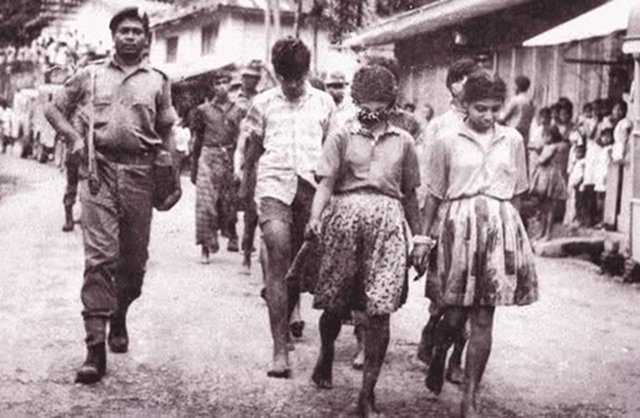
When the Commission examined the remaining 50 accused (excluding the 10 charged with murder), 38 pleaded guilty and 12 pleaded not guilty. Among the latter was Kusuma Buddhikorala, a leading female participant in the uprising. She was born in Deniyaya, actively participated in the 1971 uprising, retreated to Sinharaja after its defeat, and was later arrested along with 11 other female rebels in Mederipitiya on June 26, 1971.
After the Criminal Justice Commission (Abolition) Act No. 12 of 1977 came into effect on October 27, 1977, JVP leader Rohana Wijeweera and others were released on November 2, 1977. Kusuma later remained active in political and educational work within the JVP and women’s organizations. She continued political activity after the 1983 ban on the JVP, was arrested again during the second uprising in 1989, later lived in Ratnapura, ran a small clothing business in Malabe, and migrated to Australia with her son in mid-2024.