
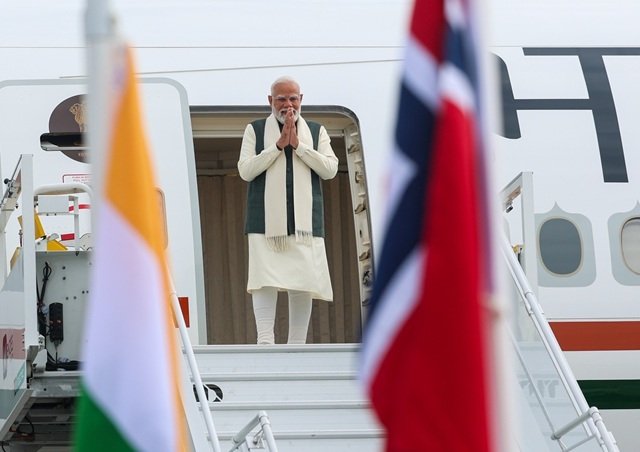
Indian Prime Minister Narendra Modi arrived in Norway expecting to reinforce India’s growing engagement with the Nordic region through trade, green technology cooperation and strategic diplomacy. Instead, his Oslo visit became overshadowed by protests from sections of the Sikh diaspora, pro-Khalistan activists and human rights campaigners who transformed what was intended as a carefully managed diplomatic engagement into a contentious international spectacle.
Outside Oslo City Hall and near Norway’s parliament, demonstrators carrying Khalistan flags and anti-government placards accused New Delhi of pursuing what they described as a policy of overseas intimidation against Sikh activists abroad. Chants against Hindutva politics echoed through the Norwegian capital while protesters questioned why a European democracy that consistently presents itself as a defender of human rights chose to award Modi the Grand Cross of the Royal Norwegian Order of Merit.
The demonstrations highlighted a growing challenge confronting India’s global diplomacy: domestic political controversies are increasingly following New Delhi onto the international stage. For years, India’s diplomatic outreach under Modi has focused on projecting the country as a rising economic power, a technological hub and a strategic balancing force in an increasingly fragmented global order. Yet protests in Western capitals now regularly accompany Indian diplomatic visits, particularly where large Sikh diaspora communities remain politically mobilized around the Khalistan issue.
The Oslo demonstrations were not merely symbolic acts of diaspora dissent. They reflected a broader internationalization of the Khalistan narrative, particularly after allegations surrounding assassination plots and intimidation campaigns targeting Sikh activists in countries such as Canada and the United States. These accusations have intensified scrutiny of India’s overseas security posture and complicated New Delhi’s relations with several Western democracies.
For pro-Khalistan groups, Modi’s Norway visit presented an opportunity to amplify claims that India is attempting to suppress dissent beyond its borders. Organizations such as Sikhs for Justice framed the protests as part of a wider campaign to expose what they characterize as economic marginalization, political repression and democratic backsliding under the Modi government. Their messaging deliberately connected Punjab’s agrarian distress, allegations of overseas targeting and broader debates surrounding civil liberties into a narrative designed for international audiences.
However, Indian officials and supporters of the Modi government continue to argue that New Delhi’s concerns regarding Khalistan activism are rooted in national security rather than suppression of dissent. India has long viewed separatist movements linked to the Khalistan cause through the lens of past militancy and territorial integrity, maintaining that certain overseas networks exploit democratic freedoms abroad to promote extremism and anti-state mobilization. From New Delhi’s perspective, criticism emerging during foreign visits is often interpreted as an attempt to internationalize India’s domestic political disputes and weaken its diplomatic standing globally.
The controversy intensified further when Norwegian journalist Helle Lyng publicly challenged Modi over press freedom and human rights concerns. Her question asking why the Indian prime minister avoids taking questions from journalists-rapidly spread across international media and social platforms. The exchange became particularly significant because it occurred in Norway, a country that consistently ranks among the world’s highest in global press freedom indices, while India’s rankings have steadily declined in recent years according to several international watchdog organizations.
The backlash directed at the journalist inside India also revealed another important dimension of the controversy: the growing polarization surrounding criticism of the Indian government abroad. Supporters of Modi portrayed the confrontation as an orchestrated attempt to embarrass India on the global stage, while critics argued that the exchange symbolized shrinking tolerance for media scrutiny and dissent.
From a geopolitical perspective, the Oslo protests illustrate how diaspora politics are becoming an increasingly influential factor in international diplomacy. Sikh activism surrounding the Khalistan issue no longer remains confined to domestic Indian politics. It has evolved into a transnational movement operating across Europe and North America, leveraging democratic institutions, media visibility and human rights discourse to challenge India’s international image.
For European governments, this creates a difficult balancing act. Countries such as Norway seek stronger economic and strategic relations with India, particularly as Europe attempts to diversify partnerships amid rising tensions with China and broader geopolitical instability. Nordic states increasingly view India as an important partner in areas ranging from maritime security and digital cooperation to green technology and supply-chain diversification. However, these governments must simultaneously navigate growing domestic pressure from civil society groups, diaspora organizations and media institutions concerned about democratic freedoms and minority rights.
The Modi government, meanwhile, faces a strategic communications dilemma. Domestically, its strong nationalist posture remains politically advantageous and reinforces the image of decisive leadership. Internationally, however, controversies surrounding minority rights, press freedom and allegations of overseas coercion risk complicating India’s effort to position itself as a democratic counterweight to authoritarian powers.
The symbolism surrounding the Oslo protests was particularly powerful because it disrupted the carefully managed optics of Modi’s Nordic tour. Diplomatic awards, ceremonial receptions and strategic agreements were overshadowed by images of protesters waving Khalistan flags, chanting anti-government slogans and accusing New Delhi of exporting repression abroad. In the digital age, such visuals travel globally within minutes and often shape international perceptions more effectively than official diplomatic messaging.
At a deeper level, the protests reveal that India’s internal political debates are increasingly difficult to contain within national borders. Questions surrounding religious nationalism, minority rights, democratic freedoms and state authority are now embedded within India’s international engagements. Major diplomatic visits increasingly become stages not only for statecraft, but also for transnational activism and ideological confrontation.
For Modi, the Norway visit was intended to reinforce India’s image as an emerging global power with expanding influence across Europe. Instead, it exposed the growing tension between India’s diplomatic ambitions and the mounting international scrutiny surrounding its domestic political trajectory. How New Delhi manages this contradiction may become increasingly important as India seeks a larger role in shaping the future global order.