A catastrophic gas explosion at a coal mine in northern China has left at least 90 people dead and dozens more injured, marking the country’s worst mining disaster in nearly two decades. The blast, which tore through the Liushenyu coal mine in Shanxi province on Friday evening, has once again drawn attention to the deadly risks embedded within China’s vast coal industry, despite years of official promises to improve mine safety standards.
According to Chinese state media, 247 workers were underground when the explosion occurred at approximately 7:29 p.m. local time. Rescue teams rushed to the site through the night as smoke, toxic gases, and unstable underground conditions complicated efforts to reach trapped miners. By Saturday afternoon, authorities confirmed at least 90 deaths, while 123 workers had been transported to hospitals for treatment. Several victims remained in critical condition.
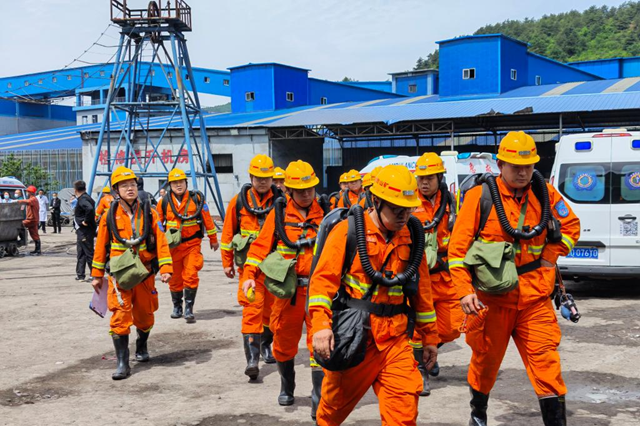
Television footage from the scene showed helmeted rescue workers carrying stretchers toward ambulances waiting outside the mine entrance. Emergency lights flashed through clouds of dust as exhausted crews continued searching underground for survivors and recovering bodies from the damaged shafts. More than 750 emergency responders and medical personnel were deployed to the disaster site, according to state broadcaster CCTV.
The scale of the tragedy has shocked the country and prompted an unusually forceful response from the central government. Chinese President Xi Jinping called for “all-out efforts” to rescue those trapped and treat the injured, while also demanding a full investigation into the causes of the explosion. State news agency Xinhua later announced that authorities had launched what it described as an “uncompromising” inquiry and pledged severe punishment for anyone found responsible.
Investigators are now examining allegations of safety violations, including the possible falsification of underground worker records and failures to monitor hazardous gas levels. Chinese authorities also ordered a nationwide crackdown targeting illegal mining activities, unsafe contracting practices, and inadequate supervision across the coal sector.
A company official linked to the operation of the mine has reportedly been taken into custody, according to state media, though few details about the individual or the company’s management have been released publicly.
Initial reports after the explosion suggested only a handful of deaths, but the toll rose dramatically as rescuers reached deeper sections of the mine. Earlier accounts indicated that dangerous levels of carbon monoxide had been detected underground after the blast, creating deadly conditions for trapped miners. Carbon monoxide is a highly toxic gas that can quickly incapacitate victims without warning.
Survivor testimonies have begun to emerge from hospitals treating the injured. One miner, Wang Yong, described a sudden burst of smoke followed by a strong sulphur smell moments before chaos spread through the underground tunnels. He recalled seeing fellow workers collapse as thick smoke filled the shafts.
“There was a puff of smoke, and I smelled sulphur,” Wang told Chinese state television. “People around me were choking. I fainted.”
He later regained consciousness and managed to escape with nearby workers after lying unconscious for nearly an hour underground. His account offered a rare glimpse into the terror miners faced in the moments following the blast.
The disaster is the deadliest mining accident in China since 2009, when an explosion at a coal mine in Heilongjiang province killed 108 people. Although the country has reduced the number of fatal mine accidents over the past two decades through tighter regulations and modernization efforts, serious incidents continue to occur with alarming regularity, particularly in poorer, coal-dependent regions.
Shanxi province, where the explosion occurred, sits at the heart of China’s coal industry. The province supplies vast amounts of fuel to power plants and heavy industries across the country and remains economically dependent on mining despite Beijing’s efforts to diversify energy sources. Thousands of miners continue to work in hazardous conditions deep underground, where methane gas leaks, collapsing tunnels, and equipment failures pose constant threats.
Critics say many mines continue to operate with lax enforcement of safety standards, especially when local governments prioritize production targets and economic growth. Industry observers have long warned that pressure to maintain high coal output can encourage companies to ignore risks or conceal safety violations.
The explosion also arrives at a moment of contradiction in China’s energy policy. While the country has invested heavily in renewable energy and installed record levels of solar and wind power capacity, it remains the world’s largest consumer of coal and the biggest emitter of greenhouse gases. Coal continues to play a central role in supporting China’s industrial economy and ensuring energy security, particularly during periods of high electricity demand.
In recent years, Chinese authorities have repeatedly pledged to improve oversight of mining operations after major accidents triggered public outrage. Yet deadly incidents continue to reveal weaknesses in enforcement and oversight mechanisms.
In 2023, a collapse at an open-pit coal mine in Inner Mongolia killed 53 people, prompting another wave of promises from regulators to strengthen inspections and punish negligence. Similar vows have followed previous disasters, but safety advocates argue that systemic problems remain unresolved.
For many families in Shanxi, the latest explosion has transformed an ordinary workday into a devastating tragedy. Hospitals across the region have been crowded with anxious relatives waiting for news about missing miners, while rescue teams continue searching underground amid fears that the death toll could still rise.
As investigations intensify, the disaster is likely to renew broader questions about the human cost of China’s dependence on coal. Behind the statistics are workers who descended into the mines expecting to return home after another shift, only to become victims of one of the country’s worst industrial catastrophes in years.