In May this year, Narendra Modi came to Scandinavia with all the trappings of a state visit, official motorcades, ceremonial halls, bilateral agreements and the artistry of statecraft. One thing that he would not have imagined, or maybe never wanted to imagine, was that there will be a very large population of the Sikh community in the diaspora waiting for him. In both Oslo and Gothenburg, the protesters ensured that New Delhi had one picture on the street, while another picture vied for it.
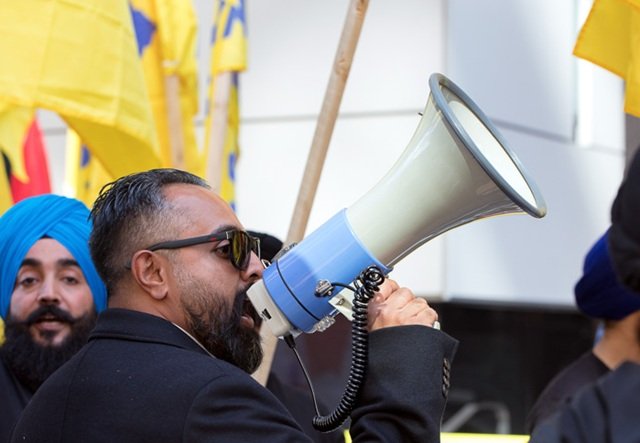
The scenes were far from subtle. From outside of Oslo, city hall, the protesters, carrying Khalistan flags, chanted slogans against Hindutva politics, directly defying the optics of the visit aimed at boosting Modi’s international image. The fight was more visceral in Gothenburg. Khalistan Referendum activists surrounded Hotel Gothia Towers at early hours on 16-17 May that was where the delegation of Modi was staying. His guards were said to have fled from the edge of his compound. Through the night, protesters chanted “killer” and “coward” outside the hotel. The diplomatic agenda that was in the talks inside was a whole different ball game outside.
These protests will be disregarded by India as the show of a fringe separatist movement without any political legitimacy. That’s a predictable and inadequate dismissal. These protesters are asking questions that go beyond the fringe questions, such as questions of weaponising Indian state machinery against dissent voices in other nations, questions of having targeted killing policies abroad, questions of minorities being treated differently at home. They are being called upon at Canadian parliamentary committees, at hearings before the American Senate, at British intelligence assessment hearings, and now on the streets of Oslo and Gothenburg. What happened to a movement that India considers as marginal that it is able to follow its Prime Minister to three continents?
Much of the diaspora’s wrath is by no means abstract. A July 2023 report by The Canadian Security Intelligence Service (CSIS) also identified the assassination of Hardeep Singh Nijjar in Surrey, Canada, in June 2023, as a turning point. Nijjar was a Canadian citizen and an influential Khalistan activist. After an internal review, Canada’s government accused Indian government agents of being involved in his death, a charge which India denies, but which Canada has continued to press through formal diplomatic channels. The case had broken India-Canada relations over the past few decades and brought the issue of transnational repression to the forefront for Sikh communities around the world—when state power is used to silence critics across borders. That fear has been compounded by reports of alleged plots against other Khalistanist leaders, such as Paramjeet Singh Pamma.
The protesters in Norway specifically raised the question of why they were honouring Modi when these allegations are still outstanding and India has been under international pressure for its actions against Sikh activists. It’s a fair question to ask. For years, Western democratic governments have debated between human rights and Western strategic and economic interests in India, a large democracy, a rising economy and a valuable counterweight to China in a turbulent Indo Pacific. The equilibrium is increasingly difficult to keep up without making a fuss. The calculation is made public when protesters appear outside a ceremonial place during a state visit and the international media report on it, and the government must be held accountable for this.
This movement is not just about the politics of a separate Sikh homeland. Salient points of the Indian farm laws and the consequences thereof – the extended farmer protests of 2020/21, which witnessed some of the biggest sustained protests in history, prominently featuring Sikh farming communities in Punjab – were clearly raised. The activists’ term for the “econocide” — a restructuring of the agricultural economy of Punjab, in their own words, that would work in favour of the big business houses at the expense of the small farmers. As much as people may wish to believe otherwise, the grievance is real: the farm protests resulted in the withdrawal of the laws but not the mistrust they had fostered in Punjab, and among the Sikh community in the diaspora.
The typical reaction of the government of New Delhi to the issue of Khalistan is in two phases. The first is to label all activities which touch the issue of Khalistan as terror or extremism, and then ask the western governments to ban pro-Khalistan groups from their respective territories. The second is to allege that Pakistan was supplying money and support to the movement which had some historical justification but as a blanket accusation conveniently avoids the domestic political failures which make separatist sentiment relevant anyway. Both are gestures of goodwill that don’t answer the substantive complaints and grievances being raised. Neither will explain why the Sikh communities in Canada, the United Kingdom, Australia and now Scandinavia, who have no personal material interest in a Punjabi political settlement, feel so strongly as to stand outside hotels at 2 am on a winter morning to challenge a visiting head of government.
So the answer is, no, for New Delhi anyway, that is, uncomfortable, that diaspora communities bring their histories with them. From 1984, the anti-Sikh riots, in which thousands of Sikhs died, and were in some places assisted, if not encouraged, by the failure or complicity of the State in addressing these incidents, has left an unhealed wound that has never been sufficiently dealt with by the Indian state. 40 years later, when allegations of Indian agents in foreign countries targeting Sikh activists are made, members of this community don’t take it in isolation. When they see it, they handle it as a pattern.
As per official reports, Modi’s trip to Scandinavia was successful. An exchange of views took place on trade agreements. Photographs were taken. Handshakes were exchanged. The photos that were shared outside the official press release, however, were images of flags outside Oslo City Hall and of security backing away from the outside of a hotel in Gothenburg. Diplomacy yields a lot of products. Does not create soundless. Three continents, two Nordic cities and the Sikh community, loud and clear, has said it will not be silent.