


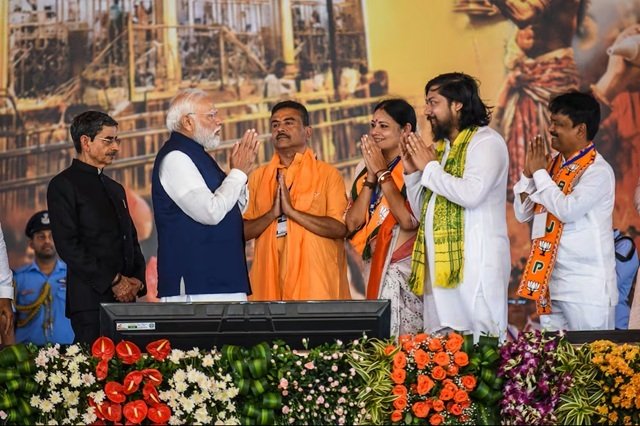
A dramatic political realignment has reshaped the landscape of Indian state politics after the Hindu nationalist party Narendra Modi’s Bharatiya Janata Party secured a decisive victory in West Bengal, a state long considered one of the strongest bastions of left-wing and regional opposition. The results, confirmed in April elections covering several states and union territories, mark a historic turning point in a region that had resisted national-level political dominance for nearly five decades. The win consolidates the BJP’s expanding footprint across India’s federal system and signals a broader ideological shift in one of the world’s most politically diverse democracies.
West Bengal, home to more than 100 million people and historically governed by leftist and center-left parties, has now fallen firmly under BJP control after the party won 207 of 293 assembly seats. The defeat of the incumbent Trinamool Congress, led by long-serving chief minister Mamata Banerjee, ended a decade of regional rule and followed an earlier era in which the Communist Party and allied left formations governed the state for 34 consecutive years. The collapse of both political traditions in a single electoral cycle has been described by analysts as one of the most significant realignments in recent Indian state politics.
Political observers cited multiple factors behind the outcome, including voter fatigue, corruption allegations, economic stagnation, and concerns over governance and public order. According to political scientist Ronojoy Sen of the Institute of South Asian Studies, the loss reflected accumulated dissatisfaction with the ruling administration and its internal party dynamics. Other analysts pointed to growing voter confidence in the BJP’s governance record in other states, particularly in areas where it has emphasized law and order improvements and administrative efficiency.
Speaking from New Delhi, analyst Manish Chand of the Centre for Global India Insights noted that the BJP’s appeal in West Bengal was strengthened by perceptions of national momentum and political stability. He argued that voters increasingly viewed the party as a vehicle for change, particularly in comparison to long-entrenched regional administrations. This perception, he suggested, helped the BJP overcome its historical image as an external force in Bengal politics and position itself instead as a credible governing alternative.
The election was also shaped by a controversial voter list revision process conducted by India’s Election Commission. Officially aimed at removing duplicate entries, deceased voters, and migrated individuals, the exercise reportedly reduced the electorate by more than nine million people, or around 12 percent. Critics alleged that the process disproportionately affected minority communities and voters in border districts, raising concerns about potential political bias. The opposition accused the electoral authorities of indirectly favoring the BJP, a claim that has further intensified political polarization in the state.
The consequences of the BJP’s victory have already begun to reshape governance in West Bengal under the leadership of Suvendu Adhikari, a former ally of the previous administration who defected to the BJP. One of the new government’s early measures includes the establishment of detention centers for undocumented migrants, a policy primarily targeting individuals from neighboring Bangladesh. The move has sparked anxiety among informal workers, many of whom fear detention or deportation amid increased enforcement activity near the 4,000-kilometer border shared with Bangladesh. Reports from local media suggest heightened movement across border checkpoints, while Bangladeshi authorities have increased surveillance amid concerns over irregular crossings and forced returns.
Beyond West Bengal, the elections marked the end of communist-led governance in India at the state level. In Kerala, the Left Democratic Front suffered defeat at the hands of a centrist coalition led by the Indian National Congress and allied parties, ending a long tradition of alternating left-wing administrations in the state. For the first time in independent India’s history, no state is now governed by a communist-led administration, underscoring the decline of leftist political influence across regional politics.
The broader implication of these results, according to analysts, is the continued centralization of political power around the BJP. With victories across most of India’s 28 states either directly or through alliances, the party’s dominance at the federal level is increasingly mirrored in state governments. Chand described this trend as a “continuous march forward,” noting that even without a standalone majority in national elections, the BJP has effectively established itself as the country’s dominant political force through its control of regional administrations.
The elections also highlighted the weakening of regional parties that once formed the backbone of India’s federal political diversity. In West Bengal, the Trinamool Congress attempted to frame the BJP as a party without local roots, emphasizing Bengali identity politics. However, internal fragmentation within the opposition and the defection of key figures to the BJP weakened that narrative. Adhikari’s role as both a former minister in the previous government and now the state’s chief leader for the BJP was seen as symbolically important in reshaping voter perceptions.
While much of the attention focused on Bengal, other states also reflected shifting political dynamics. In Assam, the BJP consolidated its position with another strong electoral performance, reinforcing its dominance in northeastern India. In contrast, Tamil Nadu witnessed a surprising rise of a new political force led by film actor Chandrasekaran Joseph Vijay, whose party secured a significant share of votes and seats in its first electoral outing. Analysts described his campaign as highly effective among younger voters, driven by strong social media engagement and celebrity appeal, a phenomenon increasingly referred to as the “Generation Z factor” in Indian politics.
Political commentator Ronojoy Sen noted that Tamil Nadu has a long history of film stars transitioning into politics, with previous leaders achieving lasting influence. Vijay’s performance, however, stood out for the speed and scale of his electoral impact, suggesting a growing convergence between entertainment culture and political mobilization in India’s southern states.
Across these diverse outcomes, a common thread emerges: a political landscape in rapid transition, where traditional ideological strongholds are weakening and voter behavior is increasingly shaped by perceptions of governance, identity, and change. The BJP’s expansion into historically resistant regions such as West Bengal marks a significant consolidation of national influence, while the decline of communist and regional parties signals a reconfiguration of India’s federal balance.









