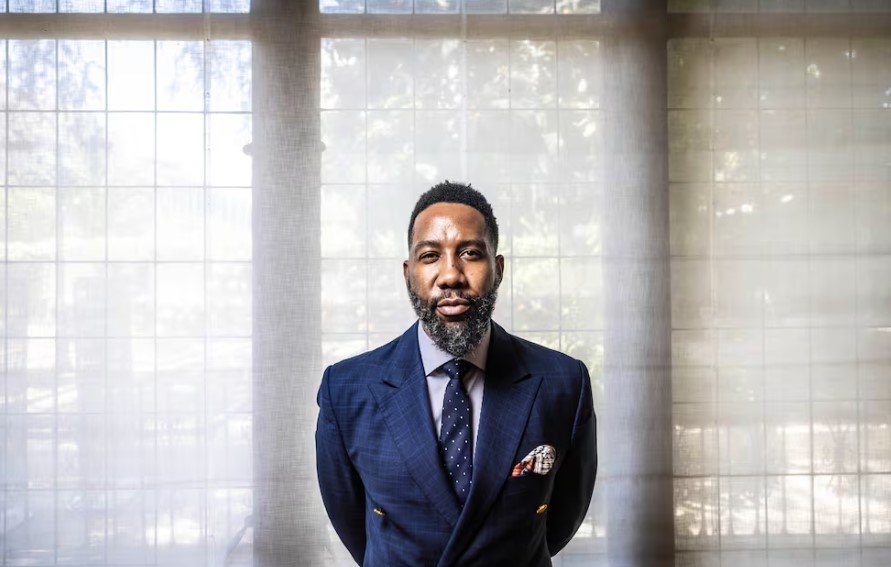
Ndaba Mandela grew up in the long shadow of one of the most influential political figures of the 20th century, but he insists that legacy is not a monument—it is an obligation. Speaking in an interview with El País, the grandson of Nelson Mandela described a South Africa still struggling to complete the liberation that his grandfather began, arguing that political freedom without economic transformation remains an unfinished project.
Born in Soweto, Johannesburg, and now 43 years old, Ndaba Mandela works as a political scientist and serves as president of the Mandela Institute for Humanity. He is also involved in international education initiatives, including Spain’s Alianza por el Futuro de la Educación, which seeks to rethink schooling in a rapidly changing global landscape. For him, education is not a secondary policy issue but the central battleground for the next generation’s survival and agency.
“The responsibility is to continue my grandfather’s legacy,” he told El País. Nelson Mandela achieved political emancipation for South Africa, he said, but the deeper economic inequalities of the apartheid era have yet to be resolved. In his view, the promise of liberation remains incomplete because structural poverty, unequal access to opportunity, and underfunded education systems continue to shape the lives of millions. “What generation will be formed without the means to become critical thinkers?” he asked, warning that a society that neglects education risks undermining its own future.
His reflections are rooted in personal memory as much as political analysis. He recalls meeting Nelson Mandela for the first time at the age of eight, when his grandfather was still living under restricted conditions in what had once been a guarded residence. For a child coming from Soweto, the experience was disorienting. He described being struck by the contrast between his own environment and the relative comfort of the space where Mandela was confined, complete with a swimming pool and staff. It was there, he said, that he encountered a chef for the first time in his life and first began to understand the extraordinary circumstances surrounding his grandfather’s imprisonment.
Even in those early encounters, Mandela’s focus on education was evident. He asked his grandchildren about their studies, their interests, and their aspirations, encouraging intellectual curiosity and discipline. Ndaba Mandela recalls initially saying he enjoyed mathematics, though he later chose a different path in life. What remained with him, however, was the idea that learning was inseparable from responsibility and self-development.
After Nelson Mandela’s release from prison in 1990, the family dynamic shifted. According to Ndaba Mandela, his grandfather played an active role in shaping his upbringing, even directing his own children toward formal education while taking responsibility for his grandchildren’s daily discipline. The household he describes was strict but purpose-driven: maintaining order, completing schoolwork, and cultivating habits of self-control were treated as essential foundations for future leadership.
For Mandela, personal discipline was not separate from social responsibility. He often emphasized that privilege carries obligations, particularly in a society marked by inequality. Ndaba Mandela recalls being told that, as a member of a family associated with leadership, he was expected to excel academically and to recognize that his circumstances were not representative of most South Africans. The message, he said, was clear: advantage must be used to serve others.
That philosophy extends into his broader understanding of his grandfather’s legacy. Nelson Mandela is widely remembered as the leader who dismantled apartheid and guided South Africa toward a peaceful transition, avoiding large-scale civil war. For Ndaba Mandela, however, the most important part of that legacy is not only political transformation but the preservation of peace during a moment of potential national collapse. He argues that this achievement must now be carried forward by new generations facing different but equally urgent challenges.
Yet he is also frank about what has not been achieved. Economic inequality remains deeply entrenched in South African society, and he warns that without sustained investment in education, the country risks failing to produce the critical thinkers needed to address its problems. He frames education as both a tool of empowerment and a safeguard against social stagnation, arguing that current reductions in resources threaten long-term national development.
Part of Mandela’s public work has involved confronting stigma around health crises as well. He recalls how his family chose to speak openly about the causes of his parents’ deaths from AIDS-related illness, rejecting euphemisms in favor of transparency at a time when the disease carried significant social stigma. That decision, he said, was guided by his grandfather’s belief that silence perpetuates shame, while openness enables collective understanding and progress.
His reflections also extend beyond South Africa. When asked about global political figures, he was sharply critical of Donald Trump’s candidacy for the Nobel Peace Prize, questioning it in light of ongoing international conflicts. His remarks reflect a broader skepticism about the symbolic use of peace credentials in contexts of active warfare and geopolitical tension.
Ndaba Mandela also occupies a traditional leadership role within his clan, which he describes as rooted in historical royal lineage. The position involves mediation between family branches and advisory responsibilities within local governance structures. He notes that Nelson Mandela himself once declined such a role after serving as president of South Africa, preferring to step away from formal leadership structures. His father and brother were also involved in the position at different times, reflecting a complex interplay between tradition, politics, and personal choice.
Now, Mandela finds himself increasingly drawn into that responsibility. His role includes supporting a rural community in Kunu, a remote area where state services are limited and local leadership structures remain essential. He describes this as a form of direct service, focused on meeting practical needs rather than symbolic authority. For him, leadership is not about status but about obligation to those who depend on it.
Despite the weight of expectation, Ndaba Mandela speaks without hesitation about embracing his position. He sees it not as inherited prestige but as a continuing commitment to his community and to the ideals associated with his grandfather’s name. “I must take care of my people,” he said in his interview with El País, framing leadership as an extension of responsibility rather than a personal ambition.
In his view, the Mandela legacy is not confined to history books or public memory. It is a living demand placed on each generation to expand justice, improve education, and protect dignity in societies still marked by inequality. The struggle that defined his grandfather’s life, he suggests, did not end with the fall of apartheid—it simply changed form.