
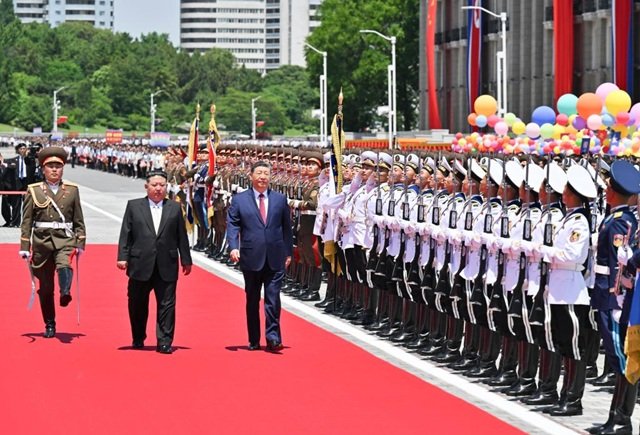
Xi Jinping’s arrival in Pyongyang on 8 June, his first in nearly seven years, is precisely that kind of visit: the visit of a patron who suspects, with some justification, that his most important client is beginning to explore new masters. The unease behind it reveals more about the shifting architecture of Asian power than any joint communiqué ever could.
Xi last visited Pyongyang in June 2019, when the geopolitical landscape looked considerably different. At that time, Kim Jong Un was emerging from a brief but spectacular flirtation with Donald Trump — the Singapore summit, the DMZ photo opportunities — which ultimately produced little of substance. China remained comfortable in its position. It was indispensable. It held the economic levers. North Korea, in strategic terms, had few meaningful alternatives.
That arrangement no longer holds in quite the same way. North Korea has been deepening its military and economic cooperation with Russia at a pace that would unsettle any traditional patron. For Beijing, long accustomed to viewing itself as Pyongyang’s primary lifeline, the Russia–DPRK relationship represents a quiet but significant challenge to its influence. This is the inconvenient truth accompanying Xi’s delegation — not merely diplomatic affirmations of friendship, but a clear undercurrent of strategic anxiety.
History offers useful parallels. When the Soviet Union courted Egypt in the 1950s and early 1960s, Gamal Abdel Nasser adeptly leveraged superpower rivalry, playing Moscow and Washington against each other with calculated precision. Kim Jong Un, often underestimated in Western analysis, appears to have internalised a similar logic. He now positions himself between Beijing and Moscow with growing confidence, extracting concessions from both.
North Korea today holds significantly more leverage vis-à-vis China than it did in 2019. That leverage stems from a single development: the war in Ukraine and the value it has created for Pyongyang in Moscow’s strategic calculus. North Korea has reportedly supplied troops and ammunition to support Russia’s war effort, and in return has received substantial assistance, including, according to South Korean security assessments, support potentially amounting to approximately $14.4 billion since 2023, much of it believed to include advanced military technology.
China, for its part, seeks to rebalance the growing Russian influence over North Korea. Beijing has little appetite for any external power eclipsing its own role in Pyongyang. Stripped of diplomatic language, that is the essence of the situation. Russia can offer military technology and wartime patronage, but China retains structural advantages that no other actor can replicate: a shared border, long-term economic support, and a permanent seat on the UN Security Council capable of shielding North Korea from sustained international pressure.
Recent developments have only sharpened the stakes. North Korea has conducted multiple missile tests in 2026, including an intercontinental ballistic missile test in April demonstrating potential range to reach the United States mainland. Days before Xi’s visit was announced, Pyongyang unveiled a new nuclear fuel production facility — a deliberately timed act of defiance, whether directed at signalling independence from Beijing or strengthening its bargaining position. Either way, it underscores a clear shift: Kim Jong Un is no longer a supplicant. He bargains. He manoeuvres. He compels patrons to come to him.
At a broader level, Xi is likely intent on projecting China’s centrality within an emerging axis of revisionist powers that includes Russia, Iran, and North Korea, while simultaneously signalling the erosion of American influence. The optics are carefully constructed. In May 2026, Xi held summits with both Donald Trump and Vladimir Putin. His arrival in Pyongyang completes a diplomatic arc intended to reinforce Beijing’s position as the indispensable node in global strategic relationships — the pivot around which both alignment and resistance to US power revolve.
Yet geopolitical triangles rarely remain stable for long. The Russia–North Korea axis has introduced new tensions into an already fragile equilibrium. Moscow is no longer content to act as a secondary partner in Pyongyang’s external relationships. Meanwhile, Kim, emboldened by new sources of support, has little incentive to revert to a subordinate position within China’s traditional sphere of influence simply because Xi arrives with diplomatic ceremony and economic assurances.
There is also speculation that Xi may be carrying messages linked to renewed diplomatic overtures from Donald Trump, who has indicated openness to re-engaging with Kim Jong Un. North Korea, however, has insisted that Washington abandon its precondition of denuclearisation before any talks can proceed. If accurate, this adds another layer of complexity: Xi positioning himself as intermediary, thereby reinforcing China’s relevance not only as a patron but as a diplomatic conduit between Pyongyang and Washington.
From a wider strategic perspective, the Korean Peninsula remains one of the most concentrated theatres of great-power competition. What has changed is not the nature of the contest, but the number of actors and the intensity of rivalry among them. International sanctions on North Korea remain formally in place, yet enforcement has weakened amid divisions within the UN Security Council. The institutional architecture designed to constrain Pyongyang is fraying, and all three powers involved are aware of it.
For Washington, Seoul and Tokyo, the appropriate response is not reflexive alarm but strategic clarity. The emerging alignment between China, Russia and North Korea is not a monolith. It is a convergence of convenience rather than conviction, held together by shared opposition to US dominance rather than genuine ideological unity. Such arrangements are historically unstable, characterised more by tactical alignment than enduring cohesion.
The deeper historical record reinforces this point. The Sino-Soviet split of the 1960s, born out of ideological proximity masking profound strategic distrust, remains one of the most consequential ruptures of the Cold War era. Xi Jinping is acutely aware of this history. So, too, is Kim Jong Un, whose political instincts have been shaped by the imperatives of regime survival above all else.
The patron has come calling. Whether the client still intends to listen in the same way is the question that now defines the moment.