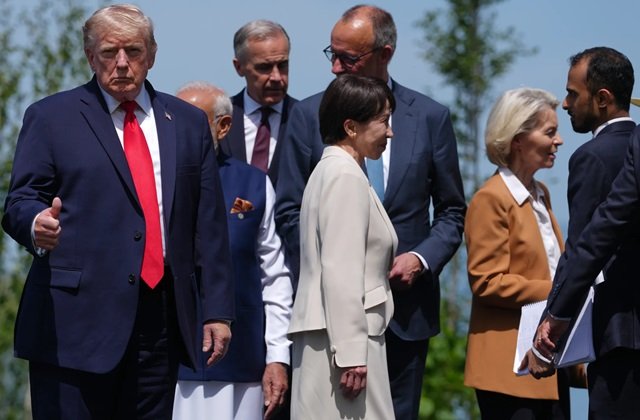
The Group of Seven summit concluded on Wednesday without a unified final declaration from participating leaders, marking a departure from traditional summit outcomes and highlighting divisions within the bloc. Instead, heads of state and government issued nine separate communiques covering issues ranging from Ukraine and Middle East security to artificial intelligence, migration, energy resilience and global health.
Among the most significant outcomes was a renewed commitment to support Ukraine’s military capabilities. G7 countries agreed to increase supplies of long-range weapons systems, air defense equipment, launchers and interceptors. The group also pledged to facilitate licensing arrangements intended to strengthen Ukraine’s domestic defense production and promised additional sanctions targeting Russia’s war economy.
The leaders also addressed developments in the Middle East, reaffirming that navigation through the Strait of Hormuz must remain open and free from disruption. The G7 stated that multinational efforts led by France and Britain could play an important role in safeguarding maritime traffic and restoring normal shipping activity. The group further reiterated its position that Iran must not acquire nuclear weapons.
Energy security emerged as another central topic of discussion. In cooperation with the International Energy Agency, G7 members joined Egypt, Kenya and South Korea in agreeing to establish a common monitoring and response mechanism aimed at preventing future energy supply crises and disruptions to global supply chains. The initiative seeks to improve coordination among participating countries during periods of market instability.
The summit also produced an agreement on critical minerals and rare earth supply chains. G7 nations committed to reducing dependence on a limited number of suppliers and pledged to lower reliance on a single source for rare earth elements and permanent magnets to below 60 percent by 2030. While no country was directly named, the measure was widely viewed as an effort to diversify supply chains currently dominated by China.
Digital safety and emerging technologies featured prominently in discussions involving both G7 members and partner nations. Brazil, Egypt, India, Kenya and South Korea joined the group in committing to stronger protections for minors online. Participants pledged to combat child sexual abuse material, non-consensual intimate imagery and the exposure of children to violent extremism and terrorism. The agreement also addressed concerns about the potential harmful effects of social media platforms and artificial intelligence technologies on young users.
The summit further announced the creation of a G7+ Ports Network to Combat Drug Trafficking, an initiative introduced by Brazil and South Korea. The network is intended to improve cooperation among major seaports and strengthen efforts to disrupt international narcotics trafficking routes.
Leaders also endorsed reforms to international development financing, with participating countries calling for increased private-sector investment and stronger support for vulnerable nations facing debt pressures, conflict and economic instability. Additional commitments included expanding cancer research, particularly for pediatric and difficult-to-diagnose cancers, and coordinating travel and public health measures in response to the ongoing Ebola outbreak.
Migration was another key area of focus. G7 countries, along with Kenya and South Korea, pledged closer cooperation with transit and origin countries to dismantle migrant smuggling networks and improve procedures for the return of individuals without legal authorization to remain in host countries.
Alongside the formal communiques, concerns about dependence on U.S.-based artificial intelligence systems emerged during summit discussions. French President Emmanuel Macron and Indian Prime Minister Narendra Modi reportedly warned that foreign governments and companies remain vulnerable if access to advanced American AI models can be restricted without notice.
The concerns intensified following a decision by the administration of U.S. President Donald Trump to block exports of certain advanced AI models developed by Anthropic on national security grounds. The move prompted discussions among G7 leaders about creating a “trusted partners” framework that could provide approved countries and organizations with continued access to advanced AI technologies while maintaining security safeguards.
The debate underscored growing international concerns about technological dependence and digital sovereignty as governments increasingly rely on a small number of companies to provide the artificial intelligence systems shaping economic and national security strategies.