


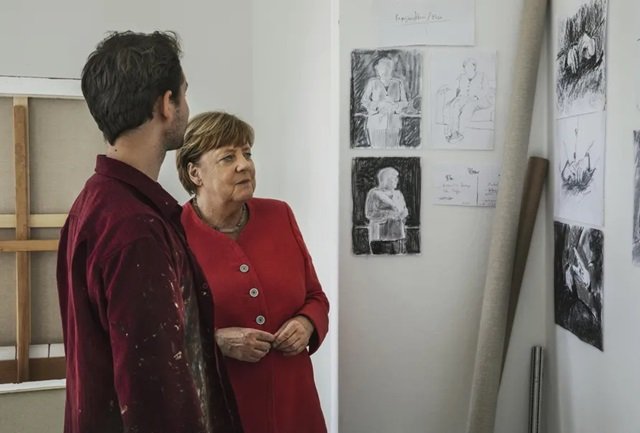
For years, the question remained unanswered: who would paint Angela Merkel’s official portrait? While generations of German chancellors had their place in the gallery of former leaders, the image of Germany’s first female chancellor was left undecided. Merkel refused to rush the decision, waiting until she found not only an artist but also a process that reflected her own approach to public life.
According to German newspaper Die Zeit, which followed the project exclusively, the portrait was ultimately entrusted to Jérémie Queyras, a young German-French artist who was largely unknown outside artistic circles when he first became connected to the former chancellor. The decision marked a departure from tradition, as Merkel chose an emerging painter rather than an established name.
The story began in 2022 when Queyras, then 24, received encouragement from a woman from Braunschweig who had purchased several of his works. She urged him to apply for the commission to create the portrait of the former chancellor. Although he initially doubted he would have any chance, he wrote a handwritten letter to Merkel and sent copies of his paintings. Years passed without a response.
Merkel, who had already left office, deliberately avoided a quick decision. The portrait was not simply about creating another official image, but about the experience behind it. She wanted time to complete her autobiography before turning to the question of how she would be represented in paint.
When the invitation finally arrived in April 2025 for Queyras to meet Merkel, he was surprised. The young artist, who had studied in London and Paris, had already assumed the opportunity had disappeared. The meeting changed that. Merkel and Queyras quickly established a connection, discussing not only the portrait but also the meaning of painting itself.
The project developed away from public attention. There was no official competition, although numerous artists had submitted proposals. Merkel reviewed different possibilities before choosing Queyras after a single conversation. She told Die Zeit that she was attracted by the idea of working with someone who brought a fresh perspective rather than selecting an already famous artist.
The decision also reflected Merkel’s long-standing interest in art, a passion that remained largely private during her political career. As a child in East Germany, she collected art postcards and developed an interest in painters including Paul Klee, Joan Miró and August Macke. Later, she visited museums alone and continued exploring art throughout her life. During her time as chancellor, she rarely spoke publicly about that interest.
For Queyras, the commission represented a significant personal and artistic challenge. Before accepting, he visited the German Chancellery to examine the existing portraits of former leaders, including those of Konrad Adenauer, Helmut Kohl and Gerhard Schröder. He considered the responsibility of creating an image that would eventually stand alongside those works.
The artist and Merkel decided that the portrait should avoid familiar symbols associated with her political career. The famous “Merkel diamond” hand gesture was rejected, and the focus shifted toward a more personal representation. The former chancellor chose to stand rather than sit, unlike many of her male predecessors whose portraits depicted them seated in positions of authority.
The process involved months of meetings in a private Berlin location near Merkel’s residence. Queyras studied her gestures, expressions and background, including a visit to Templin, the town where Merkel grew up. Together they explored places connected to her childhood, including the school she attended and a historic chapel linked to her family’s history.
The final painting measures 110 by 140 centimeters and presents Merkel wearing a blue blazer, a color that became central to the composition. The portrait includes small details from her political life, including an image of a silver cube from her desk engraved with the words “In calmness lies strength.”
Merkel also decided that the portrait would not become property of the state. She paid for the artist’s work and materials herself and arranged for the painting to remain a loan rather than a permanent government possession. The decision means she retains control over where it is displayed in the future.
The completed portrait is scheduled to be presented publicly at a ceremony on June 30 at the Bode Museum in Berlin before moving to the Chancellery in October, where it will join the gallery of former German leaders.
For Merkel, the painting represents the transition from political leadership into historical memory. “It is strange when you slowly become history,” she told Die Zeit. The portrait now stands as the image she chose to leave behind.









