


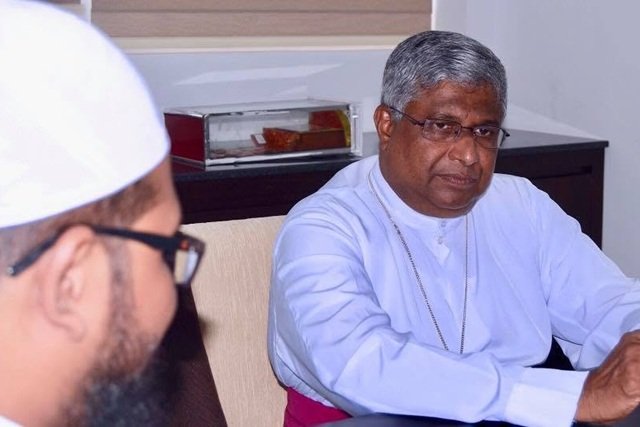
The public debate surrounding the detention of former State Intelligence Service (SIS) Director Major General (Retd.) Suresh Sallay has entered a new phase following an exchange of open letters between his wife, Manori, and retired Methodist Church Sri Lanka President Bishop Rev. Asiri P. Perera. The correspondence has shifted attention beyond the investigation itself to wider questions surrounding constitutional rights, public discourse, religious intervention and the boundaries between legal process and public opinion.
The exchange began after Manori publicly declared that her husband was “an innocent man suffering for no reason” while he remains in detention under the Prevention of Terrorism Act (PTA) in connection with investigations into the 2019 Easter Sunday attacks. Responding through an open letter, Bishop Perera acknowledged her right to express herself as a spouse but questioned whether publicly asserting innocence before the conclusion of legal proceedings risked undermining confidence in the justice system.
The retired bishop argued that innocence or guilt must ultimately be determined through judicial proceedings rather than public declarations. His letter also questioned whether her public statements could be perceived as dismissing the concerns of victims, raised concerns about political influences surrounding the public campaign on behalf of her husband, and suggested that repeated criticism of investigative officers could affect public confidence in ongoing inquiries.
Beyond legal issues, the bishop’s letter ventured into more personal territory. He questioned why Manori appeared before the media wearing a face mask, suggesting that greater openness could strengthen public credibility. He also referred to her husband’s reported refusal of food and water, suggesting that pastoral guidance from clergy could assist him in confronting what he described as possible inner turmoil and spiritual conflict. The letter concluded by urging Manori to allow the courts to determine the outcome while warning that public defence of a family member could carry moral implications should allegations ultimately be proven.
Manori’s response addressed each of those points individually while firmly rejecting the central premise of the bishop’s observations. She maintained that her husband’s innocence was not merely an expression of marital loyalty but reflected her personal conviction based on his character, professional service and the information available to her.
While agreeing that guilt or innocence must ultimately be determined by a court of law, she argued that due process begins long before a trial. Citing Article 13 of Sri Lanka’s Constitution, she emphasised that constitutional protections extend to the investigative stage and that the integrity of any prosecution depends upon investigations being conducted fairly and impartially.
According to her response, her concerns have never been directed against the administration of justice itself but rather against the participation of investigators whose impartiality she believes can reasonably be questioned. She argued that identifying potential conflicts of interest should not be interpreted as interference but as an effort to strengthen public confidence in the investigative process.
Manori also rejected the suggestion that publicly expressing confidence in her husband’s innocence undermined the justice system. She pointed instead to the constitutional presumption of innocence, arguing that every individual remains legally innocent until proven guilty by a competent court. Her public statements, she wrote, reflected that constitutional principle rather than an attempt to prejudge judicial proceedings.
Responding to the bishop’s references to public opinion, she noted that differing views within society cannot determine legal truth. She stressed that neither she nor her family had sought to diminish the suffering of those affected by the Easter Sunday attacks or the importance of a thorough investigation. Instead, she argued that investigations into events of such national significance require the highest standards of independence, professionalism and objectivity.
She also challenged suggestions that her public statements echoed political interests. Describing such claims as speculative and unsupported, she stated that her husband had served under governments of differing political affiliations throughout his military career while carrying out his professional responsibilities. She argued that introducing political assumptions into the discussion distracted from the central issues of fairness and legality.
One of the strongest responses in her letter addressed the bishop’s comments regarding her appearance before the media wearing a face mask. She described those observations as disappointing, stating that the credibility of any statement depends upon its factual foundation rather than whether the speaker’s face is visible. She further rejected any suggestion that wearing a mask implied concealment or dishonesty, describing such conclusions as unsupported speculation.
Manori also disputed the bishop’s observations concerning her husband’s reported physical and emotional condition. She stated that comments regarding alleged guilt, psychological conflict or an inability to confront the truth had been made without personal knowledge, medical evidence or professional assessment. Referring to available medical and psychiatric evaluations, she indicated that they presented a different picture and raised concerns regarding his treatment while in custody.
In concluding her response, Manori said she would not engage in an extended public exchange through the media but reiterated her request that allegations or conclusions regarding her husband should be based on evidence rather than assumption. She maintained that she would continue supporting him while seeking justice through lawful means and emphasised that differences of opinion should not replace careful examination of facts.
The exchange has drawn attention because it extends beyond the personal disagreement between a retired religious leader and the spouse of a detainee. It highlights broader questions concerning the relationship between public advocacy and ongoing criminal investigations, the constitutional presumption of innocence, the integrity of investigative processes and the role that public figures, including religious leaders, play when commenting on cases that remain before the legal system.
As investigations connected to the Easter Sunday attacks continue, the correspondence between Bishop Perera and Manori illustrates how legal proceedings increasingly unfold alongside public debate, with competing interpretations of justice, accountability and constitutional protections becoming part of the national conversation. For now, both parties maintain their respective positions, while the legal process concerning Major General (Retd.) Suresh Sallay remains ongoing.










It is quite startling to find religious interference whether Catholic or Methodist in Sri Lanka. OFCOURSE, the Wife of Major General Suresh Sallay has EVERY RIGHT TO COMMENT ON THE INJUSTICE OF INCARCERATION OF HER HUSBAND AND IMPLORE THE CONCEPT OF INNOCENSE UNTIL PROVEN GUILTY. The Catholic religious interference in the investigation has already reinstated the Police chief who was suspected of dereliction of duty regarding the Easter Sunday terrorist bombings. The Government action in this regard is HIGHLY QUESTIONABLE.