


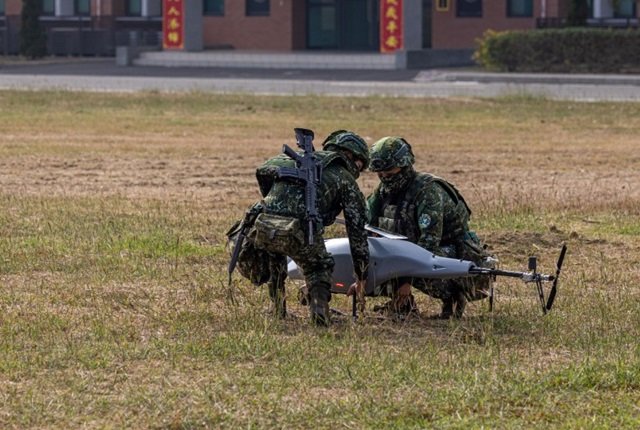
Taiwan’s main opposition party has proposed a NT$240 billion (US$7.5 billion) plan to expand the island’s drone industry, just days after delaying consideration of a similar initiative put forward by President Lai Ching-te’s government, highlighting competing approaches to defense spending and procurement oversight.
The Kuomintang (KMT) announced on Tuesday that it would introduce legislation providing funding for the development of unmanned systems and related industrial capacity over a six-year period. KMT lawmaker Lin Pei-hsiang said the proposal would allocate resources for both government procurement and the growth of Taiwan’s drone manufacturing sector.
The proposal comes amid heightened attention on unmanned systems, whose battlefield use in Ukraine and Iran has demonstrated their role in defending territory against larger adversaries. The debate carries particular significance for Taiwan as the People’s Republic of China continues to assert its claim of sovereignty over the self-governing island and has threatened to use force to pursue that claim.
Unlike the Cabinet’s proposal, which would authorize NT$210 billion in multi-year funding for drone procurement, the KMT’s legislation would finance the program through Taiwan’s annual budget process. Under that structure, lawmakers would review and approve funding each year, giving the opposition greater oversight of spending.
“The Kuomintang supports developing unmanned vehicles and strengthening national defense, but we are even more committed to ensuring that every dollar is spent transparently,” Lin said during Tuesday’s briefing.
The ruling Democratic Progressive Party (DPP) has expressed concern over the KMT’s proposed funding mechanism. According to the source text, the government believes annual reviews could make long-term drone procurement vulnerable to domestic political debates and create uncertainty for companies making long-term investments in the industry.
The DPP has also raised concerns that annual appropriations could result in reduced funding if legislators choose to prioritize other areas of public expenditure, including welfare, education or healthcare.
The KMT’s proposal includes domestic manufacturing requirements for drone production. Under the legislation, at least 50 percent of drone components would be required to come from domestic sources within two years. That requirement would increase to more than 80 percent after four years.
The latest proposal follows action taken last week by the KMT and its political allies to delay legislative review of the government’s special bill concerning drone funding.
While both the KMT and the DPP have stated their support for strengthening Taiwan’s defense capabilities, the parties continue to differ over defense policy and relations with Beijing. The KMT maintains closer ties with China, which has declined to engage with the current DPP administration. The DPP has stated that it seeks improved relations with Beijing but will not accept the conditions China has set for formal talks.
The KMT’s legislation also differs from the Cabinet’s proposal in scope. According to the source text, the opposition bill includes funding for some non-defense expenditures, while the government’s plan focuses specifically on military drones.
The latest disagreement follows another debate over defense funding earlier this year. In May, after an extended delay, opposition lawmakers approved a special defense budget totaling NT$780 billion to finance weapons purchases from the United States. However, legislators reduced funding originally requested by Lai’s administration for drones and domestically developed weapons systems, citing the need for greater parliamentary scrutiny of defense spending.
The competing proposals underscore continuing differences over how Taiwan should finance and oversee investments in unmanned systems as the island expands its defense capabilities.










