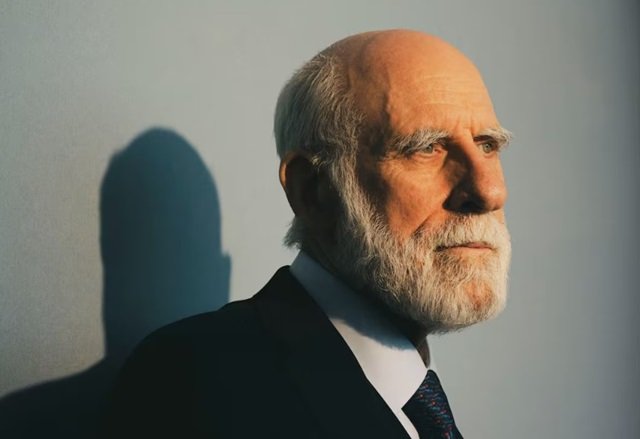
Vinton Cerf, widely known as one of the architects of the modern internet, is set to retire from his role as Google’s chief internet evangelist next week, bringing an end to one of the longest and most influential careers in computing history.
The announcement was revealed during Cerf’s appearance via video at the Open Frontier conference hosted by the Laude Institute. During the event, UC Berkeley professor Dave Patterson, known for co-developing RISC processor architecture, recognized Cerf’s upcoming departure and thanked him for his contributions to technology.
“Vint…has been at Google more than 20 years, and he is retiring a week from today, and so I think we ought to give him a round of applause for a relatively good career,” Patterson said, receiving applause from attendees. Google did not respond to a request for comment by publication time.
At 83, Cerf leaves behind a career that helped define how computers communicate across the globe. Alongside collaborator Robert Kahn, he is credited with developing the networking protocols that became the foundation of the internet. Their work on Transmission Control Protocol and Internet Protocol, commonly known as TCP/IP, established the basic framework that allows different computer networks to exchange information.
Cerf and Kahn began developing TCP/IP in the 1970s, creating a system designed to connect separate networks into a larger communication infrastructure. The technology later became the backbone of the internet, enabling the global exchange of data that now supports modern digital services.
Cerf’s contributions have been recognized through numerous honors, including honorary degrees, the Presidential Medal of Freedom and the Turing Award, one of the highest recognitions in computer science.
Since joining Google in 2005, Cerf has served as vice president and chief internet evangelist, a role focused on promoting the continued development and understanding of internet technologies. His position placed him at the centre of discussions about how the web evolved and how emerging technologies could shape its next phase.
At the Open Frontier conference, Cerf joined other computer scientists known for creating influential open-source technologies, including Patterson; François Chollet, creator of the Keras deep-learning library and co-founder of Ndea; John Ousterhout, the Stanford computer scientist behind the Tcl programming language and co-founder of Electric Cloud; and Matei Zaharia, co-founder and chief technologist of Databricks.
The panel focused on how open-source systems can be built to remain useful over long periods, a topic gaining renewed attention as technology companies develop infrastructure for artificial intelligence applications.
Much of the discussion centred on the contrast between the decentralized structure of the early internet and the concentration of advanced AI models among a small number of well-funded laboratories. Cerf said the future development of artificial intelligence agents, software systems capable of acting independently and coordinating with other systems, could create pressure for new standards and shared protocols.
“The agentic model of AI, with multiple agents from multiple sources interacting with each other, is going to force composability, and a requirement for interoperability and standardization,” Cerf said.
The comments reflected Cerf’s view that AI systems may eventually require common technical standards similar to those that allowed the internet to expand across different networks. He said companies that establish interoperability standards early could influence how future AI systems communicate and operate.
Cerf also questioned whether natural language alone would be sufficient for communication between AI agents. While some experts have suggested that large language models could exchange information through ordinary language, Cerf argued that formal standards would likely be necessary to ensure accuracy and reduce misunderstandings.
“I don’t think English is going to be the best choice. There’s a flexibility in it, but there’s ambiguity, and I think precision for interagent interaction is going to be very, very important,” Cerf said.
He compared potential communication problems between AI agents to the traditional “telephone game,” where a message changes as it passes between people. Cerf said similar misunderstandings among autonomous software systems could create challenges if AI agents rely only on natural language exchanges.
Beyond discussions about the future of technology, the conference also highlighted Cerf’s distinctive personal style. Patterson recalled meeting Cerf as a graduate student in the 1970s and described him as the best-dressed computer scientist he had encountered, noting Cerf’s habit of wearing shirts, ties and three-piece suits.
Cerf confirmed the description, saying he had even worn a vest during his early academic years. He said dressing differently was his way of standing out rather than adopting other forms of personal expression common among technology figures of that era.
As Cerf prepares to leave Google, his career remains closely tied to the evolution of digital communication, from the creation of the protocols that connected the early internet to his continued involvement in discussions about the standards that may shape the next generation of computing.