


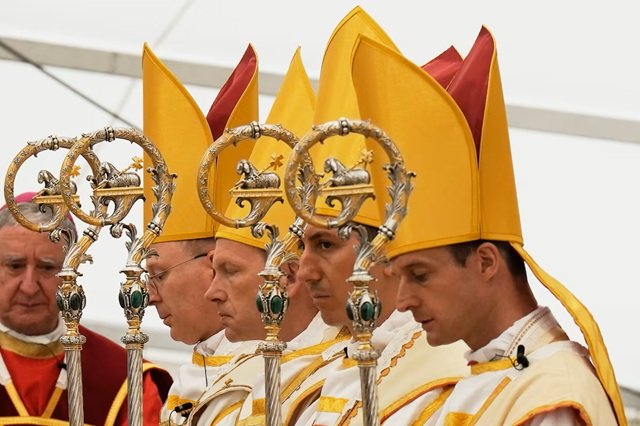
The Vatican has formally declared that the Society of Saint Pius X, commonly known as the Lefebvrists, has entered into schism with the Catholic Church after the group’s leadership proceeded with the unauthorized ordination of four bishops in Switzerland without papal approval. The decision, announced by the Holy See on Thursday morning, immediately excommunicates the bishops involved and extends the penalty to clergy and lay followers who continue to adhere to the movement.
The declaration follows a ceremony held the previous day in Écône, Switzerland, where four priests were consecrated as bishops despite repeated warnings from the Vatican. In a decree issued by the Dicastery for the Doctrine of the Faith, the Vatican stated that the episcopal ordinations constituted a schismatic act carried out against the will of the Supreme Pontiff and without the required papal mandate. The decree, signed by the dicastery’s prefect, Cardinal Víctor Manuel Fernández, states that the penalties prescribed under the Code of Canon Law were incurred automatically.
The decree identifies Bishop Alfonso de Galarreta, Superior General of the Society of Saint Pius X, as having carried out the illicit consecrations. It declares that he and the four newly ordained bishops have automatically incurred excommunication. Bishop Bernard Fellay, who concelebrated the ceremony, was likewise declared excommunicated.
The four newly consecrated bishops are Pascal Schreiber of Switzerland, Michael Goldade of the United States, Michel Poinsinet de Sivry of France and Marc Hanappier of France. Their ordinations represent the latest chapter in a conflict that has shaped relations between the Vatican and the Society of Saint Pius X for decades.
The Vatican’s action also revives a history that stretches back nearly four decades. Both Galarreta and Fellay were among the four bishops consecrated without papal authorization in 1988 by Archbishop Marcel Lefebvre, founder of the movement. That ceremony prompted Pope John Paul II to declare their excommunication, creating one of the most significant internal crises within the modern Catholic Church. Two of those original bishops have since died, while Galarreta and Fellay have remained central figures within the organization.
The Society of Saint Pius X emerged in 1970 under the leadership of Lefebvre, a French archbishop who opposed the reforms introduced by the Second Vatican Council. The movement argued that the council represented a departure from longstanding Catholic tradition and sought to preserve earlier forms of worship and doctrine. It advocates the celebration of Mass in Latin with the priest facing the altar, rejects the Church’s recognition of religious freedom and other faiths, and promotes a vision of society in which civil authority is subordinate to the Church.
Although comparatively small in numbers, the organization has established an international presence. According to the source text, it has approximately 730 priests operating in 70 countries and claims around half a million members worldwide. Its size has not diminished the significance of the Vatican’s decision, as formal schisms remain exceptionally rare in the history of the Catholic Church.
The declaration carries historical weight because divisions of this kind occur infrequently. The source notes that the last major schism in the Church’s history was the Anglican break with Rome in 1534. Within Catholic tradition, unity with the Pope is regarded as a defining element of ecclesial communion, making any formal rupture a major institutional development.
The current decision also follows years of efforts to restore the Society of Saint Pius X to full communion with the Holy See. In 2009, Pope Benedict XVI lifted the excommunications imposed on the society’s bishops in what was widely viewed as an attempt to encourage reconciliation. That effort soon became controversial after one of the bishops, Richard Williamson, publicly denied the Holocaust. Despite subsequent negotiations, no lasting agreement was reached to regularize the group’s status within the Church.
Relations deteriorated further during the pontificate of Pope Francis, who imposed additional restrictions on the celebration of the traditional Latin Mass, a central element of the Society’s identity. According to the source, members of the movement remained strongly opposed to Francis and ultimately concluded that the election of Pope Leo XIV would not alter the Vatican’s direction. After years of unsuccessful dialogue, the society proceeded with the episcopal consecrations that prompted the Vatican’s latest decree.
The source also places the schism within a broader ideological context. It states that the movement has gained renewed visibility amid the rise of ultraconservative currents internationally and describes tensions between sections of that movement and Pope Leo XIV similar to those that developed during Francis’s pontificate. It notes that public criticism of the Pope by U.S. President Donald Trump earlier this year marked a further deterioration in relations with elements of this ideological current. The source also reports that Pope Leo XIV had previously warned Spanish bishops about what he described as the manipulation of the Church by extremist groups.
Alongside the decree declaring the schism, the Vatican released an explanatory note outlining its practical consequences. It states that priests belonging to the Society of Saint Pius X illicitly administer the sacraments and that confessions heard by them and marriages celebrated by them are invalid. The Holy See urged Catholics to refrain from participating in liturgical celebrations or activities organized by the society.
The decree extends beyond the bishops themselves, warning that clergy and lay faithful who continue to adhere to the Society of Saint Pius X after the declaration will also incur automatic excommunication. At the same time, the Vatican stated that those who seek to restore full communion with the Catholic Church will be received with “sincere affection and deep concern.”
With the publication of the decree, the Vatican has formally closed a chapter of negotiations that had continued across three pontificates. The unauthorized episcopal ordinations in Switzerland have now been officially recognized by the Holy See as a schismatic act, placing the Society of Saint Pius X and its adherents outside full communion with the Catholic Church under the provisions of canon law.









