by Durga Velayudham
The death of Ayatollah Ali Khamenei has become more than a moment of mourning for the Islamic Republic of Iran. It has been transformed into a political and ideological event, with state media presenting the former supreme leader as a martyr and placing his death within one of the central narratives that has shaped the regime since its creation.
In Persian, the word “shahid,” meaning martyr, functions both as a noun and an adjective. It describes someone who accepts death for religious beliefs, but it can also be attached to names, positions and biographies. Since the establishment of the Islamic Republic, martyrdom has been a central element of the country’s political culture, used to commemorate those who died during the revolution, the Iran-Iraq War, conflicts with opposition groups and later state security operations.
Over time, the definition of martyrdom expanded. The title was applied not only to soldiers and political figures but also to police officers killed during operations and even state employees who died in workplace accidents. Anyone considered loyal to the system who died in the name of that loyalty became part of a broader ideological foundation used by the Islamic Republic to present itself as a movement built on sacrifice.
When the death of Khamenei was officially confirmed following an American-Israeli attack on Iran, state media immediately incorporated the term into his official title. Instead of using the usual Persian word for leader, they adopted the Arabic term “Qa’id,” creating a new political expression: “Qa’id-e Shahid,” or the martyr leader.
The announcement came after a period of severe pressure on the Islamic Republic. The 40-day attacks by Israel and the United States had caused thousands of deaths, damaged infrastructure, weakened the economy and intensified internal repression. Yet Khamenei’s death also removed a figure whose leadership had reached one of its most difficult points during his 37-year rule.
His foreign policy strategy, built around the so-called “axis of resistance” involving Syria under Bashar al-Assad, Hamas in Gaza and Hezbollah in Lebanon, had suffered major setbacks. Economic groups that had supported the system had joined protests, while opposition groups were preparing demands for his resignation. The government’s own figures acknowledged thousands of deaths during crackdowns on demonstrations, while opposition groups reported much higher numbers.
For supporters of the Islamic Republic, however, Khamenei’s death represented a form of final redemption. In Shia Islam, one of the key distinctions from Sunni Islam is the belief that many religious and political leaders were killed by their opponents and became martyrs. This history has contributed to the idea among some Shia communities that martyrdom carries a special religious significance.
The regime used this tradition to elevate Khamenei’s image. During mourning ceremonies broadcast by state media, emotional music accompanied images of the funeral procession. One song declared that martyrdom suited him because it was “the art of men of God,” a phrase associated with Ayatollah Ruhollah Khomeini, the founder of the Islamic Republic.
Another song addressed Khamenei directly, claiming that his martyrdom had brought life to the land. The symbolism reflected the regime’s attempt to portray his death as a moment of renewal rather than a political crisis.
The funeral itself represented a major contrast with Khomeini’s burial 37 years earlier. Khomeini’s funeral became a chaotic public event that authorities struggled to control, with crowds overwhelming security forces and disrupting the ceremony. It became an image of the Islamic Republic’s early years, marked by mass participation and unpredictability.
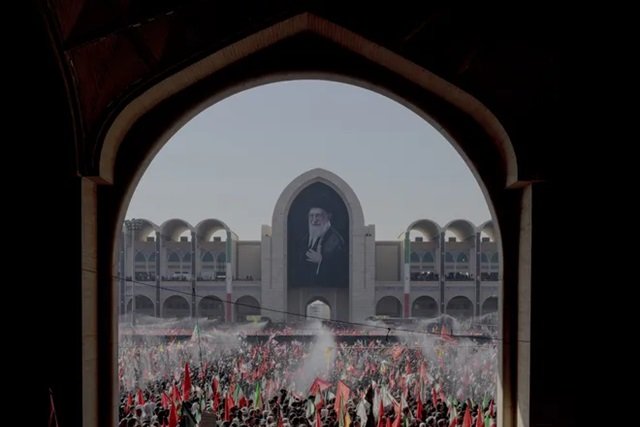
Khamenei’s funeral was the opposite: a carefully organized spectacle designed to project control. Although delaying burial for an extended period is controversial within Shia tradition, authorities postponed the ceremony for three and a half months to prepare an event spread across a week and five cities.
The ceremonies showed no signs of disorder or loss of control. Instead, every element appeared carefully planned, from the participation of foreign delegations to the selection of Quranic verses recited during their appearances.
Those verses carried political messages. During the visit of Saudi Arabia’s delegation, a passage referring to confrontation between believers and unbelievers was recited. During the Turkish delegation’s appearance, a verse about those who fight for God’s cause was chosen. For Hezbollah representatives from Lebanon, the message emphasized perseverance and victory through faith.
Even domestic political figures were targeted through symbolism. When reformist politicians paid their respects to Khamenei, a Quranic verse was recited referring to those who stay behind despite having no excuse not to fight.
The ceremony demonstrated the changing nature of the Islamic Republic, according to the analysis published by Die Zeit. The system appeared increasingly dependent on military structures, carefully managed imagery and political symbolism rather than the spontaneous revolutionary mobilization associated with its early decades.
The creation of a martyr narrative around Khamenei also serves a strategic purpose for the regime’s next phase. As religious figures appear to lose influence and technocratic figures connected to the Revolutionary Guard gain greater importance, martyrdom becomes an increasingly important source of legitimacy.
Because these newer power figures cannot claim the same religious authority, the symbolism surrounding sacrifice and martyrdom provides a way to maintain ideological continuity.
Khamenei’s burial in Mashhad, near the shrine of the eighth Shia Imam and one of Iran’s most important religious sites, forms part of this effort to create a lasting national and religious myth. The city receives hundreds of thousands of pilgrims each year, and the association between the sacred site and Khamenei’s grave adds another layer to his posthumous image.
At the same time, the regime’s relationship with martyrdom helps explain its confrontation with movements that emphasize life, personal freedom and individual choice. The “Woman, Life, Freedom” movement challenged the Islamic Republic precisely because it rejected the centrality of sacrifice and death in the state’s ideology.
The movement placed everyday life, bodily autonomy, dignity and personal freedom at the center of its demands. For the Islamic Republic, that represented a direct challenge not only to its policies but also to the ideological foundations through which it defines loyalty and resistance.
The transformation of Khamenei’s death into a national myth marks a new stage for the Islamic Republic. Through a highly controlled funeral, symbolic messages and the elevation of martyrdom, the leadership has sought to preserve continuity and strengthen its identity during a period of uncertainty.
The image presented by the regime is one of unity and renewal. Behind the carefully arranged ceremonies, however, remains a political system built around the enduring language of sacrifice, struggle and martyrdom.