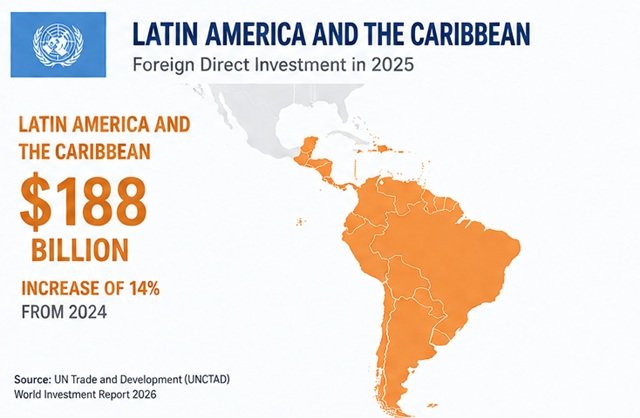
Latin America and the Caribbean attracted significantly more foreign direct investment in 2025, but the rise in capital flows was accompanied by a decline in new project commitments, creating a complex picture for the region’s future economic development.
According to the World Investment Report 2026 by UN Trade and Development (UNCTAD), foreign direct investment (FDI) inflows to the region, excluding Caribbean offshore financial centres, increased 14% to $188 billion in 2025. The figure represented about one-fifth of total FDI flows to developing economies and reflected continued investor interest in large markets, commodity-linked industries and sectors connected to the global energy transition.
The increase was driven largely by South America, with Brazil accounting for much of the regional growth. However, behind the stronger headline figures was a more uneven investment landscape, where a small number of economies captured most of the capital while indicators of future productive investment weakened.
The central challenge for the region is not simply attracting foreign investment, but ensuring that those inflows contribute to new productive capacity, economic diversification and higher-value activities.
Brazil emerged as the largest contributor to the region’s investment growth. FDI inflows into the country rose from $63 billion in 2024 to $77 billion in 2025, placing Brazil among the world’s five largest recipients of foreign investment. The increase reflected investor interest in the country’s large market, natural resources and sectors connected to changing global energy and industrial trends.
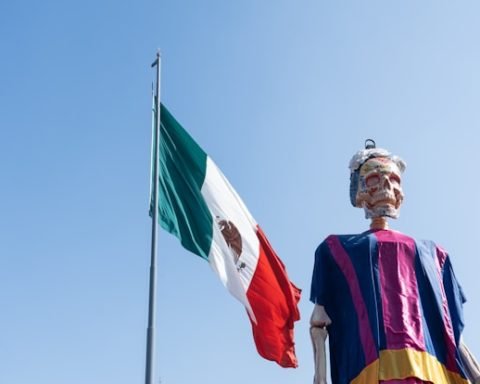
Mexico also remained one of Latin America’s leading investment destinations, with inflows rising from approximately $38 billion to $41 billion. The country continued to benefit from its position within regional production networks, supported by investment in services and manufacturing.
Despite these gains, foreign investment remained highly concentrated across the region. The top 10 recipient economies accounted for 95% of all FDI inflows in Latin America and the Caribbean in 2025. Brazil and Mexico alone represented roughly two-thirds of total regional investment, demonstrating the extent to which regional performance was shaped by a small number of major economies.
Investment continued to favour countries with large domestic markets, strong trade connections and established industrial capabilities. Commodity-related sectors and industries linked to the energy transition remained important sources of investor interest, particularly as global companies seek access to resources and new opportunities connected to changing energy systems.
However, the increase in investment inflows did not translate into a stronger pipeline of future productive projects. The clearest indication came from greenfield investment, which typically involves the creation of new facilities, infrastructure and production capacity.
While total FDI increased, the value of announced greenfield projects fell by about one-third, declining to less than $120 billion. Manufacturing and logistics were among the sectors affected by the reduction, raising questions about the pace of future expansion in productive activities.
The decline was particularly significant in Mexico, where announced greenfield project values dropped from $44 billion to $24 billion amid trade and industrial policy uncertainty. Argentina also recorded a sharp decline, with announced greenfield investment falling from about $37 billion to $1.4 billion.
The contrast between rising FDI totals and weaker greenfield commitments reflects the different nature of investment flows. Annual FDI figures can be influenced by large financial transactions, mergers and acquisitions, while greenfield projects often provide a clearer indication of where companies plan to build new operations and expand long-term capacity.
The 2025 figures therefore present a mixed picture: more foreign capital entered the region, but less was directed toward establishing new productive assets.
Latin America and the Caribbean continue to offer important advantages for investors, including significant natural resources, renewable energy potential, large consumer markets and geographic links to major global trading partners. These factors have helped maintain international interest even as competition for investment becomes more intense.
For policymakers, the focus is increasingly shifting toward converting investment interest into sustainable productive projects. UNCTAD highlights the importance of stronger investment facilitation, improved infrastructure, supplier development and regional integration that allows smaller economies to participate in larger value chains.
Countries with mineral resources and renewable energy potential also face the challenge of ensuring that investment generates broader economic value rather than remaining limited to the extraction and export of commodities. Developing local capabilities, encouraging value addition and strengthening connections between foreign investors and domestic businesses are key elements in expanding the impact of investment.
As global investors continue to reassess supply chains, industrial strategies and energy opportunities, Latin America and the Caribbean remain important destinations for international capital. But the region’s next phase of growth will depend on whether rising investment flows can be converted into new factories, stronger industries, expanded supply networks and broader economic opportunities.
In 2025, the region attracted more money from abroad. The challenge ahead is ensuring that more of that capital becomes a foundation for future productive growth.